

Table of contents
At a glance
What is GAMP 5 and how is it used in validation?
GAMP 5 is ISPE guidance on a risk-based approach to compliant GxP computerised systems. It helps teams demonstrate that a system is fit for its intended use throughout its lifecycle. The work depends on relevant risk, complexity and available evidence. Applicable regulations determine the legal requirements. Use the guide to decide how to meet them for the system and process under review.
- Intended use and process risks determine which evidence you need.
- A software category alone determines neither the extent of testing nor the documents required.
- Assess supplier evidence before deciding which parts you can use.
- Plan for changes, operation and decommissioning across the system lifecycle.
How GAMP 5, CSV and regulatory requirements fit together
GAMP stands for Good Automated Manufacturing Practice. ISPE describes it as a practical approach to patient safety, product quality and data integrity. It gives process owners, QA, IT and suppliers a common vocabulary. ISPE published the second edition of the GAMP 5 Guide in July 2022. This article explains how to apply the approach. The linked article compares the editions.
Computer system validation (CSV) establishes whether a computerised system is suitable for its intended use. GAMP 5 helps teams plan and perform that work. The activity, product and regulatory environment determine which requirements apply. EU GMP Annex 11 addresses computerised systems used in GMP-regulated activities. Within its FDA scope, 21 CFR Part 11 addresses electronic records and electronic signatures.
At the start of a project, distinguish three things: the applicable regulatory requirements, your internal quality procedures and your chosen methods. Then the team can explain whether an activity follows from a regulation or SOP, or from a practical project decision. A reference to GAMP 5 alone cannot explain that choice.
For the EU GMP context covered here, the January 2011 revision of Annex 11 applies. The draft published for consultation in 2025 has not entered into force.
Which three questions do GAMP 5, CSV and CSA answer?
CSV describes the validation task. GAMP 5 provides guidance on how to approach it. CSA is the FDA's risk-based software assurance approach for a defined area of use. The FDA guidance does not replace CSV across all pharmaceutical systems.
| Term | What it means | What the project team should establish |
|---|---|---|
| CSV | Computer system validation establishes whether a system is suitable for its intended use. | Which intended use and applicable requirements must the evidence cover? |
| GAMP 5 | ISPE guidance on risk-based lifecycle activities. | How will you select and justify suitable activities and evidence? |
| CSA | FDA guidance on software used in medical device production or in the quality management systems of medical device manufacturers. The final version is dated February 2026. | Does the intended use fall within the FDA scope described here, and which assurance activities are suitable? |
Turn intended use into risks you can test
Labels such as ERP, laboratory software or document management tell you little about validation scope. Describe the task the system performs, the decisions its data support, who uses it and which evidence must remain available. Identify functions that fall outside the intended use.
Use that description to identify failure scenarios. For example, an incorrect mapping of an imported release status could allow unauthorised further processing. Consider the consequences, existing controls and how well they work. A risk score without the underlying scenario gives little explanation of why a test is needed.
We recommend linking each significant risk to a requirement and to the evidence you intend to produce. A functional test may establish one control. A configuration review, supplier document or verified operating procedure may establish another. Explain why the combination is sufficient for the intended use and which uncertainties remain. A brief check deserves the same care in selecting it as a more extensive test.
How to use GAMP 5 software categories 1, 3, 4 and 5
Categorisation helps you understand the software components you are dealing with. One system can combine standard functionality, configurable components and custom extensions. A 2026 ISPE article therefore recommends assessing the components and cautions against deriving a validation checklist from a category alone. GxP impact, complexity and novelty also inform the decision.
A widely used standard component can support a highly critical process. Conversely, a small piece of custom code may justify a different approach from a complex system. The table describes the categories and offers our planning questions. It does not prescribe a fixed set of tests or documents.
| Category | What the category covers | Planning question |
|---|---|---|
| 1 · Infrastructure software | Software that provides the technical foundation, such as operating systems or database management systems. | Which version, configuration and operating records does the supported application need? |
| 3 · Standard components | Standard software used without customer-specific configuration of the business process. | Does the existing behaviour meet the intended use, and which supplier evidence supports that assessment? |
| 4 · Configured components | Existing functions are configured to fit the business process. | Which settings control critical decisions and how will you test their effect? |
| 5 · Custom applications or components | Program logic is developed or adapted for the specific need. | How will you verify requirements, development, error handling and changes and retain the evidence? |
Sources: [3]
A validation approach the team can explain
The sequence below is our implementation recommendation. You can use it in a sequential project or across several iterations. ISPE explicitly describes specification and verification as supporting iterative and incremental development. Preserve the link between each decision, its evidence and the specific version assessed.
Start with scope, responsibilities and existing records. Write requirements in a form you can test. “The system must be secure” leaves room for interpretation. “Only the designated role may change the reviewed status” gives configuration, permissions and testing a clearer basis. Set acceptance criteria before execution so that the observed result cannot determine what counts as acceptable.
Plan the evidence, execute the checks and document how deviations are handled. Record affected requirements, process impact, corrections and any retesting needed. Before use, evaluate the resulting system state against the intended use. Assign responsibility and a justified course of action for each open item. Prepare to handle changes and incidents and maintain the evidence during operation.
Which documents and evidence are worth preparing?
GAMP 5 does not prescribe one document pack for every system. Ask which decisions the team must be able to explain. The structure below is a way to organise that work. Your quality procedures determine whether to keep the information in individual documents, a controlled project file or a suitable tool.
For each important decision, identify the system version, the decision maker and the result supporting the decision. Duplicating information across many files adds maintenance work and can produce conflicting versions. Use references where the records remain retrievable and the team has assessed what they establish for this system.
- Scope and system description. Record intended use, process boundaries, interfaces and responsibilities.
- Requirements and risk assessment. Identify the functions needed, failure scenarios and the rationale for the depth of testing.
- Supplier assessment. Identify the relevant documents, their coverage and open questions.
- Test evidence. Record acceptance criteria, the version actually tested, observed results and deviations.
- Summary assessment. Record the coverage achieved, outstanding items and the decision on intended use.
- Handover to operations. Assign responsible roles and plan for controlled changes, incidents and training.
How to assess supplier evidence and cloud services
ISPE encourages supplier involvement and use of supplier knowledge and documentation. Our recommendation is to identify available evidence early and assess exactly what each record supports. A test report for a product version answers a different question from a report on the processes configured for your company.
Check the version, configuration and environment to which the record applies, the acceptance criteria and how findings were handled. Map covered requirements and identify where you need additional tests. The existence of a certificate or a substantial manual alone does not establish coverage.
For cloud services, agree how changes and information will be handled. Who receives release notes, assesses impacts and provides a test environment or opportunity to test? Who deals with incidents, backs up data and enables its return? Match these responsibilities to the actual service. For GMP-relevant systems, Annex 11 requires formal agreements with external parties and an appropriate supplier assessment. Apply these requirements alongside your chosen GAMP approach.
Worked ERP example linking a risk to test evidence
An interface sends an inspection status to an ERP system. Only a valid message unambiguously matched to the correct batch may change that batch's status. The business decision to release a batch follows a separately defined process. This example links a requirement to a failure scenario and the planned evidence.
Assume the supplier tested technical receipt of the message in the version you use. That record may cover message transmission. It leaves open whether your status mapping is correct and whether your team would notice a failed transfer. Focus additional testing on those questions.
| Requirement and failure scenario | Control and example acceptance criterion | Planned evidence |
|---|---|---|
| ERP-01. Only an unambiguously matched message may change a batch status. An incoming batch ID is unknown to the target system. The risk is a wrong assignment or unnoticed message loss. | Check the identifier before processing. The unknown test ID leaves every batch status unchanged. The error record preserves the original batch ID and the message ID, and the responsible team can identify the incident. | Test record, target status before and after the attempt, and incoming-message and error logs carrying the same message ID. |
| ERP-02. An identical message may affect the business process at most once. The same message ID arrives twice and could be processed twice. | Protect processing against duplicate messages. The identical message causes at most one business status change. The repeat can be identified and has no additional business effect. | Two receipts of the same test message ID, the processing log and the target object's status history. |
| ERP-03. Completion of the transfer must remain traceable after an interruption. If the connection fails before the target confirms receipt, a restart could cause a loss or duplicate processing. | Define acknowledgement and restart behaviour. The sender reports no success before the target acknowledges the transfer. After restart, the evidence identifies one final state, with no lost or duplicate business change. | Time of interruption, queue, acknowledgement, restart log and target state linked by common IDs. |
After execution, compare the actual results with the criteria and assess deviations. If the system logs a message but no responsible role sees it, the evidence for the intended operational control remains incomplete. Maintain the mapping, error-handling and change-assessment records for continued use.
When decommissioning the system, identify the data and evidence to retain, how they will remain readable and who will retrieve them. These responsibilities continue after the application is switched off.
Seven questions for the first project meeting
Use the checklist in your project meeting. Support a positive answer with a specific record or named decision. An open item signals a question to clarify. Assess its importance against the intended use. The full project start checklist below includes 18 questions, status fields and an action log.
- Have you identified the affected processes, data, components and interfaces?
- Can the team identify which regulatory requirements and internal procedures apply?
- Can the team link significant risks to requirements and evidence?
- Has the team assessed whether the existing supplier evidence is suitable?
- Have you agreed the acceptance criteria, test environment and approach to deviations?
- Can the team explain the decision to use the system on the basis of the state achieved?
- Have you assigned responsibility for changes, incidents and subsequent access to the data?
Three free GAMP 5 worksheets for your project
The free GAMP 5 resource pack from Daniel Herrmann Consulting contains three fillable PDF worksheets in English. They cover the decisions to make, the checks at project start and risk-based test planning. The test planning worksheet includes a completed ERP example and a blank template. Preview the contents below and request the pack for your company through the form.
We discuss your request with you in a short phone call, then email the worksheets to you personally. Use them to agree on the work internally and adapt them to your system and quality procedures. We developed these templates independently of ISPE.
Request the worksheets for your team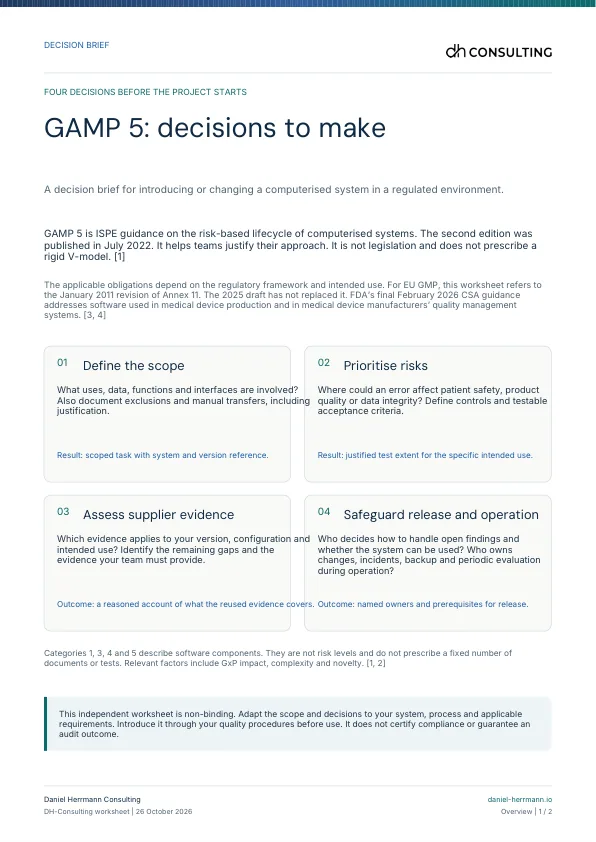
Fillable PDF · 2 pages
GAMP 5: decisions to make
Two pages help you identify the decisions needed before introducing or changing a computerised system.
For decision makers and project owners agreeing a common remit with process owners, QA and IT.
What’s included
- Page 1 covers GAMP 5, the regulatory context and software categories.
- Page 1 sets out four decisions covering scope, risks, supplier evidence, release and operation.
- Page 2 sets out the tasks of process owners, QA, IT and the supplier.
- Page 2 contains a fillable decision brief for the system version, participants, deadline, conditions for release and evidence location.
Discuss the four decisions together, then record the agreed remit and the people responsible. The team has an agreed scope and can identify the decisions that still need preparation.
The project start checklist identifies questions to resolve. The test planning worksheet develops individual failure scenarios and the evidence needed.
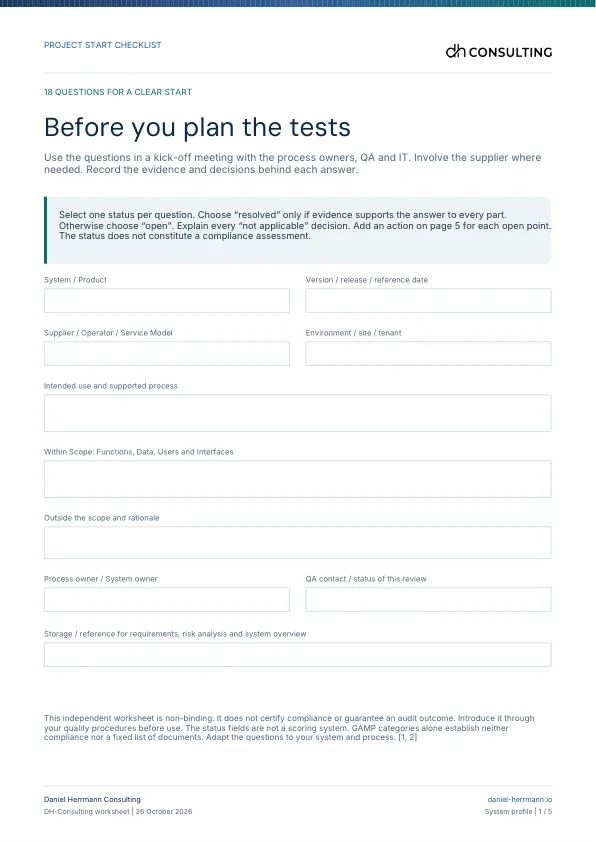
Fillable PDF · 5 pages · 18 questions
GAMP 5: project start checklist
The five-page checklist records what the team knows about the system and which decisions or evidence are still outstanding.
Use it when process owners, QA and IT start a project together, including a change to an existing system.
What’s included
- Page 1 records the system profile, version, use, interfaces, owners and reasons for exclusions.
- Pages 2 to 4 contain 18 questions about scope, responsibilities, supplier evidence, use, changes and operation.
- Each question has a status of open, resolved or not applicable and space for evidence, a rationale or an action ID.
- Page 5 has four action entries with an owner, due date and evidence.
Record the system profile and work through each question. Select a status and track outstanding items in the action log. The team has a traceable record of open tasks and the people who own them.
The decisions worksheet defines the remit. The test planning worksheet turns it into individual test scenarios.
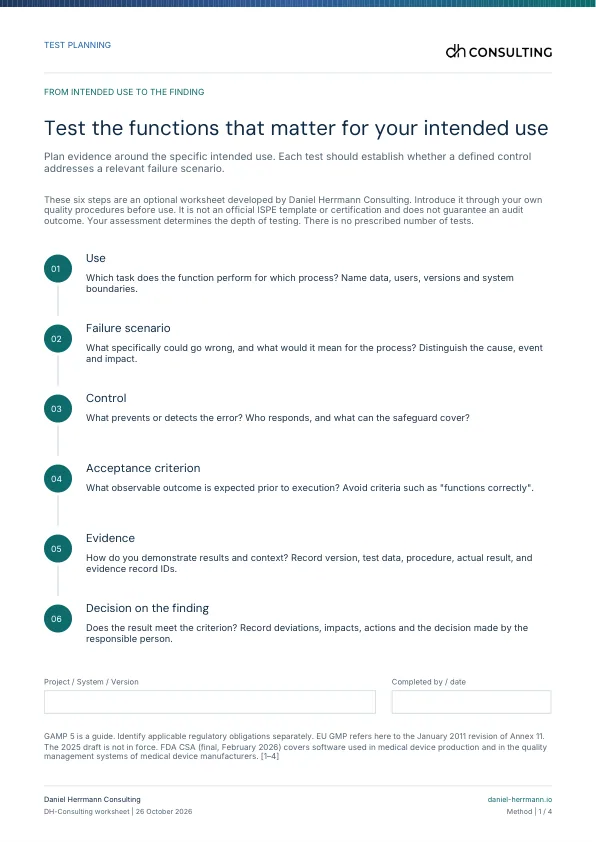
Fillable PDF · 4 pages
GAMP 5: risk-based test planning
Use the four-page template to derive failure scenarios, acceptance criteria and suitable evidence from intended system use.
It helps process owners, QA and IT turn a requirement into a justified test or change decision.
What’s included
- Page 1 covers six steps from intended use through the control and acceptance criterion to the decision on the finding.
- Page 2 works through an ERP status interface with an unknown batch ID, a duplicate message and an interrupted connection.
- Page 3 has a fillable template for your own test scenario.
- Page 4 has two entries for coverage by supplier evidence and a decision about a SaaS change.
Define expected results before testing. After execution, add the actual results, evidence and decisions on deviations. The worksheet links requirements, controls and evidence and records the remaining gaps.
The decisions worksheet defines the remit and the project start checklist identifies open questions. This worksheet records each testing decision.
Three PDF worksheets
Request the worksheets for your team
Enter your name, company, work email and a phone number where we can reach you. We will call you briefly about your request and then email you the worksheets. A newsletter subscription is optional.
We have received your request.
We will call you briefly to discuss your request, then email you the worksheets personally.
Project experience and collaboration
Apply the GAMP approach to the process your system supports
With your team, we choose a specific process and establish which decisions the computerised system influences. We link the requirements, risks, supplier records and your own evidence to those decisions. A well-understood standard solution may need a simpler approach than a heavily customised application with several interfaces. Your rationale should fit the intended use and be usable by the staff who run the system. A GAMP label alone cannot replace this work or an assessment of the applicable requirements.
Frequently asked questions about GAMP 5
Where can I get the GAMP 5 guide and free PDF worksheets in English?
ISPE sells the official GAMP 5 guide and lists the available language editions. Our three free, fillable PDFs in English are a decision brief, a project kick-off checklist and a test planning worksheet with a worked example. These are our own project worksheets and do not reproduce or translate the ISPE guide. You can request them for your company using the form. Enter your name, company, business email address and a phone number where we can reach you. We discuss your request in a short call, then email the worksheets to you personally. You do not need to subscribe to a newsletter.
Sources: [2]
Which edition of GAMP 5 does this article cover?
The article covers the second edition published by ISPE in July 2022. We checked the sources on 26 October 2026. The edition of the guide and the status of the regulatory texts are separate matters. The Annex 11 draft consulted on in 2025 has not entered into force. Check the official sources again when starting a new project.
Which GAMP 5 worksheet should we start with?
If scope and responsibility are still unclear, start with “GAMP 5: decisions to make”. Use “GAMP 5: project start checklist” to record the system profile, work through 18 questions and identify open actions. “GAMP 5: risk-based test planning” links requirements and failure scenarios to controls, acceptance criteria and evidence. It contains a worked ERP example with three failure cases and a blank template. All three documents are fillable PDFs in the free pack. Adapt them to your system and quality procedures.
What does GAMP 5 compliance mean, and is GAMP 5 a legal requirement?
GAMP 5 is an ISPE guide with no independent force of law. When using the term GAMP 5 compliance, explain which principles and internal procedures you applied to the intended use. You still need evidence for the applicable GMP requirements and a system-specific assessment. In a gap assessment, distinguish the guide, the applicable regulatory basis and your own SOP.
Does the GAMP category determine validation scope?
The category helps you assess a component. You still need to consider intended use and risk. GxP impact, complexity, novelty and existing evidence influence the activities. A fixed document list based only on a category cannot account for these differences.
Do we need to retest every standard function?
Explain the evidence you need to produce. Assessed supplier documents can cover some requirements. Consider the intended use of customer-specific configuration, interfaces and relevant workflows. We recommend mapping existing coverage first, then identifying where your own checks will add necessary evidence.
Can teams use GAMP 5 with agile development?
Yes. ISPE explicitly describes specification and verification as compatible with iterative and incremental methods. Across iterations, maintain traceable links between requirements, risks, changes and evidence. A short iteration allows the team to work through those links in smaller, verifiable steps.
Where should we start with a system that is already in use?
Start with current use and existing evidence. Assess significant process risks, known incidents, changes and available records. Use the findings to prioritise missing evidence and necessary actions. A historical list of documents alone cannot establish whether current use is adequately covered.
Can a supplier certify our system against GAMP 5?
A supplier statement does not establish suitability for your specific use. GAMP 5 is an ISPE guide. It grants no regulatory product approval. When a supplier claims GAMP conformity, ask which version, configuration, development method and evidence the claim covers. Your company remains responsible for assessing whether the documents cover the intended process.
How does this article differ from the comparison of GAMP 5 editions?
This guide explains the underlying principles and how to apply them to scope, risks, evidence and operation. The separate article on the second edition examines changes in the 2022 publication. Intended use drives project planning. An edition comparison can also help when revising an existing method.
Sources and review date
Public ISPE publications and the cited original regulatory texts were checked on 26 October 2026. The full paid GAMP 5 guide was not reviewed. Daniel Herrmann Consulting developed the tables, planning example and PDF worksheets. Consult the guide itself and assess your specific intended use.
- ISPE, GAMP purpose, lifecycle and context
- ISPE, GAMP 5 Guide, Second Edition, publisher's overview
- ISPE Pharmaceutical Engineering, When Is a Category Not a Category? (2026)
- European Commission, Annex 11 – Computerised Systems (2011)
- eCFR, 21 CFR Part 11 – Electronic Records; Electronic Signatures
- European Commission, consultation on Chapter 4, Annex 11 and Annex 22 (2025)The consultation is closed. The documents provided there are identified as drafts.
- FDA, Computer Software Assurance for Production and Quality Management System Software, February 2026Final guidance on software used in medical device production or in the quality management systems of medical device manufacturers. It does not replace CSV throughout the pharmaceutical industry.
Sources checked: .


Daniel Herrmann Consulting
Apply GAMP principles with your team
We help you use the method to make traceable decisions and select evidence appropriate to your system landscape.
- GAMP 5 consulting →
Understand how GAMP 5, EU GMP Annex 11 and 21 CFR Part 11 apply to your systems. We translate the relevant requirements into proportionate validation work and evidence your team can defend in an audit.