

Table of contents
At a glance
What does EU GMP Annex 11 require for computerised systems?
Annex 11 covers computerised systems used in GMP-regulated activities. It connects risk-based application validation and IT infrastructure qualification with controls over suppliers, data and operation. On 26 October 2026, the official EudraLex index continued to list the January 2011 revision. The 2025 consultation text is a draft. Determine which controls apply by following the activities the system performs in your GMP process.
- European Commission · Annex 11 (2011), principle and section 1
- European Commission · 2025 consultation
- GMP-relevant use determines scope. Software type alone cannot establish applicability.
- Base validation and data controls on a justified, documented risk assessment.
- The evidence also covers changes, incidents, recovery and access to data during operation.
- The 2011 revision and the 2025 consultation draft have different status.
Which systems fall within Annex 11?
Start with the GMP-regulated activity. An ERP, laboratory or manufacturing system may support it, as may a small application that performs a relevant calculation. This does not bring every software product at a pharmaceutical company into scope. Identify the functions and data that actually support the activity.
The principle of Annex 11 distinguishes validation of the application from qualification of the IT infrastructure. The system under consideration and its risks determine the activities needed. When a supplier operates the service, the regulated user's processes, responsibilities and evidence remain part of the assessment.
For scoping, follow a representative record from creation to eventual use. Include manual entries, calculations, interfaces and decisions. This may reveal a spreadsheet or external transfer that a software inventory alone would miss. Record exclusions and their rationale so the team can explain the scope later.
The 17 sections of the 2011 revision
Use the table to navigate the official text. On the left are the section numbers from the applicable 2011 revision. On the right are our questions for an initial assessment. Use them alongside the full annex and your system assessment. A similar number in the 2025 draft may address a different topic.
| 2011 section | Topic | Question for your team |
|---|---|---|
| 1 | Risk management | Which consequences of failure determine the depth of evidence needed? |
| 2 | Personnel | Who holds process and technical responsibility? |
| 3 | Suppliers and service providers | Which services and responsibilities belong to the supplier? |
| 4 | Validation | Is the documented system state suitable for the intended use? |
| 5 | Data | Which transfers could change the content or its association with a record? |
| 6 | Accuracy checks | Which additional check applies to critical manual data entries? |
| 7 | Data storage | Which data are backed up and demonstrably restored? |
| 8 | Printouts | Which electronic information must be identifiable in the readable copy? |
| 9 | Audit Trails | Which changes and deletions matter, and how are they assessed? |
| 10 | Change and configuration management | How is the impact of a change assessed before use? |
| 11 | Periodic evaluation | Does the assessment still reflect current operation? |
| 12 | Security | Who can perform each critical action? |
| 13 | Incident management | How are incidents assessed and the causes of critical incidents followed up? |
| 14 | Electronic signature | How does the signature remain linked to its record? |
| 15 | Batch release | How are certification and release by the Qualified Person controlled? |
| 16 | Business continuity | How will the critical process continue during a system outage? |
| 17 | Archiving | How will the archived record remain accessible and intelligible? |
Sources: [3]
The German regulatory context and inspection practice
For a German establishment, first determine whether its activities fall under Germany’s Ordinance on the Manufacture of Medicinal Products and Active Substances (AMWHV). Section 3(1) requires a functioning, documented quality management system appropriate to the nature and scale of the activity and checks on its effectiveness. Section 3(2) refers to Parts I, II or, for advanced therapy medicinal products, IV of the EU GMP Guide when interpreting GMP principles for the relevant activities. This does not make Annex 11 applicable to every life sciences company. Its applicability depends on the GMP-relevant use of the specific system. Where the AMWHV permits electronic procedures in place of written form, section 3(4) requires the electronic documents to be readily accessible to their intended recipients and sufficiently protected against unauthorised manipulation.
The German inspectorates' ZLG Aide-Mémoire 07121203 on the supervision of computerised systems provides inspection questions and commentary aligned with Annex 11. Use it to prepare process examples and evidence. It is an inspection aid, with no independent legal force or certification function. Completing its questions cannot replace the assessment of your system or the decisions of those responsible.
Link system inventory, requirements and risk assessment
Annex 11 calls for a current inventory of relevant systems and their GMP functions. For critical systems, the current system description also covers matters such as data flows, interfaces and security measures. Base user requirements on GMP impact and documented risk assessment, and maintain their traceability across the lifecycle.
For each system, record its owners, intended use, operating model and important connections. An entry such as “ERP, validated” gives little help when planning a change. Record the processes and sites covered by the assessed version and the systems that provide or receive data. Check that product version, configuration and relevant extensions match the documentation.
Prioritise gaps by their effect on the process. An unclear status transfer may matter more than an outdated document template. Describe the failure scenario, potential GMP impact and existing control. Use those details to justify actions and depth of testing. Write requirements clearly enough that the team can judge a later finding.
Sources: [3]
Include suppliers and outsourced services
Section 3 covers suppliers and service providers. Define the responsibilities of external parties in formal agreements. Assess the supplier's competence and reliability, and determine the need for an audit according to risk. Annex 11 does not prescribe the same on-site audit for every supplier.
For a cloud service, check who creates users, changes configuration, restores data and reports incidents or security events. Which records does the customer receive and how are changes announced? Even a contract that names responsibilities can leave the operating procedure unclear. Assess the agreement alongside what the service actually provides.
Assess supplier documents against your requirements. An infrastructure report may support part of the evidence while leaving customer-specific approvals or data mappings untested. Map each requirement to the supplier evidence and the work still needed. Give every open issue an owner and an expected outcome.
What to check and what evidence to retain
The table translates selected Annex 11 topics into practical questions. It illustrates how to plan an assessment. Consult the full text for the complete requirements. Decide from the system and its risks whether a document review, test or observation in operation is suitable.
When transferring data, check the business meaning as well as the technical transfer. An import can report success while assigning a wrong status or unit. For migration, Annex 11 specifically addresses preservation of data value and meaning. Reconcile the result against criteria set before execution.
| Area to assess | Question to ask | Example evidence |
|---|---|---|
| Requirements and validation, section 4 | Which function protects the process under assessment? | Link between the requirement, risk, test and result |
| Data and entries, sections 5–6 | Does the process detect wrong entries or assignments? | Test with invalid values and documented error handling |
| Storage, section 7 | Are the relevant data usable after restoration? | Restore test with reconciliation against the process record |
| Audit trails, section 9 | Can the team reconstruct relevant changes and show how it assessed them? | Review selected events and show how the review procedure works |
| Access, section 12 | Can only authorised people perform critical actions? | Role test covering actions that are not permitted |
| Archiving, section 17 | Can the team retrieve records after a relevant change? | Retrieve an archived example with the context needed to understand it |
Audit trails, access rights and ongoing assessment
A log is usable evidence when its content, availability and review support the question being asked. Annex 11 addresses risk-based consideration of GMP-relevant changes and deletions, their traceability and regular audit trail review. It does not specify one annual interval for every system or review.
For each review, identify the events to include, the reviewer, which findings need follow-up and where the decision will be recorded. Reviewing an individual record before a decision has a different purpose from investigating administrative actions. A large exported log does not by itself establish that the team detected relevant events.
Bring changes, access and incidents into the quality procedure. At periodic evaluation, consider current use, significant changes, open problems and control effectiveness together. Record whether action is needed and who will follow it through. A completed status list has little value if it does not describe how the system operates today.
Demonstrate recovery and long-term access
Having a backup file, restarting an application and reconstructing a complete transaction are different outcomes. EMA explains that backups must also cover necessary metadata if stored separately from the raw data. Define which information needs to be available together after recovery.
Select a representative process record with relevant relationships and statuses. After the technical restore, check whether users can find, display and interpret it. Include required histories and signature links. Record the backup version tested, the environment and any limitations found.
For an archive, identify the software, permissions and external support needed for later access. How will staff handle a request after the source system is shut down? Applicable retention requirements determine the period. There is no universal number of years for all GMP data. Document who takes over these tasks at decommissioning.
Worked example of a GMP calculation in a spreadsheet
An approved spreadsheet calculates a quality-relevant result from manually entered data. Start with the significance of the result and how it is used. The limited technical size of the application does not remove the need to assess risk.
EMA's spreadsheet guidance addresses formula verification, suitable version control and protection from unintended overwriting. A possible test plan covers typical inputs, boundaries, invalid data types and protection of calculation logic. Check also that the file people actually use matches the assessed template.
Specify where users obtain the approved template, where they save completed files and how they review results. A local copy may differ from the centrally controlled version. This example illustrates one approach. Assess each intended use and select an appropriate test set.
Revision status of the 2011 text and 2025 draft
On 26 October 2026, the official EudraLex index continued to link to the January 2011 revision of Annex 11. The document gives 30 June 2011 as its date of application. Consultation on the revision ran from 7 July to 7 October 2025 and has closed. The Commission identifies the consultation document as a draft.
The consultation highlights lifecycle management, system requirements, supplier oversight, data integrity, audit trails, electronic signatures and security. These topics can inform preparation. Neither a draft nor a previous timetable establishes that a new text has entered into force.
Assess the system against the applicable requirements and track the revision separately. That allows teams to address current gaps and prepare for possible changes. Record the source and status of each point, and check the official published text again before making a binding change.
Does the evidence fall short, or has the control failed?
Suppose a laboratory information system reports successful backups but the project file has no traceable restore test. The initial finding is that the team cannot locate the evidence it needs. That does not establish whether an actual restore would succeed or fail. Record what is known before deciding on the response.
For a restore test, the team could select a released sample with its result, method, calculation parameters and history. Decide beforehand which relationships must remain present and usable after restoration. Starting the service alone would not meet that criterion. Record the backup version, environment and actual result together.
If the result is visible but the required processing history is missing, describe that missing link. Assess the impact, scope and any interim decision about use. Close the action after correcting the problem and verifying the result. The example illustrates planning. Set criteria and responsibilities for your own system.
| Step | Example outcome |
|---|---|
| Facts | Successful backup messages are available. Suitable restore evidence has yet to be established. |
| Question to test | Can the selected sample be used again with the context it needs? |
| Finding | Record which information was present and which was missing in the version tested. |
| Decision | Record the impact, limits on use and responsible person. |
| Closure | Link the correction to a fresh reconciliation of the record. |
Sources: [3]
Checklist for an initial Annex 11 assessment
Use the questions for an initial review. For each relevant answer, record the evidence, outstanding question or action. The checklist alone cannot establish compliance.
- Are the GMP functions, system scope and responsible roles described accurately today?
- Can the team trace requirements to risks and test results?
- Have external services and their responsibilities been agreed?
- Have critical entries, data flows and failure cases been checked appropriately?
- Are access permissions, relevant histories and their review under control?
- Does the evidence establish that a restored process record can actually be used?
- Does the team assess changes, incidents and current system state systematically?
- Have you established how to access the records you must retain?
Worksheets for your team
Annex 11: Link the system profile to the supporting evidence
These two fillable worksheets connect the system and its owners with a targeted review of existing evidence. For selected sections of the 2011 revision, record what is available, what is missing and what follow-up is needed. The worksheets are neither official forms nor sufficient evidence of full compliance.
Request the worksheets for your team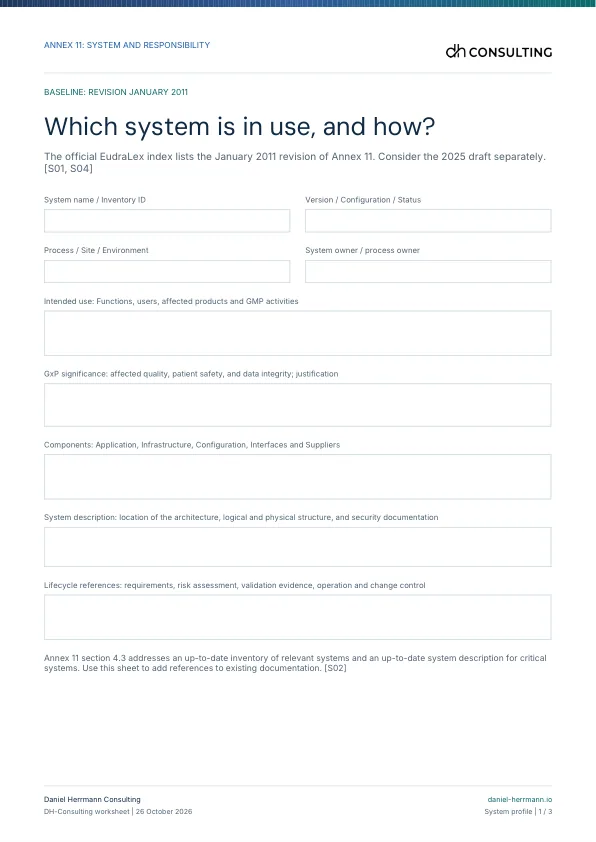
3 pages, A4, fillable PDF
Annex 11: system and responsibilities
Create a version-specific system profile showing data flows, its inventory reference and the limits of each party's responsibility.
System owner, process owner, IT, supplier and QA.
What’s included
- Page 1: Complete a system profile covering version, inventory reference, intended use, components, criticality and documentation.
- Page 2: A cloud laboratory example and spaces to document two transfers, their sources, destinations, controls and owners.
- Page 3: Assign roles and supplier responsibilities for operations, data review, changes, backup and escalation. Includes sources.
Start with the system in use. Agree roles and the limits of the service provider's responsibilities with the people involved. A system profile, register of data transfers and agreed boundaries for tasks and supplier responsibilities.
Bring the system inventory, data flow and responsibilities together in one working document.
4 pages, A4, fillable PDF
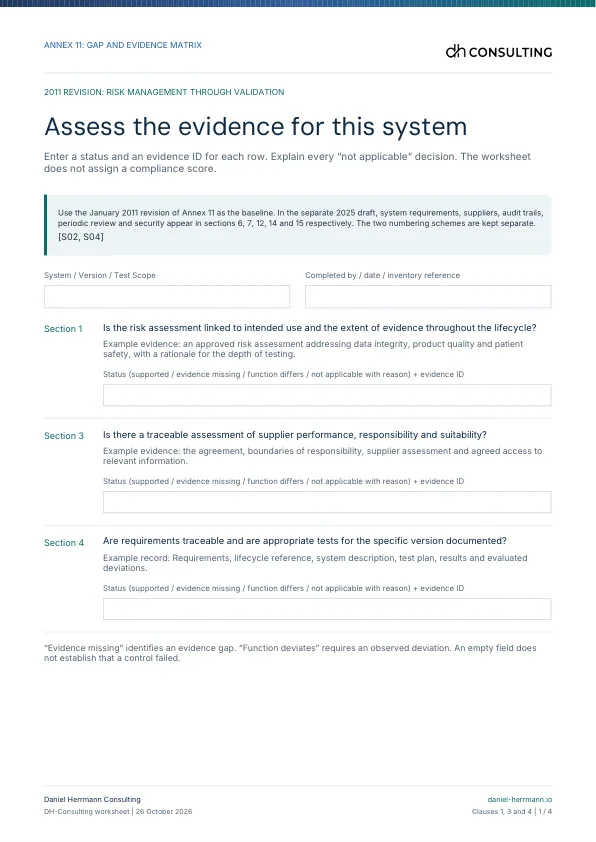
Annex 11: gap and evidence matrix
Review a system against specific Annex 11 provisions, recording questions, evidence and actions.
QA, IT quality, system owner and responsible operations team.
What’s included
- Page 1: How status is recorded, the applicable system and three evidence questions about risk, suppliers and validation.
- Page 2: Three evidence questions on backup, audit trails and change or configuration management, with space for your finding.
- Page 3: Three evidence questions on security, business continuity and archiving. Distinguish missing evidence from an observed functional failure.
- Page 4: Record two actions, their regulatory references, types of finding, immediate responses, owners, deadlines, results and decisions. Includes sources.
Review the nine provisions on pages 1–3. Record missing evidence and functions that differ as actions on page 4. A fillable evidence matrix that distinguishes types of findings and assigns owners for follow-up.
Map questions to the section numbers of the 2011 revision only. The 2025 draft is identified separately.
Two PDF worksheets
Request the worksheets for your team
Enter your name, company, work email and a phone number where we can reach you. We will call you briefly about your request and then email you the worksheets. A newsletter subscription is optional.
We have received your request.
We will call you briefly to discuss your request, then email you the worksheets personally.
Project experience and collaboration
Identify the Annex 11 controls your process needs
To assess a system, we bring process owners, QA and IT together around a single workflow. Which decision depends on the application, which data must be reliable and who can intervene? We use the answers to identify requirements and evidence. We reuse suitable documentation. A list of product features cannot establish how the system is actually used. The starting point determines whether to assess gaps in an existing system or plan a new one. We distinguish the current text from possible future changes.
Frequently asked questions about EU GMP Annex 11
Which version of Annex 11 applies?
On 26 October 2026, the European Commission's EudraLex index listed the January 2011 revision. The 2025 consultation is closed and its text remains marked as a draft. A timetable or expected publication date does not bring that draft into force.
Does Annex 11 apply to every IT system in a pharmaceutical company?
Applicability depends on use in a GMP-regulated activity. Assess the processes and data actually supported. The system name, industry and application size alone are insufficient. Document the boundaries and the rationale.
Are cloud systems exempt from Annex 11?
Annex 11 gives no general exemption for cloud systems. Assess the GMP-relevant use and the division of work between supplier and regulated user. Supplier evidence can contribute, alongside assessment of your configured workflows, responsibilities and controls.
Does periodic evaluation have to be annual?
Annex 11 calls for periodic evaluation, without setting a universal annual deadline for each system. We recommend selecting the interval and triggers according to risk, the pattern of changes and your quality procedures. A significant change or critical incident may require a further assessment.
Does a successful backup provide sufficient evidence?
A successful backup run does not establish that data can be fully restored and used. Test recovery separately. Include the metadata and relationships needed to reconstruct a transaction. Assess both technical recovery and the resulting process record.
Do Excel files need validation?
Yes. A spreadsheet used in a GMP-relevant activity needs evidence and controls proportionate to use and risk. EMA identifies validation under Annex 11 section 4 at least for files with custom code such as VBA. Formulas and algorithms also need accuracy checks. A file without macros may still need version control, formula protection and other controls.
How does Annex 11 differ from 21 CFR Part 11?
Annex 11 addresses computerised systems used in GMP-regulated activities across their lifecycle. Part 11 covers electronic records and signatures within its FDA scope. Some controls overlap, but assess applicability separately. A common evidence plan may then be appropriate.
Is there a fillable Annex 11 checklist?
Our pack contains two fillable PDFs. One records the system and its responsibilities. The other tracks gaps and supporting evidence. Use them to organise intended use, ownership, outstanding evidence and actions. Daniel Herrmann Consulting created the worksheets. They are not official forms or a complete demonstration of compliance. After a short call about your request, we send them to you personally.
Sources and review date
The original sources were checked on 6 October 2026. Version status and new questions concerning the reading guide and worksheets were checked against primary sources on 26 October 2026. The guide distinguishes the 2011 text, supplementary EMA interpretation and statements from the draft. The tables, example and checklist support implementation and cover only part of a full audit programme.
- Germany's AMWHV section 3, quality management systems and interpretation of GMP
- ZLG, Aide-Mémoire 07121203 on supervision of computerised systems, technical review dated 31 August 2022
- European Commission, Annex 11 – Computerised Systems (2011)
- European Commission, EudraLex Volume 4 official index
- European Commission, consultation on Chapter 4, Annex 11 and Annex 22 (2025)
- European Commission, Annex 11 consultation draft (2025)
- EMA, GMP and GDP questions and answers on Annex 11 and data integrity
- eCFR, 21 CFR Part 11 scope
Sources checked: .


Daniel Herrmann Consulting
Assess the evidence for your system
We help your team establish the current evidence position and implement specific actions for your GMP-relevant system.
- GAMP 5 consulting →
Understand how GAMP 5, EU GMP Annex 11 and 21 CFR Part 11 apply to your systems. We translate the relevant requirements into proportionate validation work and evidence your team can defend in an audit.