
GAMP 5 2nd Edition: What Changes for Your Computer System Validation
GAMP 5 Second Edition modernizes Computer System Validation: Critical Thinking, agile lifecycles, cloud and supplier governance. What to adapt.
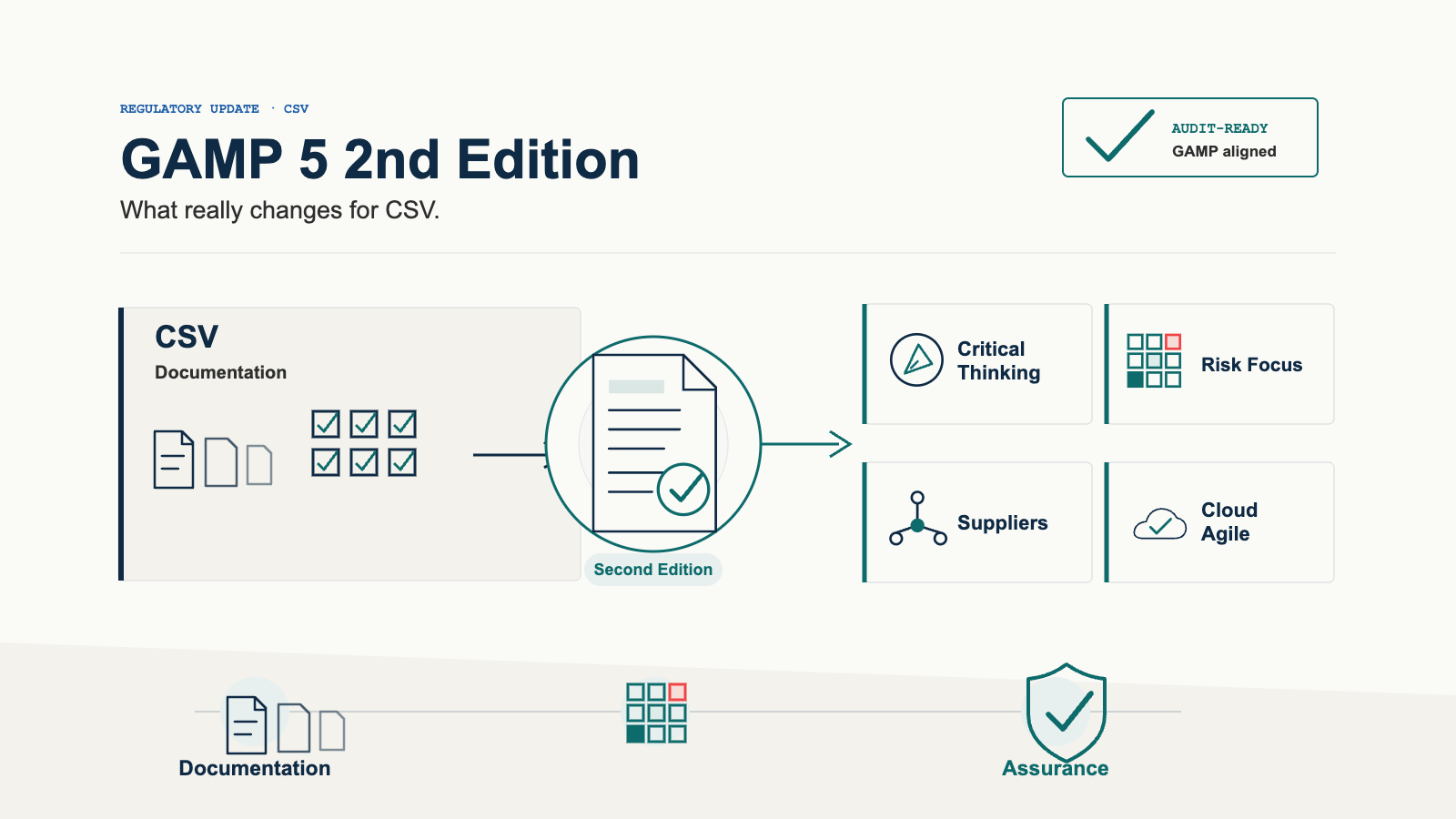
GAMP 5 Second Edition (ISPE 2022) strengthens three guiding principles: Critical Thinking instead of test volume, iterative and agile lifecycle models, and risk-based governance of cloud services and suppliers. Software categories 1 to 5 remain structurally intact but are interpreted more pragmatically. For IT directors and Business Process Owners this means less redundant documentation, more professional judgement and a clearer framework for modern software architectures.
GAMP 5 has been the de facto standard for Computer System Validation in regulated industries since 2008. Fourteen years later, ISPE published the second edition — a methodological modernisation rather than a cosmetic update. A first-edition mindset no longer reflects cloud services, agile development and short release cycles adequately. This article explains what that means for your validation framework.
What fundamentally changes — the three guiding principles of the 2nd Edition
The second edition of GAMP 5 is evolution, not revolution. The familiar structures — software categories 1 to 5, V-model as reference, ICH Q9 as risk framework — remain sound. What has changed is the thinking behind them. In 2022, ISPE did not reinvent the guide. The organization adapted it to a software reality that did not exist in this form in 2008.
Three guiding principles carry the modernization:
First guiding principle: Critical Thinking as a methodology. The first edition steered Validation primarily through documentation depth and test volume. The second edition puts professional judgment at the center. No longer "test everything," but "assess risk-based, document the decision, deliver a defensible audit trail." That reduces effort — and increases the meaningfulness of Validation.
Second guiding principle: Iterative and agile lifecycle models. The V-model remains permissible but is no longer the default implication. GAMP 5 Second Edition explicitly recognizes that modern IT organizations work iteratively and agilely — and delivers the methodological framework for how validation activities are integrated into sprints, releases, and continuous delivery pipelines.
Third guiding principle: guidance for new software realities. Cloud, SaaS and short release cycles were peripheral in 2008. The second edition strengthens the risk-based treatment of modern architectures, supplier evidence and iterative change.
These three principles work together. Consistent Critical Thinking supports iterative work and proportionate assurance of modern cloud architectures. The second edition sharpens what validation should deliver in 2026.
GAMP 5 1st vs 2nd Edition — the key differences compared
The following table shows the central methodological shifts between the first and second editions:
| Aspect | GAMP 5 1st Edition (2008) | GAMP 5 2nd Edition (2022) |
|---|---|---|
| Methodology paradigm | V-model, sequential | Lifecycle, iterative and agile-compatible |
| Risk Management | ICH Q9 as external reference point | ICH Q9(R1) integrated + Critical Thinking |
| Test philosophy | Full testing as the standard reflex | Risk-based, CSA-aligned |
| Cloud and SaaS | Barely covered | Dedicated chapter + service provider guidance |
| Data Integrity | Bolt-on appendix | Integrated throughout (ALCOA+) |
| Documentation depth | Extensive, procedural | Value-driven, lean |
| Supplier assessment | Standard assessment | Granular, tiered, knowledge-driven |
The biggest practical movement is not in any single point but in the interplay: less mandatory documentation, more decision-making responsibility, more compatibility with modern IT practice. Anyone who reads the table as a pure list of changes underestimates its scope. Anyone who reads it as a methodological realignment will recognize: your validation framework is allowed to become leaner — provided the professional substance behind it holds up.
Critical Thinking instead of test volume — how less documentation creates more compliance
Critical Thinking is the central methodological lever of the second edition. The term sounds academic but has a very concrete meaning in everyday validation work: away from reflexive full testing, toward documented assessment of what actually needs to be tested.
An example makes the difference clear. For a LIMS function that changes sample status, first assess which transitions are GxP-relevant, which supplier evidence is usable and which combinations occur in the intended process. This produces justified test depth instead of blanket full testing.
Three consequences follow for your IT organization:
First: responsibility shifts to the practitioner. Critical Thinking does not work through templates. It works through qualified staff who can assess GxP relevance. That places demands on training and competency profiles — and on the willingness to recognize professional judgment as a legitimate validation output.
Second: selection needs a defensible decision path. Your dossier must show why you selected these tests, which risks they address and how supplier evidence was considered. Volume alone does not replace that rationale.
Third: alignment with FDA Computer Software Assurance becomes possible. FDA revised its final CSA guidance in February 2026 to align it with the amended 21 CFR Part 820 Quality Management System Regulation (QMSR); this version supersedes the September 2025 guidance. It directly applies to software used in medical-device production or quality management systems and supports risk-based assurance. GAMP 5 Second Edition can align methodologically, but a GAMP 5 implementation is not automatically CSA-compliant because the scopes differ.
dh Consulting applies the risk-based approach within its self-reported track record of 60+ validated systems, a 100% audit pass rate and zero critical findings. The objective is not less documentation, but appropriate evidence without unjustified redundancy.
"Critical Thinking does not save on compliance — it saves on redundancy."
Iterative and agile process models — Validation for DevOps-driven IT
The second edition acknowledges that modern IT organizations work iteratively. Sprints, continuous delivery, DevOps pipelines are no longer exceptions in 2026, but standard — including in GxP-relevant areas. The first edition had no methodological answer for this way of working. The second edition delivers it.
What changes in practice? Three points:
Lifecycle models may be iterative. The V-model remains as a reference but is no longer the only option. Iterative models — Scrum, SAFe, Kanban — are explicitly permissible, provided validation activities are adapted to the iteration. Concretely, this means: each iteration contains defined validation steps, not one large validation phase at the end.
Automated tests are recognized as validation evidence. If your DevOps team already runs unit tests, integration tests, and end-to-end tests automatically, those test results can — with clean configuration — count as formal validation evidence. Prerequisite: the test environment is qualified, the test scripts are GxP-assessed, the results are reproducibly archived.
DevOps pipelines become a controlled change process. A CI/CD pipeline is, at its core, a defined workflow with quality gates. GAMP 5 Second Edition allows such a pipeline to be qualified as a formal change-control process — which massively shortens release cycles without compromising compliance.
What remains challenging? The tension between sprint velocity and QA release. A two-week iteration cannot tolerate a three-week QA approval loop. This requires organizational adjustments: integrated validation roles in the sprint team, clear escalation paths, defined quality gates per release stage. The second edition delivers the methodological framework — the organizational implementation remains the task of your IT and QA leadership.
For IT Directors whose development and operations teams work agilely, the second edition is therefore the long-awaited methodological foundation. It spares the recurring debate over whether agile approaches are at all compatible with GxP. The answer is clear: yes, and explicitly documented with the second edition.
Cloud and SaaS — what the 2nd Edition means for new architectures
The first edition of GAMP 5 treated cloud services only in passing. The second edition places modern service and supplier models more clearly in the risk-based lifecycle. This is particularly relevant for IT organisations operating cloud LIMS or SaaS quality systems.
Cloud and SaaS get a dedicated chapter. The second edition acknowledges that validating a cloud application follows different logics than validating an on-premise installation. You will not qualify the cloud provider — only the provider does that themselves. Rather, you will document the assessment of the provider, clarify the shared responsibilities, and separately validate the GxP-relevant configurations of your instance.
In practice, a clear shared-responsibility model is required: which evidence comes from the SaaS provider, which configurations and processes remain yours, and how changes are assessed. This boundary avoids duplicated effort and closes accountability gaps.
Service provider assessment becomes granular. The first edition had a standard assessment for suppliers. The second edition differentiates: a hyperscale cloud provider is assessed differently than a niche-specialized SaaS vendor, a certified co-location provider differently than an internal IT service unit. The tiered assessment schemes reduce effort for established providers — and sharpen the focus on critical components.
AI systems require a separate, use-specific validation strategy. GAMP 5 provides risk-based foundations but does not replace the definition of intended use, system boundary, data controls, acceptance criteria, human oversight and monitoring. dh Consulting covers this commercial scope only through its AI system validation in GxP offer.
Practical consequence for your IT architecture: cloud platforms and SaaS solutions can be assured with a clearer risk-based method than under a purely documentation-driven implementation. The boundary between supplier and operator responsibility remains demanding.
What you should do now — adjustments to your validation framework
The most important message up front: a complete overhaul of your existing CSV framework is not necessary. The second edition is evolutionary by design — existing structures remain sound. What is worthwhile are targeted adjustments at four points:
First: check your CSV framework against 2nd Edition principles. Three guiding questions are enough for an initial assessment. Is Critical Thinking anchored as a methodology in your SOPs — or do you steer through test volume? Are iterative lifecycle models permitted — or does your framework enforce the V-model? Are there assessment templates for cloud service providers — or do you treat each cloud rollout as a one-off? Anyone answering "no" to all three questions has the greatest optimization potential.
Second: modernize your test strategy. Switching from full testing to risk-based testing is the fastest lever with the greatest impact. It typically reduces documentation volume by 40 to 60 percent — at the same or better audit defensibility. Prerequisite: documented risk assessments, qualified practitioners, a clean audit trail of the test selection.
Third: introduce cloud and SaaS assessment templates. Anyone introducing cloud solutions or SaaS platforms over the next 18 months — and practically every pharma and biotech organization is — benefits directly from a tiered assessment scheme. Three assessment depths are enough: tier 1 for hyperscale providers with established certifications, tier 2 for specialized SaaS vendors, tier 3 for critical or insufficiently established providers.
Fourth: update the cloud and supplier operating model. Define which supplier evidence you use, which configurations you verify yourself, and how releases, deviations and changes are controlled within the validated state.
These four adjustments can be tackled sequentially or in parallel. A realistic modernization horizon is 6 to 12 months — depending on the size of your IT organization and the number of affected systems. This is not a crash program, but a structured transition.
Frequently Asked Questions
Do we have to completely overhaul our existing CSV framework?
No. The second edition is evolutionary, not revolutionary. Existing structures remain sound. What is adjusted: methodology (Critical Thinking instead of test volume), test strategy (risk-based), and cloud or supplier assessment. A complete overhaul is neither necessary nor sensible.
Is GAMP 5 2nd Edition legally binding?
No. GAMP 5 is a guideline, not a law. However, authorities such as the FDA and EMA reference GAMP as a recognized industry standard. Anyone who deviates carries the burden of justification in an audit. In practice this means: the second edition is not mandatory — but every deviation must be documented and professionally defensible.
How do GAMP 5 2nd Edition and FDA CSA relate to one another?
They can be complementary, but they are not interchangeable. GAMP 5 is broader and supports risk-based validation across GxP contexts. FDA CSA has a defined scope for medical-device production and quality management system software. Alignment must be demonstrated against both applicable references rather than assumed automatically.
Primary sources
- ISPE: GAMP 5 Guide, Second Edition (July 2022)
- ICH: Q9(R1) Quality Risk Management, Step 4 (January 2023)
- FDA: Computer Software Assurance for Production and Quality Management System Software, revised final guidance (February 2026)
- European Commission: EU GMP Annex 11 — Computerised Systems
- eCFR: 21 CFR Part 11 — Electronic Records; Electronic Signatures
- PIC/S: PI 041-1 — Good Practices for Data Management and Integrity (July 2021)
- ISPE: GAMP Guides and Good Practice Guides
Author
Daniel Herrmann Consulting — Boutique consultancy for GxP compliance and Computer System Validation in pharma, biotech, and medtech. 17+ years of hands-on expertise. 60+ validated systems. 100% audit pass rate. 0 critical findings.