

Table of contents
At a glance
How do you define the scope of a cloud or SaaS validation project?
Define the process, records and system boundaries for the cloud or SaaS service. Assess supplier services, suitability and available evidence. Agree requirements, configuration, suitable testing and migration where needed. Include operations: who assesses changes and incidents, and how will records remain accessible on exit? SaaS delivery does not remove responsibility for your intended use.
- Supplier assessment and validation of own usage are interrelated tasks.
- Certificates only address the questions within their actual scope of application.
- Even without proprietary program code, configuration and data pathways can be critical.
- Release information, failure reporting pathways, and exit procedures must be clarified prior to implementation.
Which process is supported by the cloud service?
State the intended use, service scope, considered environment, and relevant data. Describe a complete process including pre-existing identity services, interfaces, and utilized resources. A SaaS service can only constitute part of the control chain. Technical ownership boundaries and functional process boundaries are not always aligned.
Additionally, specify which functions are intentionally not used. This may limit the scope of the audit assignment but requires an appropriate approach to unintended use and subsequent changes. A general statement such as "cloud validation" neither indicates which process must be demonstrated nor identifies the specific system or infrastructure that is central to such validation.
The workflow assistance document "Cloud Project: Assigning Responsibilities and Documentation" makes this boundary actionable for your team. "Cloud Operation: Prepare Release and Exit" complements the decisions made after implementation. Both templates deepen the following evaluation questions; product release does not automatically follow from form completion. Please complete the four contact fields so that we can align with your needs in a brief telephone conversation and personally deliver the relevant documentation.
Align supplier assessment on specific questions
Assess the services provided by the supplier and, if applicable, the subcontractor. This includes development and change management processes, operation, support during outages, and the required data availability. The scope and depth of the evaluation should be commensurate with the significance and risks associated with the services.
For EU GMP, use the specific questions from Annex 11: Section 3.1 requires formal agreements with clearly defined service provider responsibilities. Section 3.2 addresses competence and reliability, as well as a risk-based determination of audit necessity. Section 3.4 covers the provision of quality and audit information to inspectors. Section 4.5 requires appropriate assurance that the system was developed under an appropriate quality management system.
From this, derive the documentation you are entitled to receive, evaluate, and present during an inspection. Assign open questions, information rights, and subcontractors to the actual agreement. A sample evidence with an inappropriate scope of product coverage does not close a gap.
Security or quality certificates may provide relevant information. However, the scope of inspection, the considered time period, and exclusions must be understood. Evidence of infrastructure does not constitute automatic proof of your technical workflow configuration. Leave missing information visibly apparent and assess its significance, rather than concealing it behind a general certificate list.
Shared responsibility in the specific service
The principle of shared responsibility helps structure technical responsibilities. The actual allocation arises from service, contract, and usage. As an example for a manufacturer, Microsoft highlights that customers retain responsibilities for data, identities, and their own environment in cloud models. Therefore, no single, identical contractual matrix applies to all providers.
Review the responsibility assignment with stakeholders and document any open handovers. Agreements must align with your intended use and be understood by the roles that will manage the service in the future.
| Subject | Clarify the specific service. | Own decision |
|---|---|---|
| Access | What identity and role functions are available? | Who receives which rights and who verifies them? |
| Change | What information and lead times are provided? | Who evaluates the impact on their own process? |
| Disruption | How are incidents reported and investigated? | How are affected records and decisions handled? |
| Backup | What is secured and how is restoration governed? | What evidence is required for internal use? |
| Data access | What export options and retrieval capabilities are available? | Is the content, context, and readability suitable for the purpose? |
| Exit | Which services end, and when? | How is required access maintained after contract termination? |
Link supplier evidence to your own configuration
Capture roles, forms, decision rules, and interfaces that define your usage. Review existing evidence to verify that they actually address your specific requirements. An unchanged standard function may require different enhancements compared to a customer-specific workflow.
Define appropriate tests for the remaining questions. The focus should be on traceable expected and actual results, not on reproducing all vendor tests. The test environment and the production environment must be adequately aligned and compared. Relevant differences shall be evaluated and, if necessary, addressed with additional evidence.
Sources: [1]
Treat a cloud migration as a data and process change
A migration involves more than simply uploading files. Determine which contents, relationships, metadata, and versions are required for continued use or retention. When transitioning to a new data model, a technically successful transfer may still be functionally incomplete.
Annex 11 Section 4.8 requires, when transferring data to a different format or system, assessments to ensure that data remain unchanged in value and/or meaning. Prior to such transfers, define an appropriate reconciliation approach and a procedure for handling exceptions. Consider the potential period of parallel system operation and the decision on which dataset shall be considered the authoritative source. Repeated test migrations can assist in refining data mapping and procedural approaches; however, they do not substitute the evaluation of the actual transferred production inventory.
Example: A release alters the approval workflow
Assuming that a provider changes a permission function used. The responsible role first checks the change information against its own configuration. If the change involves a relevant decision-making process, appropriate evidence and, if necessary, work adjustments are planned.
Depending on the impact, a targeted regression test may suffice or a more comprehensive evaluation may be required. If a pre-release inspection is not necessary, this circumstance should also be considered in the risk assessment and operational organization. The example does not specify a particular release procedure for a cloud-based product.
For a specific inspection task, "check release" is still insufficient. In one variant of the example, the company has defined that the data entry operator and the release approver for a process must be different individuals. After a release, it must be assessed whether this specific rule continues to function in accordance with the established role model. The following table outlines possible delivery outcomes. It does not assume the presence of any specific cloud product functionality.
In the scope of the assignment, also specify the end of the service: Does the partner provide a change evaluation, carry out agreed testing, or accompany the report review process? The responsible internal function requires a measurable work status. A general support agreement does not automatically address this question.
| Contribution | Usable result | Still required for decision |
|---|---|---|
| Supplier provides release indications | The affected function and change are clearly identified and traceable. | Comparison with own configuration and actually used process. |
| Partner conducts a demonstration | The depicted process is clear. | A valid result record commensurate with the own facility; the demonstration alone is still not a complete coverage. |
| Scheduled inspection at the agreed location | Data entry operator attempts self-approval; intended use, actual response, and result are documented. | Assessment of suitability and open findings by the responsible authority. |
| Required testing capability is missing | Access, pre-run, or proof is not available. | Risk of implementation and appropriate additional measures to be determined; do not treat the gap as accepted. |
Sources: [1]
Assess data availability and exit practically
Do not accept only the statement "data export is possible"; instead, evaluate a representative export example. Does it contain the required information, relationships, and change histories? How can these be read and linked to specific processes later? The use of a technically readable file format does not prove that all necessary content has been preserved.
Separate backup, recovery, and long-term archiving. They serve different purposes. For system exit, responsibilities, timelines, and remaining access must be clarified. These issues are often easier to resolve when selecting the service than immediately prior to contract end or system decommissioning.
What your team must take over after the project
A complete request specifies outcomes related to supplier assessment, internal usage, testing, migration, and handover. It also identifies assumptions: what information is provided by the supplier, which system is already stable, and which responsibilities are assumed by the internal team. Open prerequisites require a clear and traceable resolution.
Plan the operations prior to project completion. A designated responsible party should be able to handle a release notice, a deviation, and a requested data export based on existing documentation. The appropriate solution may be a limited internal process with external support, or a more comprehensive operational structure.
- Describe the actual cloud and process boundary.
- Evaluate supplier documentation based on statement reliability and exclusions.
- State own configuration and remaining justifications.
- Test data transfer and subsequent retrievability.
- Hand over change assessment and exit arrangements with clear responsibilities.
Worksheets for your team
Commission cloud or SaaS validation
Identify the handovers between the supplier and your team. Use the worksheets to assign evidence and describe release and exit scenarios for your intended cloud use.
Request the worksheets for your team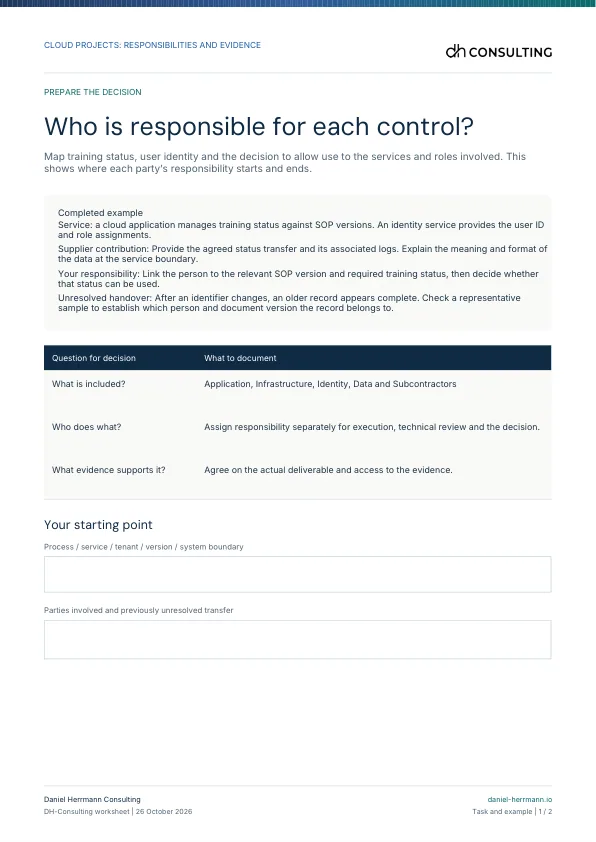
2 pages, A4, fillable PDF
Cloud projects: responsibilities and evidence
Assign technical and operational responsibilities for a cloud GMP process and identify the evidence for each.
System owner, IT, QA, process team and service provider.
What’s included
- Page 1: Who is responsible for each control? Includes a worked example, questions for the decision and space to record your starting point.
- Page 2: Assign tasks, handovers, evidence and your team's decision. Record unresolved boundaries, action, owner, deadline and confirmation. Includes sources and context.
Follow a specific process and its services. At each boundary, record the task, result, evidence and decision your team owns. A map of responsibilities for the intended use, with named handovers and outstanding evidence.
Map the running service and its evidence. Use the second worksheet for a specific release or exit decision.
2 pages, A4, fillable PDF
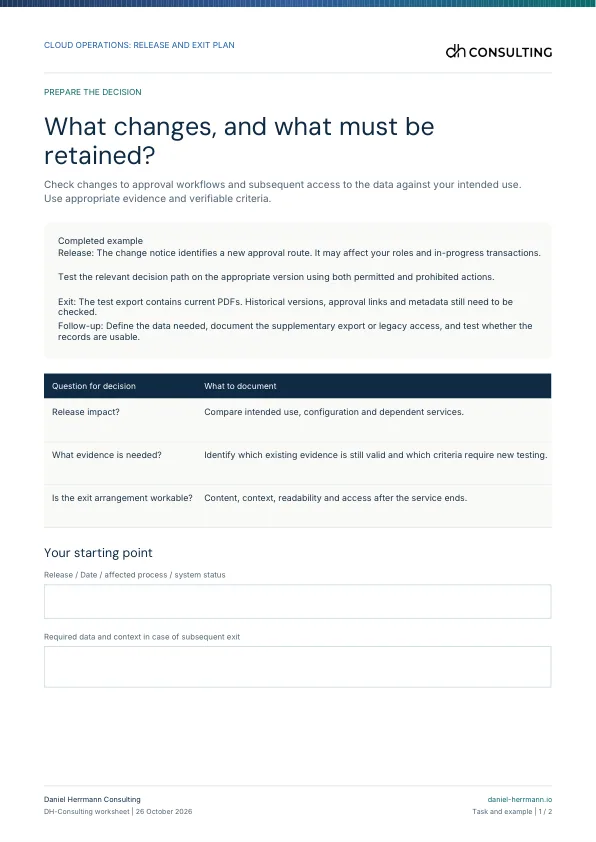
Cloud operations: release and exit plan
Prepare a SaaS release and the later data exit based on affected processes, evidence and access limits.
System owner, IT operations, process owner and QA.
What’s included
- Page 1: What changes, and what must be retained? Includes a worked example, questions for the decision and space to record your starting point.
- Page 2: Assess the release, follow-up tests, exit rehearsal and result. Record the decision, use limits, owner, deadline and decision date. Includes sources and context.
Assess the current release and check whether the agreed exit arrangements preserve the records you need. A release brief that identifies retesting needs, plus an exit step to verify access to the data you need.
Assess the change and future data availability. The worksheet replaces neither a general responsibility matrix nor a legal plan for termination.
Two PDF worksheets
Request the worksheets for your team
Enter your name, company, work email and a phone number where we can reach you. We will call you briefly about your request and then email you the worksheets. A newsletter subscription is optional.
We have received your request.
We will call you briefly to discuss your request, then email you the worksheets personally.
Project experience and collaboration
Assess cloud use from the business process through to exit
We compare the cloud provider’s documentation with your actual process. With the process owner, QA and IT, we identify what those documents demonstrate and what still needs checking in your configuration. An established service with clear data flows needs a different starting point from a new platform that requires migration. We also agree who handles release information, incidents and a subsequent data export.
Frequent Questions on Cloud and SaaS Validation
Does SaaS mean that the provider assumes our validation?
No. He can provide appropriate development, operational, and testing documentation. The scope of the requirements, configurations, and processes covered must be evaluated. Responsibilities can be assigned under contractual agreements. The contractor's responsibility for overseeing outsourced activities and evaluating their results remains as specified in Section 7, Items 7.4 and 7.8.
Is an ISO certification of the cloud provider sufficient?
A certificate can be a significant piece of information, provided its scope aligns with the specific inquiry. It does not automatically validate the suitability of your configuration or the completeness of your records. Therefore, evaluate the credibility and address remaining questions in a specific and targeted manner.
Sources: [1]
Is an on-site audit mandatory for every cloud service provider?
Annex 11 No. 3.2 links audit requirements to a risk assessment; this does not imply a general on-site obligation at every supplier. The nature and scope of supplier evaluation are determined on a risk-based basis. Available evidence, criticality, and open questions influence the appropriate approach. The rationale must remain transparent and justifiable.
Sources: [1]
Do we need to perform complete testing for every SaaS release?
Why should exit planning be included in the implementation strategy?
Required records must also remain appropriately accessible following a supplier change or system decommissioning. Export capabilities and contractual support influence feasibility. A practical export example can identify potential gaps early.
Sources: [1]
What information does a cloud validation consultant need?
Useful are the intended process, product, and service model, existing supplier documentation, our own configuration and data pathways. Supplement with migration planning, required storage, and known limitations. From this, a task can be defined based on specific outcomes.
Sources and review date
Primary source date: 17 October 2026. The article addresses cloud usage in the context of human pharmaceutical GMP. The Microsoft depiction of shared responsibility serves as a technical guidance and is not a universal agreement. Matrices and release examples are standalone planning aids. Specific functionalities, contractual commitments, and legal issues must be evaluated at the selected service provider. EU GMP statements relate to human medicinal products (EudraLex Volume 4).
- European Commission: EU GMP Annex 11, Computerised Systems, January 2011 revisionHuman medicinal products – GMP; in particular, §§1–4, 7, 10–13, 16–17; specific application for each section.
- ICH Q9(R1): Quality Risk Management, official text from the European CommissionRisk-driven decisions, appropriate formalities, and handling of subjectivity; own matrices are implementation proposals.
- European Commission: EU GMP Chapter 7, Outsourced ActivitiesOutsourced GMP-related activities, suitability, responsibilities, agreements, and monitoring.
- Microsoft Learn: Shared responsibility in the cloudTechnical responsibility boundaries for Cloud/SaaS; no official authorization required for customer usage.
- European Commission: EU GMP Chapter 4, Documentation, January 2011 revisionControlled documentation and records; official EudraLex entry with original chapter.
- European Commission: EU GMP Chapter 2, Personnel, effective from 16.02.2014Personal, role-specific training and assessment of practical effectiveness; official EudraLex entry with original chapter.
Sources checked: .


Daniel Herrmann Consulting
Combine a process and the supplier documentation.
Provide a brief description of intended use, service documentation, and details regarding your own setup. Based on a data or decision pathway, it can be determined which questions have already been addressed and which remain open prior to a reliable assignment.
- Cloud and SaaS validation →
Maintain the validated state of cloud and SaaS systems as suppliers issue new versions. We define the boundary between your responsibilities and the supplier’s and agree how each release will be assessed.