

Table of contents
At a glance
What belongs in a validation traceability matrix?
Link each identified, versioned requirement to the reason for testing, its implementation and specific result evidence. Record relevant findings, their assessment and the current coverage status. Trace changes and whether earlier evidence still applies. A table or suitable system can hold the matrix. What matters is that the links and results can be checked.
- A test plan describes the evaluation; only the executed and assessed evidence describes its result.
- Requirement, configuration and result documentation need a comprehensible version reference.
- A link, or a full set of links, does not by itself demonstrate adequate coverage.
- Changes and open findings remain visible until their impact on the evidence base is assessed.
A complete matrix is not yet a receivable release evidence.
When engaging in the development or review of a Traceability Matrix, distinguish between the assignment of requirements and the evaluation of results. A properly linked requirement may still have an open or failed evidence of validation. Therefore, clarify whether the engagement is limited to establishing relationships, evaluating gaps in evidence, or also preparing necessary supplements. These evaluation outcomes should not be included under the same final release.
The following working example assumes that requirements and associated system statuses are known. It illustrates possible status decisions during the review. The terms are part of an internal reference guide. Ultimately, the key point remains whether the specific evidence actually supports the current requirement.
| Existing Situation | Statement in the review | Next step |
|---|---|---|
| Performed, executed, and evaluated test passed | Covered for the documented requirements and system status as applicable | Assess validity in the event of changes |
| Field or assignment empty | Coverage cannot be established | Investigate missing assignments and identify their root cause |
| Test linked, results evidence missing | A planned qualification is not yet a demonstrated result. | Actual execution and evaluation status describes |
| Associated test failed | Requirement of this test not successfully demonstrated | Assess findings, implications, and appropriate further processing actions |
| Investigation or evaluation still open | Decision is still pending | State responsibility and required evidence |
| Not applicable | Rational basis for exclusion from the scope under consideration, no prior test conducted | Justify and obtain approval in a traceable manner |
A summary shall be prepared, and empty fields, missing documentation, errors, and unresolved evaluations shall not be considered as fulfilled requirements. A justified exclusion must remain clearly identifiable; such an exclusion does not constitute a successful test. Partial criteria shall be assessed separately when documentation only covers part of a requirement. The decision regarding the scope of release may be justified in this manner, but cannot be derived automatically from a link count.
The support document "Traceability: Coverage and Gaps Determine" assists with this review prior to handover. "Traceability: Tracking Changes and Retrospective Review Requirements" follows: What relationships and prior documentation must be re-evaluated for a specific change? Both documents support technical alignment and do not replace a final assessment. Name, company, business email address, and telephone number are required for the request. Following a brief telephone conversation, we will personally send you the relevant documentation.
Traceability makes the audit trail verifiable
Traceability here refers to the demonstrable link between requirements and validation evidence. This does not pertain to the traceability of a batch through the supply chain nor to the technical code coverage of a software test. The central question is: Where does this "should" originate, how was it implemented, and on what basis can it be asserted that it meets the intended use in the intended environment?
Annex 11 §4.4 addresses the traceability of user requirements throughout the lifecycle. It does not provide an Excel template nor a one-to-one mapping between requirements and tests. The current EudraLex directory, in the human medicinal product area, still references the revision from January 2011. This article utilizes the published GMP guideline, not any new obligations arising from consultation drafts.
The following fields and status terms represent a distinct practical presentation. The URS defines the required specifications. The risk assessment justifies the necessary validation evidence. Traceability links both the defined requirements and the actual implementation to the resulting outcomes. It does not replace this work but helps to promptly identify missing or no longer applicable documentation.
With a clear requirement and its current status beginning
Assign stable identifiers and maintain the relevant text version. "Permissions work" leaves open which role is authorized to perform which action. A verifiable requirement specifies the permitted action, affected data, and relevant restrictions. The matrix does not need to fully repeat these details, but must provide a reliable reference to the corresponding version.
If an acceptance criterion changes, the previous version remains recognizable as a previous reference. Do not just overwrite the text behind an unchanged reference. Otherwise, an old test seems to cover a new expectation that did not yet exist during execution. For example, use the combination of requirement identifier, version state and change reference.
Separate multiple technical criteria within a single comprehensive requirement if they are evaluated or assessed differently. A consolidated requirement for access control may include login, write rights, professional authorization, and administrative privileges. A single login test only validates a portion of these. Sub-criteria or clear assignments within the test case make these differences visible, without artificially splitting any single statement into a separate document.
Link risk and implementation such that assignment provides clarity
A risk assignment should explain why certain criteria require in-depth evaluation. Therefore, link as specifically as possible to the actual error scenario rather than merely referencing the title page of a risk assessment. For example, in the case of role separation, this would include the unobserved approval of a dataset created by the same individual. The technical rationale remains clearly identifiable even if a different person later maintains the matrix.
Additionally, ensure appropriate implementation: role rules, workflow configuration, interface mapping, or documented operating procedures. Select an appropriate level of accuracy. A complete configuration export can serve as a suitable baseline; the matrix should enable identification of the relevant section or supplementary inspection note within it. Reference to the system name alone is often insufficient for a specific change analysis.
Not every requirement is exclusively fulfilled technically. A controlled review may consist of a software function and a work instruction. Link both components and their corresponding evidence. Whether this combination is sufficient from a technical standpoint is determined in the evaluation. Traceability should present this transparently and must not replace an unverified technical lock with a simple reference to a SOP.
Sources: [2]
These fields make the matrix practical for daily use.
The following structure serves as a workflow aid, not an official form. You may distribute fields across multiple interconnected views. What matters most is that a reader can progress from the current requirements to the relevant evidence and understand the rationale behind the decision. An additional column provides only limited value if it is consistently and reliably maintained.
Avoid redundant copies of results. Retain the result record at the controlled location and reference it precisely. A clear, unambiguous status with relevant limitations is sufficient in the matrix for decision-making. If two summary results contradict each other, it must be clearly established which controlled record is decisive and who resolves the discrepancy.
| Component | What the entry is intended to address |
|---|---|
| Requirement and Version | What is the required and individual criteria applicable to this state? |
| Risk or inspection reason | Which failure mode or any other requirement justifies the demonstration? |
| Implementation reference | Which configuration, function, or operating rule meets the requirement? |
| Testing and Results | Which run on which environment demonstrates the actual observed behavior? |
| Find and Assessment | What deviation occurred, what impact was assessed, and by whom? |
| Coverage status | Documented, partially documented, open, or not applicable at this time – with rationale. |
| Change reference | Which change affects the relationships and what subsequent review follows therefrom? |
Distinguish a planned test from an actual inspection
A test script can mention all requirements and still never have been executed. Therefore, when covering the results, refer to a clearly identified test run. This includes the information relevant for its statement, such as software level, configuration, test data, execution time, expected behavior and actual observation. The scope depends on the test task.
A screenshot can illustrate a visible state. However, without context, it does not indicate which user performed the action or whether a required lock was actually verified. Link the screenshot to the test step and result evaluation. For an interface test, the input file, processing log, and target state may all be required. A standalone green job status does not answer a technical assignment question.
A test can demonstrate multiple requirements; a requirement may necessitate multiple tests. Assign relevant steps or criteria as appropriately as possible. Avoid generic references whose evaluation would require re-establishing the entire project knowledge base. Annex 15 supplements its qualification and validation scope by emphasizing clear document relationships and the evaluation of results against acceptance criteria; for computerized systems, it explicitly references Annex 11.
Display open findings and partial coverage visibly
The overview of status at the beginning of this article distinguishes between results, pending testing, and justified exclusions. Additionally, "partially supported" requires a clear boundary: which criterion is addressed and which remains open? "Planned" indicates only the intended evidence and must not be considered as a valid result.
Retain records of previous failed runs, including results and processing details, within the audit trail. The historical record is not deleted even if a subsequent successful test or closed ticket is completed. Summarize the current status only using a designated reference batch; link count, execution status, and technical coverage represent distinct attributes.
Example: a role change does not invalidate every previous test
This example describes assumed states. Requirement R-17 in version 1 permits only authorized reviewers to approve a test dataset. The assumed test T-21 on configuration K-3 demonstrates both authorized and prohibited roles. For version 2, an additional criterion is introduced: the dataset creator shall not approve their own dataset, even if they simultaneously hold reviewer privileges.
This specific role segregation is an assumption of the example, not a general obligation derived from Annex 11 applicable to every dataset. The new error scenario pertains to the combination of two roles. T-21 remains as evidence of its original scope. It, however, does not automatically validate the new exclusion. The change assessment must additionally justify whether its statement continues to hold for the current configuration.
For T-22, a user is assigned with both roles and a dataset created by them is provided. The expected behavior is rejection of self-approval when further permissible review of foreign datasets is still possible. In the first example run, self-approval is permitted. Findings B-04 remain open until corrections and appropriate supporting evidence have been evaluated.
| Status and Relationship | Existing example record | Gap or decision | Coverage |
|---|---|---|---|
| R-17 V1 → K-3 → T-21 | Approved cycle: Access of defined roles verified. | Documents the original scope; historical reference maintained. | V1 occupied |
| R-17 V2 → planned status K-4 | T-21 remains available but does not verify self-approval. | Assess validity for unchanged portion; additionally schedule T-22. | V2 not fully justified |
| R-17 V2 → K-4 → T-22 → B-04 | Accepted non-conformance: combined role approved for own dataset. | Assess the impact; indicate that the affected process has not been fully validated. | Criterion open |
| R-17 V2 → K-5 → Post-test T-22-R1 | Correction and retrospective testing are planned in the example. | First results plus necessary regression evaluation to be assessed; planning is not a closure document. | Still open |
Assess changes throughout the evidence chain
Begin the change assessment at the actually modified object. For R-17, this would be the rule for own approval. Follow the links to roles, configuration, test scenarios, and operating instructions. Then review the reverse direction: Which other requirements are associated with the same configuration? A correction could inadvertently prevent valid approvals of foreign datasets.
Therefore, in this example, a targeted repetition of the affected portion of T-21, in addition to T-22-R1, may be appropriate. Whether additional tests are required depends on the nature of the change and its interdependencies. There is neither an automatic requirement to revalidate all components nor to retest only the defective case. Ensure that the rationale is documented when existing evidence for unchanged portions is reused.
The review also includes a review from test to requirement. Independent tests may reveal an overlooked requirement, a technical inspection rationale, or an outdated scope. Not every such test is unnecessary. Investigate the underlying reason and document the appropriate relationship or a controlled exclusion. Remove historical evidence not only to make the current table more concise.
Maintain the matrix without establishing a second documentation system
Establish a leading placement and clear maintenance responsibility. The technical department evaluates the technical validity. IT and supplier provide traceable configuration references. Result review and decisions on open findings follow your quality system. Anyone who merely updates a document number should not be able to inadvertently alter a technical coverage decision.
A spreadsheet may be adequate for a limited scope. For numerous releases and relationships, an integrated tool can facilitate maintenance. Assess the use and controls of such a tool, particularly access rights, changes, filters, and exports. Automatically generated links reduce data transfer effort; however, they do not independently evaluate whether a test addresses the appropriate technical question.
During handover and subsequent modifications, verify that references remain accessible to authorized readers. A link to a temporary project workspace does not constitute a durable and reliable traceability access. For an archived project status, the versions referenced at the time must also be retrievable. Major sources of effort include scattered folders, changing identifiers, extensive aggregate requirements, and ambiguous result states—not merely the number of table rows.
Checklist: Does the traceability chain for a specific inquiry remain valid?
Select a modified or particularly relevant requirement and trace its chain without verbal supplementation. Then, review an open deviation in the opposite direction. The following checklist helps systematically address missing relationships and ambiguous status indications.
- The current requirement is clearly identified and linked to its status.
- Individual criteria are identifiable, even when multiple criteria are combined within a single requirement.
- The investigation root cause refers to the specific risk or another reasonable basis.
- The appropriate implementation is demonstrable through suitable configuration or procedure records.
- Test planning and actual execution have distinct references.
- The result record demonstrates the relevant system status and the actual observed outcome.
- Open findings, impact assessments, and decisions are interrelated.
- The coverage status describes the extent of fulfillment and does not mask any partial criteria.
- Changes result in an evaluation of affected relationships and existing documentation.
- Historical records, current references, and nursing responsibility remain traceable.
Worksheets for your team
Use traceability for acceptance and change decisions
Linking a test does not establish that a requirement was met. Use the worksheets to assess actual coverage and identify what needs retesting after a change. Open, failed and inapplicable items remain visible.
Request the worksheets for your team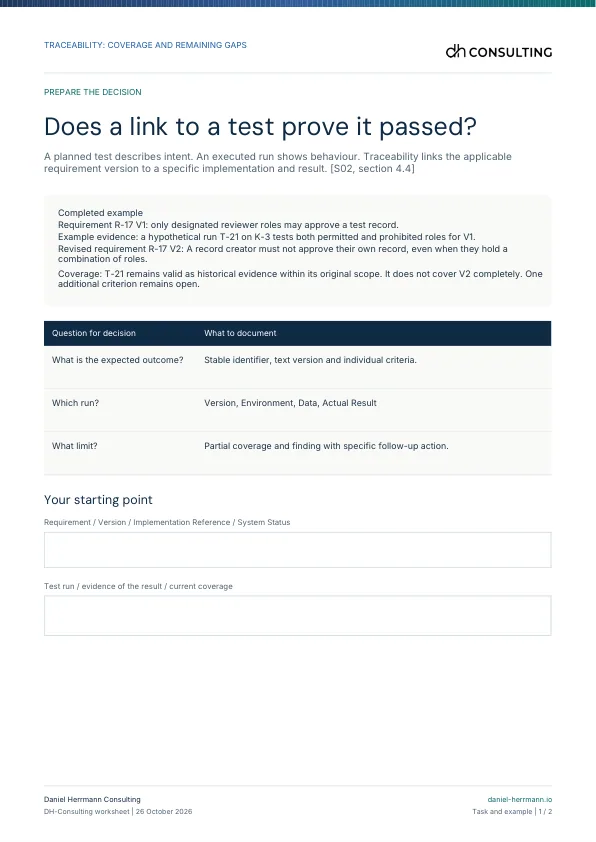
2 pages, A4, fillable PDF
Traceability: coverage and remaining gaps
Evaluate the actual coverage of a versioned requirement through implementation, test run, result and findings.
Validation lead, subject matter expert, tester and QA.
What’s included
- Page 1: Does a link to a test prove it passed? Includes a worked example, questions for the decision and space to record your starting point.
- Page 2: Compare the requirement, implementation and supporting evidence. Record coverage, remaining gap, decision, impact on use, deadline, reviewer and date. Includes sources and context.
Select a requirement and version. Trace it to the actual result and identify individual criteria that remain open. A justified coverage decision with the result record, remaining gap and owner for follow-up.
Assess coverage for one version. The change worksheet traces the effect of a specific change through the evidence chain.
2 pages, A4, fillable PDF
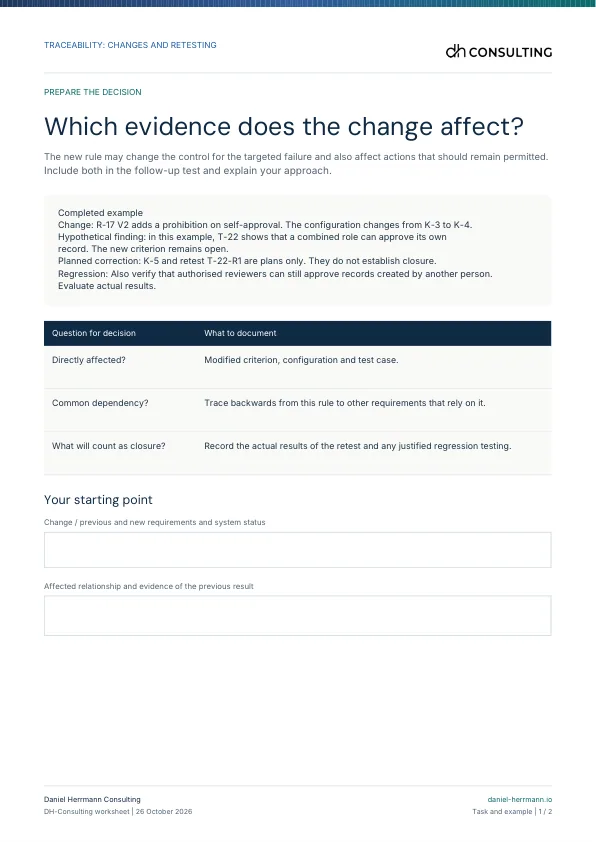
Traceability: changes and retesting
Trace the impact of a requirement or configuration change on existing evidence and the need for retesting.
Change owner, system owner, tester and QA.
What’s included
- Page 1: Which evidence does the change affect? Includes a worked example, questions for the decision and space to record your starting point.
- Page 2: Trace a change through its impact, existing evidence, follow-up tests and result. Record the close-out decision, open item, decision-maker, date and follow-up. Includes sources and context.
Start with the changed item. Track affected relationships forward and backward and justify additional tests. A traceable change record that retains earlier references, identifies the open criterion and specifies an appropriate follow-up check.
Follows changes and regression; it does not declare a historical test invalid solely because of a version change.
Two PDF worksheets
Request the worksheets for your team
Enter your name, company, work email and a phone number where we can reach you. We will call you briefly about your request and then email you the worksheets. A newsletter subscription is optional.
We have received your request.
We will call you briefly to discuss your request, then email you the worksheets personally.
Project experience and collaboration
Trace the requirement through to the assessed result
Your team selects an important requirement and follows its links to the executed test and evaluated finding. Where a link is missing, we establish whether only the reference is incomplete or required evidence is absent. A maintained table may suffice for a small project. Numerous versions and parallel changes need clear visibility of the effective state. We identify who checks new links and how to determine after a change which conclusions still hold.
Frequently asked questions about Traceability Matrix
Is a traceability matrix required to be maintained in Excel?
No. Annex 11 describes the traceability of user requirements throughout the lifecycle, without prescribing a specific file format. Select a controlled presentation that aligns with the scope and maintenance process. A table may suffice; a suitable tool can facilitate complex relationships. What remains critical is whether a reader can reliably identify the current valid requirements, the appropriate evidence, and outstanding questions.
Must each requirement have exactly one test?
No. A requirement may necessitate multiple criteria and thus multiple pieces of evidence. Conversely, an end-to-end test can validate multiple requirements. Assign the relevant steps or result points accordingly to ensure the linkage remains clear. A consolidated link to an extensive protocol is only helpful if the actual evidence for each specific criterion can be unambiguously identified therein.
What is the difference between test coverage and an existing test link?
A link initially indicates only that two entries have been linked. Technical coverage requires that the referenced inspection actually evaluates the relevant criterion at the appropriate stage and produces a assessable result. Therefore, review the execution status, results, and open findings. Clearly indicate a planned or failed test accordingly, rather than considering the linkage alone as compliant.
Can you reuse evidence from tests that passed before a change?
Yes, if their statement remains logically defensible for the considered unchanged portion. Assess requirements, configuration, environment, and relevant dependencies. A new role parameter may require additional validation, without rendering any existing test obsolete. Document the validity assessment. The previous run must not appear, retrospectively, as having been evaluated against a criterion that was unknown at the time.
How do we handle a failed test in the matrix?
Link the finding to the assessment and its professional evaluation. Leave the affected criterion open or appropriately restricted until sufficient evidence supports a different decision. Capture correction and follow-up testing additionally; do not overwrite the original run. A closed ticket is only part of the traceability chain when the required professional conclusion is actually verifiable.
Does a 100 percent coverage rate prove successful validation?
No. A ratio may, for example, only indicate that all requirements have a corresponding link. Define the denominator and numerator rule prior to deriving a status from it. Unverified criteria, inappropriate versions, and open relevant findings must remain visibly distinct. A fully linked matrix may document an incomplete evidence base; it does not replace a professional assessment of the results.
How do we record supplier documentation in the traceability system?
Reference the specific documentation with version, scope, and relevant result location. Specify which part of your requirement is covered thereby and which customer-specific questions remain unresolved. A package name alone is insufficient for this mapping. Evaluation of the documentation forms part of the acceptance process; the matrix maintains traceability of the results and their alignment to internal requirement specifications.
Sources: [2]
Who is responsible for maintaining and professionally reviewing the Traceability Matrix?
Name the nursing responsibility and distinguish between formal updates and business decisions. Project coordination may maintain references; responsible personnel assess whether results meet criteria. IT supports in maintaining the configuration status, while QA ensures alignment with responsibilities within the quality management system. Roles may overlap in SMEs. Authorities and required competencies must remain clearly defined; a universal list of signatures is not applicable.
What do we do with a requirement that is no longer needed?
Document the change and the rationale for the withdrawn scope. Assess dependencies, including those related to other processes, data, or operating procedures. Flag the previous state as historical and the new scope as non-applicable, rather than deleting the line without comment. A withdrawn requirement must not be confused with an ongoing GMP requirement.
How do we efficiently verify the matrix prior to transfer?
Carry out a targeted review of a critical requirement, a recent change, and an open finding. Can appropriate versions, actual results, and decisions be identified without additional knowledge? Additionally, systematically verify missing references and conflicting status values. Such a sample review supports the evaluation process, but does not constitute a general substitute for the required professional completeness assessment of the release scope.
Sources and review date
Primary sources were opened on 6 October 2026. Traceability of validation within human medicinal product GMP is considered. Annex 15 is additionally incorporated within its scope of application for qualification and validation. Tables, status descriptors, and role examples are standalone work aids and not prescribed document templates. Editorial addition dated 26 October 2026: The new decision section and its work matrix are independent methodological proposals. The previously mentioned source status remains separately defined.
- European Commission: EudraLex Volume 4 – Current Directory for Human Medicinal Product GMP
- EU-GMP Annex 11: Computerised Systems – in particular Section 4.4 and Section 10
- EU-GMP Annex 15: Qualification and Validation – Document Relationships and Result Evaluation
- EU-GMP Chapter 4: Documentation – Identification, Control and Records
Sources checked: .


Daniel Herrmann Consulting
Connecting requirements, configuration and results documents in a comprehensible way
Daniel Herrmann Consulting supports you in categorizing existing evidence, identifying open relationships, and establishing feasible traceability for introduction, modification, and operation.
- Computer system validation →
Bring your GxP systems into validated operation, from laboratory software, MES and eQMS to ERP. We define the scope, plan risk-based tests using GAMP 5 and hand the evidence to QA for release.