

Table of contents
At a glance
What should a supplier agreement specify for GMP-relevant IT services?
Annex 11 section 3.1 requires formal agreements defining responsibilities for relevant third-party services. Chapter 7 adds detail on outsourced GMP activities, responsibilities, information flows and access to evidence. Define the service, boundary, deliverable, evidence and client contributions. Check the agreement, technical specification and actual operation against each other. Certificates and service promises can contribute within their evidenced scope but do not allocate these responsibilities on their own.
- Define specific tasks and outcomes rather than merely role headings.
- Data access, change information, and traceability evidence must be practically usable.
- Supplier assessment, contract, and ongoing performance monitoring serve various purposes.
When performance is assured but transfer remains pending
Prior to a contract extension or supplier change, two documents may each be fully implemented and yet still leave the same gap. The service agreement specifies an update notification. Internal procedure only outlines who is responsible for applying the update. It remains unclear who evaluates the impact on their own process and what information is required in a timely manner for that evaluation. A technical review of the actual service incident makes this handover concrete.
In the example of a change event, the service provider replaces a component of its managed environment. For your process, it must be clarified which description of the affected service, supporting evidence, and known limitations are provided. This information enables your team to assess their own inspection requirements and evaluate the transition. The subsequent section on restoration addresses a different service scenario with a distinct responsibility structure. The table below serves as a proposed discussion point; it is not a contractually required annex.
| Service case | To be clarified with the supplier | Own technical contribution |
|---|---|---|
| Restoration following a disruption | Restored status, actions performed, results, and known limitations | Assess the usability of the required records and decide on further use |
| Change to a relevant function | Affected function, available change information and agreed evidences | Assess impact on own usage, testing requirements, and potential transitional measures if applicable |
| End or transfer of performance | Required data, context, formats, access rights, and responsible parties for provision | Assess completeness and future usability for the intended purpose |
An open point may have different implications: an enhanced scope of performance, an additional required justification, or a differently allocated responsibility. First, establish the need and then derive the specific agreement from it. Whether a formulation is legally enforceable, which liability applies, and how conflicting contractual provisions should be resolved falls within the scope of separate legal assessment.
The templates "Annex 11: Performance, Evidence, and Responsibility Alignment" and "Annex 11: Service Incidents and Handover Agreement" are provided. They prepare the discussion between process owner, QA, IT, procurement, and supplier; they are not binding signed agreements. The documents will be provided to you personally following a brief telephone conversation. The form captures the following information: name, company, business email, and telephone number.
State the outsourced GMP contribution
Annex 11 § 3.1 identifies, among other activities, the provision, installation, configuration, integration, validation, maintenance, modifications, storage, and data processing by third parties. Chapter 7 addresses outsourced GMP activities. The applicability arises from specific functions performed within the quality process, not solely from the label "Cloud".
The sources used herein are the versions listed in EudraLex as of 7 October 2026 for human medicinal product GMP. First, describe which activities are actually being transferred. A license purchase without additional services raises different questions than a package including hosting, administration, and data retention. Outsourcing does not automatically eliminate ownership and control over the relevant process.
Define performance and own contribution clearly and specifically
Break down the intended service into clear, actionable work steps. Who is responsible for backup execution, who reviews feedback, who initiates restoration, and who subsequently assesses the technical usability? A single line "Backup: Supplier" can obscure these responsibilities.
For each relevant performance, specify the expected outcome and the conditions required therefor. If the service provider can only investigate a disruption based on complete reference data, you must be able to provide such information. Conversely, it should be clearly defined what technical expertise and activity evidence will be returned. This establishes a verifiable performance linkage rather than a collection of unbinding keywords.
Contract questions with a validation purpose are binding
The following internal matrix serves as a technical work plan, not a finalized legal agreement. Review existing master agreements, scope of work descriptions, and quality commitments jointly. Inconsistent terminology or unclear priority rules may lead to both parties interpreting the same service differently.
Describe particularly the information you need for your own decisions. A report does not need to include all vendor-sensitive documentation. However, it must be usable for the agreed purpose. The specific details and access rights required depend on the activity, its risk, and the other supporting evidence.
| Topic | Question to ask | For what the answer is required |
|---|---|---|
| Limit of performance | Which authority, environment, and activity are covered? | Assignment to the actually used system |
| Changes | What relevant changes are being implemented as announced? | Prepare own impact assessment prior to action |
| Incidents | What information and escalation procedures are agreed upon? | Assess findings and align corrective actions |
| Data and evidence | What contents, formats, and access pathways are available? | Investigation, review, and retention are enabled |
| Further service providers | How are subcontracting agreements evaluated and established? | Trace the responsibility chain |
| Closure | How are required data remain usable? | Controlled transition instead of inaccessible legacy inventory to ensure continuity |
Example: Performance package for restoration of a document service
Assume a contractor operates a document management application. The system controls SOP content, role authorizations, and functional usage. In this example, the package includes technical backup and recovery, but does not enable the contractor to independently determine which SOP is valid for a manufacturing step.
Our intended model describes the handovers during a restoration process. The information provided is not a contractual document and does not define any manufacturer's responsibility. This clear distinction makes the work instruction useful: you can verify whether your actual package includes the required steps or whether a responsible party is missing.
| Step | Agreed responsibility in the example | Expected result |
|---|---|---|
| Contain the disturbance | Operation reports the affected instance and observation | A clearly identified order instead of an ambiguous error message |
| Prepare for restoration | Service provider provides current status and implications | Operation can assess potential data loss. |
| To be technically executed | Service providers based on agreed scope | Performed activities and results traceable |
| Technically reconcile | Operations verifies relevant document and status records | No unreviewed replacement of outdated SOPs |
| Continue to decide | Named operational responsibility | Justified use with evaluated open items |
Use supplier documents according to their real scope
Evaluate what an audit report, certificate, or validation package actually demonstrates. A specific evidence of service performance may be relevant; a general statement about the organization may leave critical operational questions unanswered. Neither "proves everything" nor "proves only standard functions" constitutes a reliable conclusion without thorough review.
Arrange access so that internal evaluations and, if applicable, official inspections are practically feasible. Annex 11 § 3.4 addresses quality and audit information relating to suppliers; Chapter 7 covers, among other things, record-keeping and audit capabilities for outsourced activities. Confidentiality must be considered, but it must not replace the required evidence with a mere assertion.
Changes and subcontractors do not lose in small print
Assess which changes to your quality decisions may be impacted: site, data retention, access, interfaces, software version, or other service providers. Agree on which information will be provided, when, and by what means, to enable appropriate response. A general deadline derived from regulatory guidelines cannot be established for this purpose.
Chapter 7 deals with the prior evaluation and approval of subcontracting agreements. Apply this to the actual outsourced activity. A current list of company names alone does not explain what these companies do and what data they influence. Changes need an understandable technical reference and a comprehensible decision-making process.
Check data access and end of service performance in advance
Define how required data and their relevant relationships remain accessible upon contract termination. Assess format, completeness, readability, and, if applicable, additional software dependencies. A provided export can be valuable, but must align with your records and future usage requirements.
The agreement should also clearly address the transition between the old and new operations. Who provides the documentation, who verifies the transfer, and what level of support is included? The existence of an existing exit statement does not constitute evidence of a successful data transfer. Technical and functional suitability must be assessed to an appropriate extent.
Review the agreement and actual operational practice together
Use a specific event, such as a deviation or planned change, to walk through the agreed handovers. Are contact persons available, do the contents remain clear, and are the required supporting evidence accessible? Such questions highlight gaps that may remain undetected in a purely textual review.
For processing, you require process responsibility, IT, QA, and, depending on the specific issue, procurement and legal support. This technical assistance does not replace legal advice on contract law. Its value lies in enabling you to clearly define your requirements so that services can be agreed, evaluated, and implemented in practice.
- Outsourced activity and affected system environment clearly specified.
- For each step, agree what the supplier delivers, what your team contributes and what outcome is expected.
- Access to required data, reports, and audit information is agreed.
- Changes and incident communication practically demonstrated.
- Account for subcontracting and termination of service.
- Visible gaps in performance or traceability evidence decisively.
Worksheets for your team
Review the technical scope of the supplier agreement
Use a specific service case to compare the agreed work, available evidence and your responsibilities. These worksheets support operational agreement and handover. They are neither legally reviewed templates nor agreements ready for signature.
Request the worksheets for your team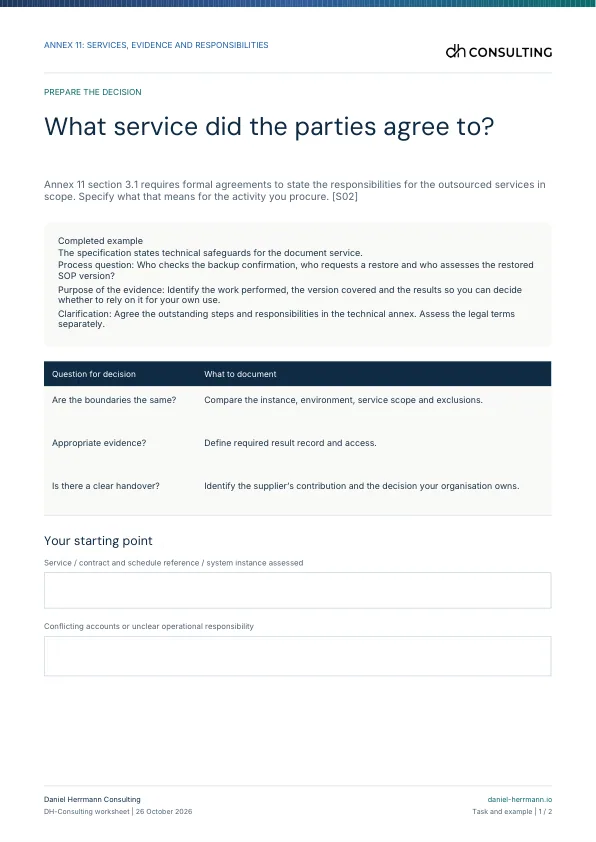
2 pages, A4, fillable PDF
Annex 11: services, evidence and responsibilities
Compare a GxP IT service against the existing agreement, required evidence and actual responsibilities.
QA, procurement, system owner and the contracts or legal team.
What’s included
- Page 1: What service did the parties agree to? Includes a worked example, questions for the decision and space to record your starting point.
- Page 2: Compare the service, deliverables, evidence and your responsibilities against the agreement. Record the open contractual question, owner, technical and legal reviews, date and next action. Includes sources and context.
Select one service. Check whether the main contract, service description and actual process deliver the same result. A list of questions about service boundaries, the purpose of evidence and unresolved responsibility at handover.
Compare the technical content of existing agreements. This worksheet is neither a legal contract template nor an opinion on the validity of individual clauses.
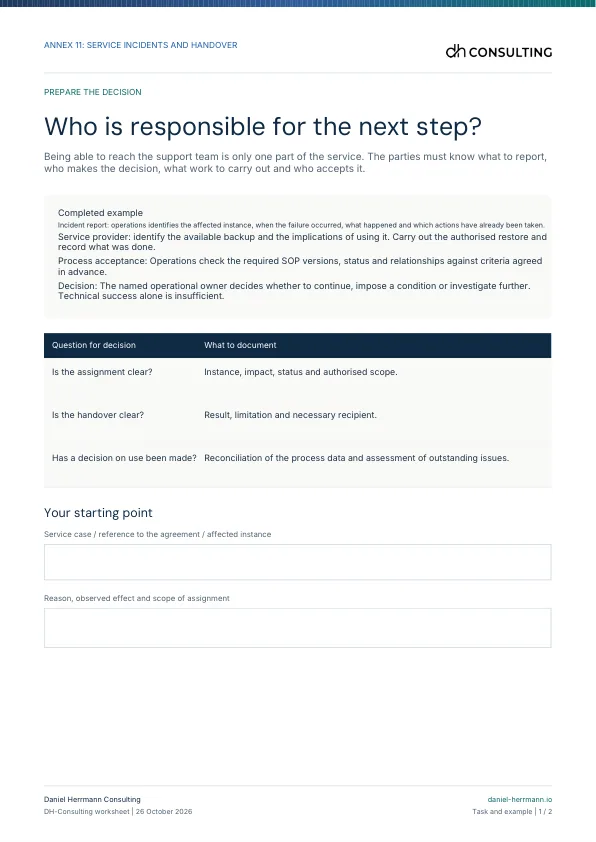
2 pages, A4, fillable PDF
Annex 11: service incidents and handover
Follow a service case from notification and assignment through technical work and operational acceptance to the decision to continue operations.
System owner, service provider, IT operations, process owner and QA.
What’s included
- Page 1: Who is responsible for the next step? Includes a worked example, questions for the decision and space to record your starting point.
- Page 2: Record the service notification, decision, work performed, handover and operational check. Document continuation or restrictions, decision-maker, date and follow-up. Includes sources and context.
Walk through a representative service case together. Agree the deliverables and handovers, then record the evidence from the actual case. A traceable service brief with the information, responsibilities and evidence needed to decide whether use can continue.
Test the handovers in a realistic service case. The worksheet does not prescribe contractual clauses or universal response times.
Two PDF worksheets
Request the worksheets for your team
Enter your name, company, work email and a phone number where we can reach you. We will call you briefly about your request and then email you the worksheets. A newsletter subscription is optional.
We have received your request.
We will call you briefly to discuss your request, then email you the worksheets personally.
Project experience and collaboration
Test contractual commitments against an operational scenario
With process owners and the IT provider, we work through a support or recovery case. What information must be available when, who provides it and who decides internally whether use may continue? Existing contract schedules may suffice where responsibilities and evidence fit together clearly. We address missing handovers or subcontractor rules directly. We help prepare business and technical requirements. Legal contract assessment and operational decision authority remain with the responsible parties.
Frequently asked questions about Supplier agreements
Do we always need a separate quality agreement as its own file?
Annex 11 Section 3.1 refers to formal agreements with clearly defined responsibilities; Chapter 7 Sections 7.1 and 7.14 require a written contract for outsourced GMP activities. This does not necessarily imply a specific file structure. The main agreement and its annexes may work together, provided that content, scope, and validity are unambiguous and no material contradictions exist.
Does Annex 11 § 3.1 apply only to cloud service providers?
No. The passage identifies various third-party services, including installation, configuration, integration, maintenance, and data processing. Crucially, the specific support provided for the relevant system must be assessed. Internal IT departments should also be considered analogously; the appropriate organizational agreement must be established.
Sources: [1]
Does a supplier assessment replace a contract?
Are supplier certificates for the purpose of verification worthless?
No. The benefit depends on the subject matter, scope, recency, and relevance to the intended use. Assess the actual coverage. Appropriate evidence can support internal decisions, while an inadequate scope leaves critical questions unanswered. A blanket coverage is equally incorrect as a blanket lack of effect.
What reporting deadline must be included in the agreement for equipment failures?
Annex 11 and Chapter 7 of EU GMP do not specify a general time limit for any IT disruption. Determine the required information and response pathway based on potential consequences and your process. Agreed timeframes must be practically feasible and cannot be justified by a purported general GMP deadline.
Do we need to receive all of the supplier’s raw material documentation?
Define the records and information required for control, investigation, and regulatory requirements. Not every internal document is automatically relevant. The scope and access format must adequately support the actual need for evidence; a summary may inadvertently omit critical details.
What must be clarified with subcontractors?
Which activities are delegated, what potential impacts may arise, and how assessment, authorization, and information dissemination occur. Chapter 7 explicitly addresses this chain of responsibility. A list of companies without performance linkage does not establish who influences which data and operational responsibilities.
Sources: [2]
Can the supplier, upon restoration, justify resuming GMP operations?
The provider can perform and confirm the restoration. The decision on the technical usability of the data and the continuation of the GMP operation remains within the responsibility of your company. In the case of outsourced GMP activities, the client remains responsible for their control and evaluates records and results (EU-GMP Chapters 7 No. 7.4 and 7.8). Determine which evidence the provider provides and who evaluates them internally; a technical finished report does not replace this evaluation.
Is a data export sufficient at the end of a contract?
How do we start with an existing standard contract?
Sources and review date
Source date: 07.10.2026. The relevant area here is human medicinal product GMP. EudraLex incorporates Annex 11 and Chapter 4 as of January 2011; the consulted draft from 2025 is not considered a current regulatory requirement. The completed examples and tables are internal guidance tools and do not constitute official template documents. Editorial update of 26 October 2026: The newly introduced decision section and its work matrix are independent methodological proposals. The previously mentioned source date remains distinct from this update.
- EU GMP Annex 11: Computerised SystemsRevision January 2011; Effective date 30.06.2011; Access date 07.10.2026. References: §§3.1–3.4, 7, 10–13, 16–17
- EU GMP Chapter 7: Outsourced ActivitiesRevision 1, in effect since 31.01.2013; accessed 07.10.2026. Reference sections: Principle; §§7.1–7.8, 7.11–7.17
- EU GMP Chapter 4: DocumentationRevision January 2011; Effective date 30.06.2011; Access date 07.10.2026. Citations: §§4.1, 4.10–4.12
- PIC/S PI 041-1: Good Practices for Data Management and IntegrityPI 041-1, 01.07.2021; Access date 07.10.2026. Citations: §9.1.10; §10.3, in particular 10.3.5–10.3.6
- European Commission: EudraLex Volume 4Status as of 07.10.2026: Human medicinal product section implements Annex 11 January 2011 and Chapter 4 January 2011; Access date 07.10.2026. Relevant provisions: Human medicines / Chapter 7 / Annex 11
- European Commission: Consultation 2025 on Chapter 4, Annex 11 and Annex 22Status as of 07.10.2026: closed; 07.07.–07.10.2025. Occurrences: details; revision of Annex 11; links explicitly marked as draft guidelines. Serves solely for status demarcation and is not considered an authoritative source of requirements.
Sources checked: .


Daniel Herrmann Consulting
Address the specific control and verification requirements
Daniel Herrmann Consulting supports you in adapting this procedure to your system portfolio, evaluating gaps, and preparing appropriate validation evidence. The scope and level of involvement are determined by your actual process.
- Cloud and SaaS validation →
Maintain the validated state of cloud and SaaS systems as suppliers issue new versions. We define the boundary between your responsibilities and the supplier’s and agree how each release will be assessed.