

Table of contents
At a glance
How do you prepare a team for questions about a GMP process?
Choose a real transaction within the inspection scope. Have the people who performed and reviewed it show the requirement, original record, action and resulting decision. Ask who can retrieve each record and how outstanding findings were assessed. Rehearse with evidence the team can actually produce. Prioritise any gaps by their impact.
- A regulatory inspection, an internal audit and a rehearsal have different purposes.
- The records should reflect the process staff actually follow.
- Open findings need traceable assessment and follow-up.
- External support can help you prepare. No consultant can guarantee the inspection outcome.
What should an inspection preparation engagement deliver first?
As the inspection approaches, define the first outcome you need. Does the team need to link existing evidence to questions more quickly, assess a known gap or agree who handles requests across departments? A specific brief gives external support a concrete task.
Suppose a manufacturing decision relies on a laboratory result. Each document exists, but the team needs to trace the original record, relevant system version, processing and documented use. Record what the team could demonstrate, which evidence remains outstanding and who will resolve each question. This overview shows the current state of preparation. It cannot retrospectively confirm a past event.
| Starting situation | First task | People and access needed |
|---|---|---|
| Individual records are available, but the links between them are unclear. | Trace a selected transaction through the original evidence and identify any links that remain unresolved | A process owner who knows the activity and can access the relevant records. |
| A known finding affects how the transaction can be explained. | Record the actual finding, potential impact and follow-up separately. | Owners for assessment, correction and the decision about the process. |
| Questions span several teams. | Practise routing, answering and tracking requests. | Available contacts and a common request log. |
A walkthrough should expose uncertainty. Keep missing evidence open. A rehearsed answer or prepared text cannot supply it. Identify the source and status of externally prepared summaries as well. Preparation cannot determine the authority’s decision or guarantee an inspection outcome.
Our worksheets “GMP inspection: tracing a process to original evidence” and “GMP inspection: responses and follow-up” support the preparation. A mock audit tests a justified sample in a rehearsal and produces its own findings report. If you need both services, agree separate roles and deliverables. We send the worksheets personally after a short call. The request form asks for your name, company, business email and telephone number.
What do we know about the reason for the inspection and its scope?
List the activities, products, sites and systems likely to come within scope. Where FDA has jurisdiction, identify the US requirements that actually apply. They are not automatically equivalent to EU GMP. FDA describes risk-based prioritisation of surveillance inspections and for-cause inspections. For EU inspections, consult the Union procedure “Conduct of inspections of pharmaceutical manufacturers or importers” (version 1, effective 1 January 2024, published 1 August 2024). Chapter 9 of the EU GMP Guide covers self-inspection and does not set out the sequence of a regulatory inspection.
Start with the actual communication from the authority. Identify the contacts, information requested and logistical arrangements. Record any uncertainty about scope and prioritise preparation by supported risk. For an FDA inspection, confirm the working language and how document requests will be handled. Agree who receives each request, brings in the right specialist and tracks what was supplied. Consider translation support against the actual documents and participants.
The German ZLG Aide-Mémoire 07121203 on supervision of computerised systems provides inspection questions and commentary linked to Annex 11. Use it to connect questions to your processes and evidence. It is an inspection aid. Completing it does not establish legal compliance, certify a system or replace decisions by the responsible staff.
Explain one transaction using its original records
Choose a quality decision based on a laboratory result processed in a computerised system. Trace the source, transfer, processing, relevant changes, review and use. Ask the person responsible to show the original records. The walkthrough reveals how technical and organisational controls work together.
Check the link to both the current system version and the version in use at the time. A current SOP may only partly explain an event that followed an older procedure. A completed test form without a system reference cannot show which use was tested.
Organise evidence by the questions it can answer
For each record, identify which question about the transaction it answers. The inspection context may require further topics. We developed the table for preparation.
FDA Compliance Program 7356.002, dated 16 September 2022, describes six systems for drug manufacturing inspections. They cover quality, facilities and equipment, materials, production, packaging and labelling, and laboratory controls. Its systems approach always includes the quality system. LIMS, MES and QMS data can span several systems. Trace the process across software boundaries. This program is directed at FDA staff. Establish the requirements that apply to your own operation separately.
Prioritise open issues by their potential effects. A formatting defect and an unexplained change to data may have very different consequences.
| Question | Starting evidence | Possible gap |
|---|---|---|
| What should the system do? | Justified intended use and requirements | A generic product description with no link to your use |
| What was tested? | Relevant records identifying the version and observed result | A draft test treated as an executed test |
| Who may take the action? | Assigned roles and actual access rights | The documented role does not match system access. |
| What changed? | Change assessment and affected evidence | A technical update with no assessment of its effect on the process |
| What went wrong? | Finding, investigation and assessment of the actions taken | Only a “closed” status with no explanation |
| Can the data still be retrieved? | Evidence of retrieval or restoration for the intended use | A backup confirmation does not demonstrate retrieval. |
Assess and address known gaps
Do not invent or backdate a test to fill a gap in historical evidence. Record the actual finding and assess its effect on previous and future use. Current investigations, corrections and additional controls may be needed. Choose their scope from the specific risk.
Separate immediate measures, work on the cause and the later assessment of effectiveness. Identify owners, justified deadlines and verifiable outcomes. Keep the true status of outstanding actions visible. External support should help resolve the issue and preserve an accurate history.
Prepare people to explain their own responsibilities
Identify knowledgeable contacts and deputies. Agree how requested records are found, checked and provided. The internal process should help staff supply complete, relevant information. It must never conceal relevant information or change an actual finding.
Practise with real questions. Who can explain a laboratory status, the technical transfer or the assessment of a deviation? People should explain their own responsibilities clearly and refer questions outside their knowledge to the appropriate colleague.
Example of a result discrepancy after an update
Suppose someone finds an incorrectly displayed result after a software update. Trace which functions changed, which tests were actually performed and which records may have been affected. Assemble the established sequence of events and the current investigation status.
Depending on the finding, begin with a focused data investigation or a broader review of the process and change. Distinguish established facts from assumptions still under investigation. The example predicts no particular regulatory response.
| Who responds? | Which evidence can the person show? | What can a reviewer establish? |
|---|---|---|
| System owner | Change request, system version and test result | Which version was in use at the time of the transaction? Which display was checked with that version? |
| Process team | Original record and displayed result for the same transaction | What was originally recorded and where does the display differ? |
| Quality assurance | Deviation assessment identifying affected transactions and open points | Which results have been assessed? Which decision still needs evidence? |
What is the difference between FDA observations and a final assessment?
FDA explains that Form 483 records inspection observations. It is not a final determination of compliance. FDA considers further information in its later assessment. A Form 483 is distinct from a Warning Letter and may not list every possible issue.
FDA generally refers to 15 US business days for a voluntary response to Form 483. Review the actual communication and arrange a timely technical assessment. The period does not apply universally to every regulatory response. Understand the wording of each observation, the facts and the planned actions. Involve the responsible specialists. A generic response without a suitable investigation cannot address the specific issue.
Sources: [2]
What should external preparation support deliver?
Define the systems, processes, records and way of working. Deliverables may include a traceable findings list, prioritised actions, targeted evidence review and clear routes for requests. For a separate mock audit, our guide covers auditor selection, sampling and reporting. Identify the limits of the engagement and any specialist input needed.
Distinguish assessment from remediation. A review report cannot itself resolve a technical or organisational deficiency. Agree who implements each action and how the outcome will be assessed. Replace aspirations such as “no findings” with verifiable criteria for the work you commission.
- Record the applicable regulatory scope and the reason for the inspection.
- Trace selected transactions through their original records.
- Keep incomplete evidence visible with its actual status.
- Prioritise actions by impact and assign an owner to each.
- Prepare staff to answer factual questions about their own work.
Worksheets for your team
Commission GMP inspection preparation
Prepare by linking a specific activity to retrievable original evidence and people who can explain it. Use the worksheets to organise the evidence trail and outstanding questions. They do not constitute an authority's report.
Request the worksheets for your team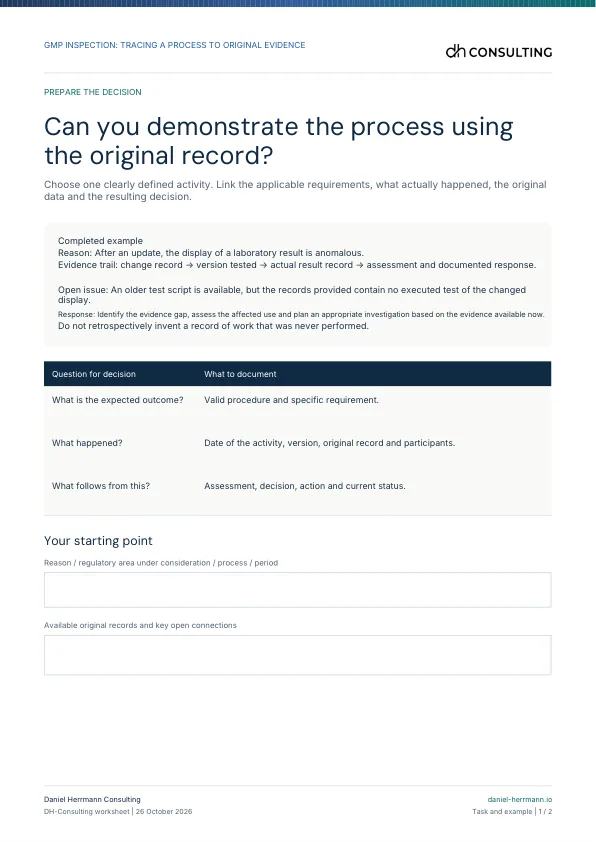
2 pages, A4, fillable PDF
GMP inspection: tracing a process to original evidence
Trace a selected GMP activity from the requirement through execution and the original record to the decision.
QA, inspection coordinator, process owner and system owner.
What’s included
- Page 1: Can you demonstrate the process using the original record? Includes a worked example, questions for the decision and space to record your starting point.
- Page 2: Trace your original evidence from the expected result and its source through execution, original records and assessment. Document the next action, owner, due date and current status. Sources and context.
Select an actual transaction. Follow the references to the original records and identify any information that is missing. An evidence trail with accessible original records, people who can explain them and visible gaps.
Organise the factual evidence. Then use the response worksheet to coordinate a specific question and its follow-up.
2 pages, A4, fillable PDF
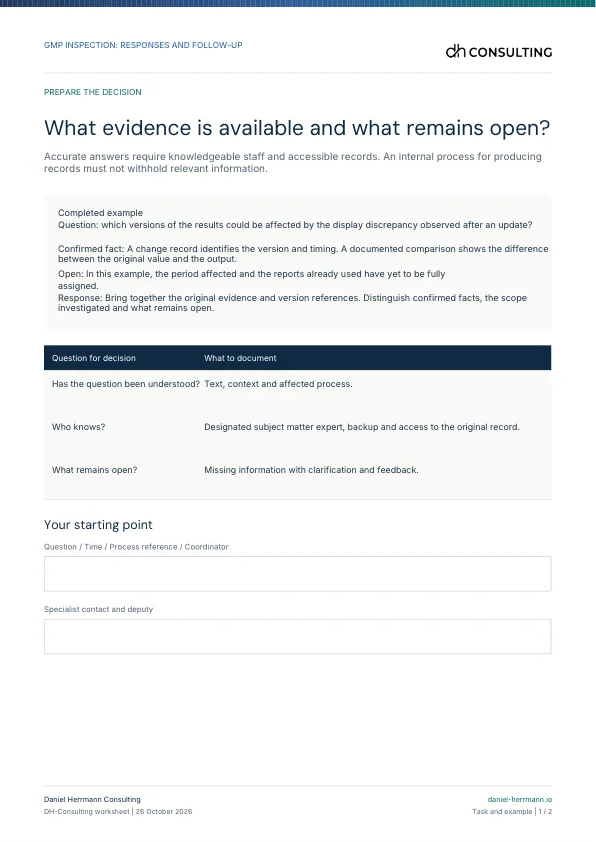
GMP inspection: responses and follow-up
Coordinate the answer to an inspection question using named roles, original evidence and outstanding points.
Inspection coordinator, QA, knowledgeable staff member and deputy.
What’s included
- Page 1: What evidence is available and what remains open? Includes a worked example, questions for the decision and space to record your starting point.
- Page 2: Record confirmed facts, scope of the response, outstanding question and follow-up. Confirm the response note, date and remaining open item. Includes sources and context.
Record the question asked. Identify which parts can be answered, the original evidence and outstanding questions. Preserve the facts and findings. A traceable response note with confirmed facts, outstanding questions and a named owner for the reply.
Helps coordinate the response to a specific question and any follow-up. The worksheet neither predicts an inspector's decision nor approves a prepared answer.
Two PDF worksheets
Request the worksheets for your team
Enter your name, company, work email and a phone number where we can reach you. We will call you briefly about your request and then email you the worksheets. A newsletter subscription is optional.
We have received your request.
We will call you briefly to discuss your request, then email you the worksheets personally.
Project experience and collaboration
Prepare for inspection using actual records
We start with selected activities and their original records. Your team explains the workflow, and together we check whether the records support the decisions made and identify the system versions involved. We prioritise unanswered questions by their importance and practise how staff would respond to a request. An announced inspection requires different priorities from an early rehearsal without a fixed inspection date.
Questions about preparing for GMP and FDA inspections
Is an FDA inspection the same as a GMP audit?
Must every open issue be closed before the inspection?
Can we document historical tests that are missing?
What is an FDA Form 483?
It records certain observations made at the end of an FDA inspection. It is not a final regulatory decision and does not automatically lead to a Warning Letter. Review the actual communication and follow-up with the people responsible.
Sources: [2]
Can a consultant guarantee a successful inspection?
No. Preparation can help your team explain and address real questions. The outcome depends on the actual state of the operation, the matters examined and the authority's assessment. Agree deliverables you can verify.
Where should we start if little time remains?
Identify the reason for the inspection, affected processes and known critical findings. Confirm access to knowledgeable staff and key original records. Use this information to set the order of work.
Sources and review date
Primary sources were checked on 17 October 2026. The EU GMP texts and FDA information have different scopes. We developed the table and system-update example as preparation tools. The focus is systems and data for human medicinal products. Other product classes and authorities may require different preparation. On 26 October 2026 we added the decision section and its working matrix as our own methodological suggestions.
- ZLG, Aide-Mémoire 07121203 on supervision of computerised systems, reviewed 31 August 2022
- FDA, Pharmaceutical Inspections and ComplianceFDA's information on inspection and assessment in human pharmaceuticals. Form 483 is not a final regulatory decision.
- European Commission and EMA, Conduct of inspections of pharmaceutical manufacturers or importersVersion 1, effective 1 January 2024 and published 1 August 2024. Describes regulatory inspections as distinct from self-inspection.
- European Commission, EU GMP Annex 11: Computerised Systems, January 2011 revisionHuman medicinal products GMP. Sections 1–4, 7, 10–13 and 16–17 are particularly relevant, depending on the activity.
- European Commission, EU GMP Chapter 4: Documentation, January 2011 revisionControlled documentation and records. The EudraLex entry links to the original chapter.
- FDA, Data Integrity and Compliance With Drug CGMP: Questions and Answers, December 2018Data integrity under drug CGMP. Current tests must not be presented as historical evidence.
- European Commission, EU GMP Chapter 1: Pharmaceutical Quality SystemQuality management, responsibilities, assessment of causes, CAPA and change control. The chapter does not set project prices.
- FDA, Compliance Program 7356.002: Drug Manufacturing InspectionsProgram edition dated 16 September 2022 and implemented on 17 October 2022. FDA's program directory links to this systems approach for agency staff.
- European Commission, EU GMP Chapter 2: Personnel, effective 16 February 2014Personnel, role-specific training and assessment of practical effectiveness. The EudraLex entry links to the original chapter.
- European Commission, EU GMP Chapter 7: Outsourced ActivitiesOutsourced GMP activities, suitability, responsibilities, agreements and oversight.
- ICH Q9(R1), Quality Risk Management, official text hosted by the European CommissionRisk-based decisions, appropriate formality and management of subjectivity. The matrices in this article are our examples of practical application.
Sources checked: .


Daniel Herrmann Consulting
Discuss the inspection scope, systems and open findings
Bring the inspection communication, a system overview and the open issues you already know about. Together we can define a preparation task that connects the questions to the evidence available.
- Audit and inspection preparation →
Go into an audit or inspection with accessible evidence and a prepared team. We begin with a walkthrough, rank open issues by risk and rehearse the inspection with your team.