

Table of contents
At a glance
How do you assess a GxP software supplier?
Define what the supplier delivers, the intended use and the boundary of responsibilities. Identify the evidence needed for development, the supplied version, implementation and ongoing service. Assess available information and unresolved issues in proportion to criticality. Record why additional testing or an audit is needed, the accepted scope of use, responsibilities and triggers for reassessment.
- Software vendors, implementation partners, and operational service providers may require different forms of validation evidence.
- A certificate responds only to questions within the scope of its actual validity.
- Supplier records may be utilized; the suitability of internal use remains to be assessed.
- Support, changes, and data release prior to selection to be specifically agreed.
First define the performance criteria, then assess the supplier.
"Software supplier" may refer to the manufacturer of a standard product, a configuration partner, or an operator with access to your data. Multiple organizations may be involved. Document clearly who is responsible for development, installation, configuration, integration, updates, and operation. Strong evidence of one of these responsibilities does not automatically imply responsibility for the others.
The article concerns computerised processes in GMP manufacturing of human medicines. Annex 11 explicitly addresses software and service suppliers. Chapter 7 may also apply to outsourced GMP activities. Material suppliers, medical devices and clinical trials have additional or different requirements. Assess those audit provisions before applying them to a software purchase.
Furthermore, separate the quality system evaluation of the provider from the validation of your intended use. A controlled development process creates confidence in the delivery. It does not yet prove that your release rule has been properly configured. Likewise, qualified infrastructure alone does not prove a technically suitable application. The supplier evaluation therefore follows a comprehensible assignment to your requirements.
For your own evaluation, the support documents "Software Supplier: Assessing and Accepting Evidence" and "Software Supplier: Determining Audit Needs and Outstanding Items" are available. The first document specifies which statement constitutes valid evidence of your usage. The second document progresses from remaining uncertainties to a justified next audit action. These are internal decision guidelines, not prescribed audit forms. You can request the documents via the form containing four mandatory fields; we will briefly confirm the need by telephone and send the documents to you personally.
Deriving the test depth from application and intervention possibilities
Evaluate not only the product name or company size. Key factors include affected decisions, data, impact of outages, and potential for intervention. A support service with administrative access may be more critical to data integrity than a supplier without access to the live system.
Consider what can be identified and controlled directly. A silent error in an automated result import requires different validation evidence compared to a function whose output is fully verified against a reliable source. Unclear architecture or ambiguous ownership is treated as an open question, not a low-risk issue.
The following matrix is an internal working aid. It does not assign any specific audit obligations and does not assign universal supplier classes.
| Deliverable | Key Question | Targeted required evidence |
|---|---|---|
| Quality-relevant data management software | How are relevant functions developed, validated, and released? | Versioned specification, test evidence, release, and handling of errors. |
| Customer-specific configuration or interface | Who implements your requirements and controls changes? | Configuration status, mapping, requirement-based validations, and handover. |
| Cloud operation and data security | Who protects data and ensures its recovery during system failures? | Responsibility model, backup/restore records, and failure handling process. |
| Maintenance with privileged access | How are interventions authorized and traceable? | Access procedures, intervention logs, and escalation procedures for unexpected outcomes. |
| Archival or exit performance | Must required records remain retrievable for an extended period? | Deliverable formats, scope, metadata linkage, and verifiable transfer criteria. |
Evaluate SDLC evidence based on a specific release
The Software Development Lifecycle (SDLC) describes the development lifecycle. For evaluation, an actual, completed case is often more informative than a lengthy list of well-intentioned plans. Please request a clear linkage between requirement, implementation, testing, defect resolution, and release for any relevant change.
This does not need to include the full source code for every supplier. Depending on the risk, approved procedure excerpts, anonymized example datasets, summary test reports, or limited access under confidentiality agreements may be appropriate. Assess whether the evidence directly addresses the specific question. An internal guideline for evaluation is not equivalent to proof of its actual application.
Please inquire about known errors and their impact on the current released state. Of particular interest is how a calculation error was isolated, which versions were affected, and how customers were notified. Simply stating that a ticketing system exists does not explain this process.
Assign unique identifiers to version numbers and product components. When multiple components are present, a test package may be suitable for the platform, while a customer-specific add-on module may be missing. Document this boundary, rather than deriving a general release of all components from a single development standard.
Verify supplier packages against their actual scope
A supplier package may cover standard functions, a specific installation, or even agreed customer-specific workflows. The content is decisive. Review version, configuration, test environment, executed steps, results, and evaluated deviations. The terms IQ, OQ, or PQ alone do not address these questions.
Align the documentation to user requirements. A generic interface test, for example, may cover the transfer protocol, while the mapping of your material numbers remains open. If the supplier has specifically verified this mapping against the agreed cases and the evidence is credible, the performance does not need to be revalidated solely because the evaluation was conducted externally.
Evaluate also pre-assumed customer actions. A test may only be valid for a specific role model or a particular database configuration. Document such conditions during handover. A supplier report showing only a green overall status may require additional clarification before it can meet a risk-relevant requirement.
A specific acceptance decision may begin on a small scale. In the following example, a role review for version 4.3 is to be accepted. The internal requirement prohibits an operator from approving their own process. The supplier provides a previously conducted test from version 4.2. This establishes that the review conducted in the past has been completed; however, coverage for version 4.3 and the implemented roles remains to be clarified.
The question for an audit arises from remaining uncertainty. If only the version reference is missing, a traceable amendment to the release package can address the question. If the origin, release, or reliability of the documents is overall unclear, a different evaluation is required. Therefore, note which information is missing and what action is intended to provide it. An open table row alone neither confirms nor excludes the need for an audit.
| Current Status | Open assignment | Next decision |
|---|---|---|
| Test report for version 4.2 | Affected role function in 4.3 unchanged? | Assess the targeted change information and validity of the voucher for the new site. |
| Test result matches the version but not the customer role. | Does the block work with the configured permission profile? | Compare own configuration and verify remaining questions appropriately. |
| Only a test draft, no results | Was the planned check actually performed? | Request an execution certificate; do not accept a plan as a completed test. |
| Performed test including error scenario | Are identical requirements and prerequisites logically traceable? | Record the coverage and the rationale for accepting the evidence. Plan additional work for the remaining gap. |
Sources: [2]
When documentation is sufficient and when an audit is justified
Annex 11 requires a risk-based determination of the need for an audit. This does not imply a full on-site audit for every supplier nor a general waiver for known brands. Begin by asking: what specific uncertainty is actually addressed by the audit?
For a certificate, verify the issuer, validity, registered organization, activities, and locations. ISO distinguishes between certification and accreditation; a logo alone does not establish the status. A management system certificate and a report on a single technical service can both be useful, but they address different questions. Neither is automatically evidence of your application validation.
A targeted remote audit may enable verification of a batch release process. If the required records are not accessible or if key information remains inconsistent, a presentation may be insufficient. In such cases, define additional inspection, a more appropriate audit approach, or an alternative procurement decision. An external audit report must also be evaluated based on scope, recency, competence of the auditors, and remaining limitations.
Define responsibilities prior to contract signing
Agreements should align with the actual services delivered. A general reference to "GMP-compliant operation" leaves open questions regarding who evaluates deviations, what information is available, and who authorizes changes. Therefore, work with clearly defined responsibilities and specifically named points of contact.
For your process, the following points may be critical: reporting of relevant changes and deviations, access to appropriate documentation, participation in investigations, vendor interventions, data backup and recovery, and data access at contract end. Align the contents with Purchasing, QA, IT, and the respective contract responsible parties.
Do not accept time specifications without verification from a sales label. Clarify whether a reaction time refers solely to the acknowledgment of a request or to the actual resumption of your process. If the supplier provides a specific release procedure, incorporate it. The contract, service description, and actually implemented process must be consistent; not all critical information is exclusively contained in the contract.
Service chain, support, and data exit to be evaluated together
Please explain the relevant chain of responsibility: Who operates the application, who manages the infrastructure, who handles security controls, and who has access to content? A list of known cloud providers is insufficient when responsibility boundaries remain unclear. For outsourced GMP activities, Chapter 7 outlines requirements for the evaluation and agreement with additional subcontractors.
This does not automatically call for an on-site audit of every data centre provider involved. Check which evidence and contractual controls your direct supplier offers. Keep unresolved dependencies visible in the decision. A data protection agreement does not by itself answer every question about quality-related records.
Plan the data exit from the outset during system selection. Request a representative export or a clear, traceable description of scope and format. Key considerations include, in addition to files, versions, relationships, signature information, and histories. Verify whether the data can be understood without a permanent subscription and determine any agreed-upon support or additional costs for handover.
In addition for ongoing operations, it is important how access is terminated, emergency interventions are documented, and disruptions are communicated. A backup service is only justified when responsibility and evidence for restoration are clearly defined.
Example: Cloud-QMS plus implementation partner
Assume a small pharmaceutical company wishes to implement a cloud-based QMS for Standard Operating Procedures (SOPs), training, and deviations. The software vendor provides a release package; a separate partner takes over legacy documents and configures user roles. The infrastructure is operated by a third-party service provider.
The assessment is divided into three performance components. For the software, release and functionality documentation are relevant. For the partner, mapping, configuration, and handover are key. For operations, access, recovery, and service provider responsibility are considered. A strong cloud provider certificate does not address migration concerns.
The following decision note illustrates how specific findings can lead to actions. The stated conditions apply only to this example. In particular, an open line does not constitute automatic authorization to commence production under any circumstances.
| Finding | Significance for the intended use | Next test result or decision |
|---|---|---|
| The release package matches the version offered. | Existing functional evidence can be assigned. | Compare customer requirements and configuration conditions. |
| The migration partner provides only a demo. | Historical version retention has not been substantiated. | Perform representative trial run with origin, version and acceptance. |
| Support may have privileged access. | Interventions can affect quality-related data. | Evaluate authorisation and traceable intervention logs. |
| Restoration is only referenced as a service. | Practical rework remains unclear. | Clarify appropriate documentation and customer-specific responsibilities. |
| The export contains only current PDF files. | Historical relationships might be missing. | Compare required documentation scope; do not assume suitability. |
| Major open issues remain unaddressed. | The intended use has not yet been justified as supportable. | Select or scope adjustment; no blanket release based on point total. |
Scope of release and reasons for re-evaluation to be documented
Document the specific deliverable and intended use for which the assessment applies. A supplier may be appropriate for a standard software delivery, while a new operating service must be evaluated separately. Therefore, avoid a perpetual release "for all" that could later be used as a substitute for any additional evaluations.
Reasons for a reassessment may include relevant version or architecture changes, new functionalities, changed subcontractors, repeated support issues, or a failed restoration. Additionally, internal usage patterns may shift: a previously incidental report may suddenly become the basis for a GMP decision.
Plan a proportionate monitoring approach and assess outstanding actions for completion and effectiveness. The intensity should be based on performance, risk, and experience; a universal annual full audit cannot be justified thereby. In the face of significant new findings, do not await an arbitrarily selected calendar date.
Checklist for Joint Selection Decision
A sound evaluation concludes with a justified decision, not with an excessively lengthy document request. Use the following checklist for the discussion between QA, IT, Procurement, and process responsibility holders. Missing information will be visibly assigned; it will not be counted as met.
- Deliverable, relevant version, and actually engaged company are clearly defined.
- GMP usage, data, and critical decisions are described.
- The required testing depth and most significant uncertainties are justified.
- Development and release records are consistent with the components under consideration.
- Supplier package, customer requirements, and remaining tests are assigned.
- Certificates and audit reports are evaluated based on scope and currency.
- Support access, malfunctions and changes have regulated responsibilities.
- Relevant third-party service providers and their control documentation have been considered.
- Data release, storage, and recovery are practically resolved.
- Scope of release, open conditions, and reasons for reevaluation are documented.
Worksheets for your team
Assess software suppliers and decide which evidence to accept
Which supplier evidence can you use, and which questions need further investigation? Assess specific evidence against the software version in use, then decide separately whether an audit is needed.
Request the worksheets for your team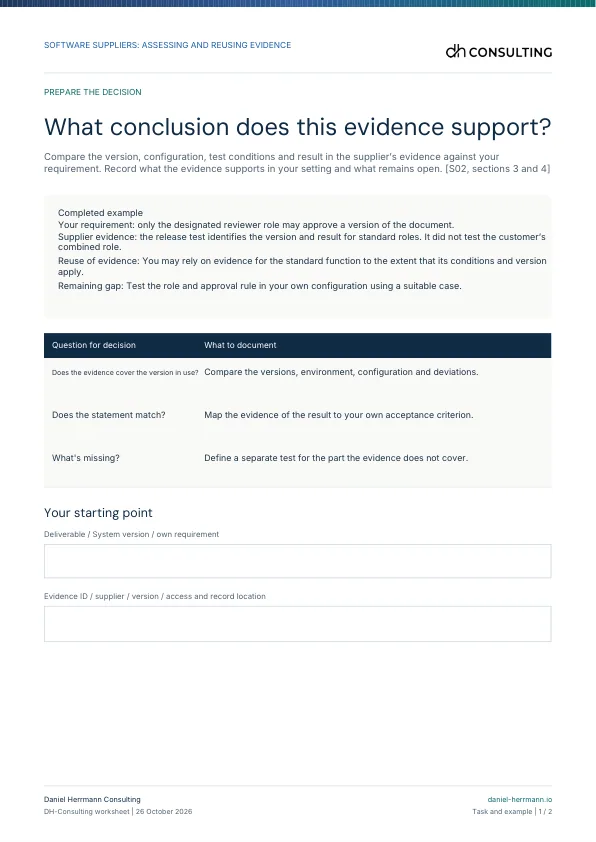
2 pages, A4, fillable PDF
Software suppliers: assessing and reusing evidence
Assess whether specific supplier evidence applies to your requirement and version.
QA, IT quality, system owner and technical reviewer.
What’s included
- Page 1: What conclusion does this evidence support? Includes a worked example, questions for the decision and space to record your starting point.
- Page 2: Assess the supplier evidence, its applicability, the criteria covered and the remaining gaps. Record your decision. Sources and context.
Select an actual evidence item and a specific requirement. Check context and result, then plan your remaining tests. A justified decision on accepting supplier evidence, with its exact reference and any remaining gap.
Assess one item of evidence. Use the second worksheet to decide whether unresolved questions about supplier performance warrant an audit.
2 pages, A4, fillable PDF
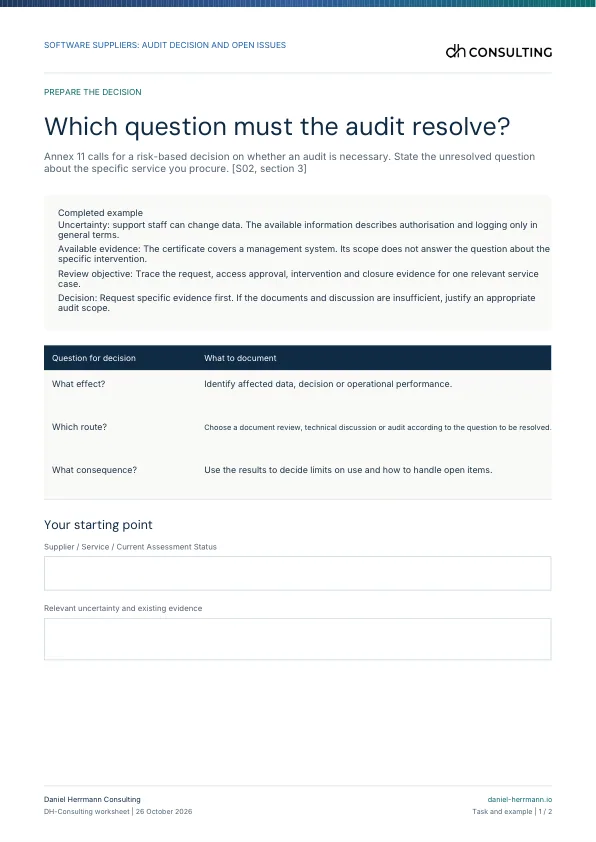
Software suppliers: audit decision and open issues
Use outstanding questions about the software supplier to decide whether a targeted audit is needed.
QA, procurement, IT and the supplier assessment owner.
What’s included
- Page 1: Which question must the audit resolve? Includes a worked example, questions for the decision and space to record your starting point.
- Page 2: State the question, chosen assessment and audit scope if needed. Record the result, open item, use restrictions, action, owner, deadline, decision-maker, date and reassessment trigger. Includes sources and context.
Describe the uncertainty and available evidence. Choose an assessment that can answer the question. A reasoned choice of document review, discussion, targeted audit or other assessment, with follow-up actions.
Identify outstanding supplier questions. The worksheet neither accepts test evidence nor requires an audit based solely on a risk rating.
Two PDF worksheets
Request the worksheets for your team
Enter your name, company, work email and a phone number where we can reach you. We will call you briefly about your request and then email you the worksheets. A newsletter subscription is optional.
We have received your request.
We will call you briefly to discuss your request, then email you the worksheets personally.
Project experience and collaboration
Assess the supplier against the actual scope of supply
With your team, we compare the supplier proposal and delivery documents against the application you need. What does the supplier do during development, setup and operation, and which records demonstrate it? A relevant executed test package may already answer open questions. Significant uncertainty over an important function or service may require supplier questions, additional evidence or a more detailed assessment. We record the evidence that can be relied on and its limits. A quality seal or general presentation does not establish suitability for your use.
Frequently asked questions about Assessing software suppliers
Do we need to conduct on-site audits of every software supplier?
No. Annex 11 bases the need for an audit on risk assessment. Identify the uncertainty remaining about the actual service. Reliable existing evidence may suffice, while unresolved critical questions may require further assessment. Justify the scope and method. Requirements for audits of active pharmaceutical ingredient manufacturers do not automatically apply to a software supplier.
Sources: [2]
Does an ISO certificate suffice for supplier release?
A certificate is a potential component. Verify its validity, issuer, and scope of application, as well as the actual organization and performance. The certificate does not automatically address questions regarding your version, configuration, or data migration. Supplement with appropriate evidence for the intended use. A recognized logo is neither a comprehensive supplier assessment nor proof of customer-specific validation.
Which SDLC documents should we request?
Start with risk-relevant questions: requirements control, version control, testing, defect management, and release decision. Please provide evidence demonstrating the actual application of the described process. Depending on the risk, approved excerpts or controlled access may be appropriate. A complete copy of any internal document or the entire source code is not a universal objective of the evaluation.
Can a manufacturer's package replace our own tests?
It may provide appropriate validation evidence and thus avoid redundancies. Verify actual coverage, including version, configuration, and customer workflows. A comprehensive package must not be reduced to generic standard tests. Unaddressed requirements shall be supported by alternative robust validation evidence. Critical is a traceable assignment, not the question of whether the test was performed internally or externally.
Sources: [2]
Must we treat implementation partners and manufacturers separately?
When different performances are delivered, these performances should be evaluated separately. The manufacturer can provide evidence of a product function, while the partner implements the mapping or role model. Assess the respective responsibilities and handover documentation. A joint evaluation is possible, provided that these boundaries remain clearly visible and no critical tasks remain unresolved between the parties.
What do we do when the supplier does not provide confidential documentation?
First, clarify exactly what information is required and why. A confidential information access agreement, a relevant audit report, or a limited data excerpt may be appropriate. Assess whether the specific uncertainty is adequately addressed. If critical questions remain unanswered, this must influence the selection or scope of access; a completed marketing questionnaire does not close the gap.
Who is responsible for cloud sub-service providers?
The responsibilities of the parties must be clearly defined within the actual performance chain. For outsourced GMP activities, Chapter 7 outlines the evaluation and agreement of additional subcontractors. Assess how your direct supplier controls their services and provides relevant information. This does not automatically require conducting a on-site audit of every infrastructure provider. However, the key dependencies relevant to your operation must not remain unknown.
What points should be clarified prior to contract signing?
Above all, scope of responsibilities, access rights, relevant changes, disruptions, traceability of data, and data release. Align response and restart objectives with actual process requirements. Incorporate published supplier processes and assess their validity for your service. General compliance commitments are insufficient when, during a specific disruption, no one provides data, point of contact, or appropriate documentation.
How frequently must we re-evaluate an already approved supplier?
There is no uniform, meaningful monitoring interval applicable to all software suppliers. Establish a reasonable monitoring schedule and consider relevant changes and lessons learned. New operational capabilities, altered service chains, or critical outages may trigger an earlier assessment. A stable, well-documented performance does not require the same level of review simply due to a calendar-based trigger as a fundamentally redesigned architecture.
How does a small company prevent an overloaded supplier assessment?
Begin with the few key decisions that actually drive the intended use. Assign appropriate evidence and a responsible party to each significant question. Leverage existing qualified evidence, consolidate queries, and justify additional inspections. Avoid document collections without a defined evaluation purpose. Critical gaps must not be masked by a high overall score or a general management signature.
Sources and review date
Authority and guidance sources were made available on October 6, 2026. The focus is on software and service provider evaluation for human medicinal product GMP. Chapter 7 refers to actual outsourced GMP activities. Tables, examples, and checklists are standalone reference tools, not completed audits.
- European Commission: EudraLex Volume 4 – EU Guidelines for Good Manufacturing Practice
- European Commission: EU GMP Annex 11 – Computerised Systems
- European Commission: EU GMP Chapter 7 – Outsourced Activities
- ICH Q9(R1): Quality Risk Management – FDA Final Guidance
- PIC/S PI 041-1: Good Practices for Data Management and Integrity in Regulated GMP/GDP Environments
- European Commission: EU GMP Chapter 4 – Documentation
- ISO: Certification
Sources checked: .


Daniel Herrmann Consulting
Align supplier documentation with actual end-use application
Daniel Herrmann Consulting supports QA, IT, and procurement in defining required evidence, categorizing existing documentation, and systematically addressing open questions prior to implementation or expansion.
- Cloud and SaaS validation →
Maintain the validated state of cloud and SaaS systems as suppliers issue new versions. We define the boundary between your responsibilities and the supplier’s and agree how each release will be assessed.