

Table of contents
At a glance
Which maintenance management systems offer CSV documentation and validation support?
The suppliers of eMaint CMMS, GxPReady Suite and osapiens HUB for Maintenance publicly describe validation support. This guide covers those three examples. Ask each supplier which documents are included for the version and services offered. Test each computerised maintenance management system (CMMS) against the same maintenance, calibration and status cases. Daniel Herrmann Consulting can help assess supplier evidence against your requirements and identify remaining tests for your computer system validation (CSV) project.
- Allow the authorized role in example case D03 to correct the reading from +0.35 °C to +0.53 °C. Verify whether the usage restriction remains in place.
- Compare for each supplier the offered system version, the demonstrated functionality, and the associated documentation.
- Conduct five identical demo test cases and document open items with responsibility and deadline.
When does a CMMS impact a GMP decision?
A CMMS manages equipment, maintenance tasks, due dates, and potentially calibration activities. Prior to selection, document the actual workflow. Where is the equipment ID assigned? Who evaluates the calibration result? Which system or procedure determines whether the device may continue to be used? Document the record that supports this decision and identify the interfaces affected.
The regulatory framework for this guide is the EU-GMP-regulated manufacture of human medicinal products. Chapter 3 of the EU-GMP Guide addresses, among other aspects, the maintenance and calibration of measuring, weighing, recording, and control equipment. Annex 11 covers computerised systems used in GMP-regulated activities. Derive the audit requirements from the specific use and its impact. A simple schedule planner and a system whose equipment status controls quality-relevant operations have distinct validation and evidence requirements.
Comparison matrix for maintenance software in pharma
Define the mandatory criteria and expected behavior jointly with maintenance, IT, and QA prior to demonstrations. Use the same example data for each vendor. Capture version, module, operating mode, and deviations from the offered configuration. For each criterion, document evidence, status, and if applicable, any remaining actions.
Use the status "assigned", "partially assigned", "open", "not met", and "not applicable". Justify why a criterion falls outside the scope of your application. Evaluate the demonstration against the agreed target in D01 to D05 and retain the assignment reference. Assign supplier documentation separately by criterion, version, and open task.
Capture costs in parallel. Compare offers without unmet mandatory criteria on the same cost basis. A partially supported or open mandatory requirement must be substantiated with evidence or a documented, accepted alternative whose effectiveness for the intended use has been verified. An unmet mandatory requirement excludes the offer to the extent concerned.
On narrow screens, you can drag the comparison table sideways.
| Criterion | Show or have delivered by the provider | To clarify the selection |
|---|---|---|
| Equipment and calibration | Unique device identification, interval, expiry date, test result, and associated evidence. | For which equipment do the rules apply? How are legacy data and master records transferred? |
| Usage status and deviation | Show overdue application and findings outside tolerance with roles, escalation and feedback. | Where is the decision made regarding usage? Who is authorized to change a status according to which rule? |
| Correction, Release Authority and Access | Test the correction and release using the intended roles. Show the change history and, if applicable, the signature reference. | Who is authorized to correct a finding or lift a usage restriction? How is the decision justifiable and traceable? |
| Interfaces and restart | Delay and repeat status update. Perform reconciliation between CMMS and target system including error path display. | Who identifies and addresses a deprecated or inconsistent device status? |
| Data access, export, and recovery | Export the equipment history with its work order, finding, release and attachments. Request separate evidence of successful recovery. | Are the required information for the intended duration accessible, readable, and mutually linked? |
| Validation support | Template for version status, test case, required versus actual, results, finding, and coverage to be provided. | Which documentation meets your requirements, which is available under contractual agreement, and which assessments remain pending? |
| Operation and Scope of Agreement | Explain responsibilities, test access, release information, support pathway, and data transfer. | What services are included? What are the costs for add-on modules, migration, testing, updates, and subsequent handover? |
Example of a vendor selection decision. Vendor A demonstrates that a status is correctly tracked following a system interface failure. Vendor B only shows the normal operating procedure and offers fault handling as an additional service. If process restart is a mandatory requirement for your process, Vendor B remains open until verified through a confirmed follow-up review. The next step is to schedule a meeting for D04 and confirm the documentation to be presented.
Which CMMS vendors provide validation support?
The table shows three examples of publicly described validation support. They are alphabetically ordered. The information is provided by the manufacturers. Please inquire with each supplier regarding the scope of services for your site and the version offered.
| Example | Public manufacturer statement | Specific inquiries |
|---|---|---|
| eMaint CMMS | Fluke Reliability describes a service for CSV and revalidation of eMaint. | What deliverables and version changes does the service cover? What documentation can your team access? |
| GxPReady Suite | GxPReady describes support with IQ/OQ documentation included in the handover package. | Which modules and settings are covered by the package? What documentation is provided for the configured state? |
| osapiens HUB for Maintenance | osapiens provides support for qualification and validation in the pharmaceutical industry. | What specific services, documents, and tasks during implementation are included in the concrete offer? |
Apply the same mandatory criteria and demonstration cases to each offer. Accept a supplier's statement as a selection justification only when you can verify its scope and alignment to the proposed state.
Five demonstration test cases for supplier comparison
Ask the provider to perform the processes in a test system. Use synthetic data, such as the device KAL-017, the maintenance order WO-042 and the roles maintenance, QA and production. Write down system status, time zone, relevant settings and the expected response before the appointment. In a proposed manual control, the provider should show the transfer and verifiable evidence for this.
The following expected results illustrate an example case for selection. Adjust limits, status rules, and procedures according to your specific application. Whether a technical lock is required or an alternative effective procedure is appropriate is determined by technical expertise and risk assessment.
| Test case | Action in the demo | Expected observation and documentation |
|---|---|---|
| D01 · Due date | Set the test duration to Demo Start plus 20 minutes (Europe/Berlin) or use a pre-demonstrated time simulation in the test environment. Verify the status before, at, and after the boundary within the agreed time resolution. | Maintain fixed deadlines, time resolution, and evaluation intervals. Verify when the rule actually becomes effective and how it applies at the site of use. If the behavior cannot be demonstrated during the demo, the case remains open. |
| D02 · Outside of tolerance | For a representative acceptable deviation of ±0.20 °C, record a reading of +0.35 °C. Close the task and re-initiate the device for use. | Find and escalation remain visible. The agreed usage restriction applies until the anticipated evaluation. Evaluation assignment, prior device usage, and status are documented. |
| D03 · Correction and release authority | Production is attempting to alter the result. Both production and maintenance are attempting to lift the restriction. The authorized role corrects the temperature misreading from +0.35 °C to +0.53 °C, with justification. | Unauthorized actions fail. Both values lie outside the tolerance, the restriction remains in effect. User roles cannot modify the system-wide record regarding value change, person, timestamp, and reason. If applicable, verify the signature reference. |
| D04 · Interface Failure | Interrupt the transmission of the locked device status message together with message MSG-0042. Transmit the same message twice and compare the states of both systems. | Errors and repetitions remain detectable. The target status aligns with the agreed-upon rule, and repetition in the example does not carry a dual impact on the process. Comparison and local response confirm. |
| D05 · Release and Export | Following D04, the QA responsibility assigned in the example documents the assessment BEW-017 after a re-calibration with a deviation of +0.05 °C and releases the calibration record KAL-017 for use. Subsequently, update the device identifier and export WO-042 including result, appendix, assessment, and history. | Release is assigned to the authorized role and BEW-017. Device identity, historical context, and relationships remain readable. Document the version reference and request a separate test certificate for restoration. |
Which decision comes next in your CMMS selection? Tell Daniel how you intend to use the system. A short description is enough.
Ask about CMMS selectionWhich CSV documentation should you request?
Please request an example of a black box test case that consolidates requirements, verified version, configuration, test step, expected and observed results. Demonstrate how open test findings are addressed and which modules are captured in the evidence. Clarify prior to contract signing whether you will have access to the documents, be able to reference them for your project, and receive updated versions upon configuration changes.
Annex 11 No. 3.1 identifies formal agreements and clear responsibilities for third-party parties involved. No. 3.2 links the decision to conduct a supplier audit to a risk assessment. No. 3.3 requires evaluation of commercially available standard software documentation against the requirements of the regulated user. According to No. .3.4, quality and audit information related to suppliers or developers shall be available upon request to inspectors. GAMP 5, as an industry guidance document, describes a risk-based approach to the use of appropriate supplier documentation.
Assign each record to your own requirements. If a manufacturer audit reveals standard functions, verify which statement applies to your configuration. Typical open items include roles, local limits, data transfer, or device status transfer to another system. For each gap, document who is responsible, by when it will be closed, and which record your team expects.
Supplier comparison and demo protocol for your team
In the fillable supplier comparison, you maintain side-by-side information from multiple suppliers. You document which version, modules, and services a statement refers to, and identify where evidence is still missing for mandatory criteria. This establishes a common foundation for procurement, maintenance, and QA.
With the demo review protocol, each supplier is assigned the same task. Enter the expected behavior, observed result, and documentation reference. Open questions can then be converted into specific follow-up requests with assigned responsibility and deadline. Both PDFs can be requested jointly through the form.
Specific system items for preparation
Use the system modules to formulate more precise questions for your demo. In SAP PM, a maintenance task may be linked to a subsequent usage decision. For GxPReady Suite and Blue Mountain RAM, calibration and device history are key features. Review each question against the available modules and your intended workflow.
Worksheets for your team
CMMS toolkit for comparing suppliers and running demos
Compare proposals using the same criteria and identify missing evidence. The second PDF sets out the same five test cases for each demo. Request both fillable PDFs together.
Request the worksheets for your team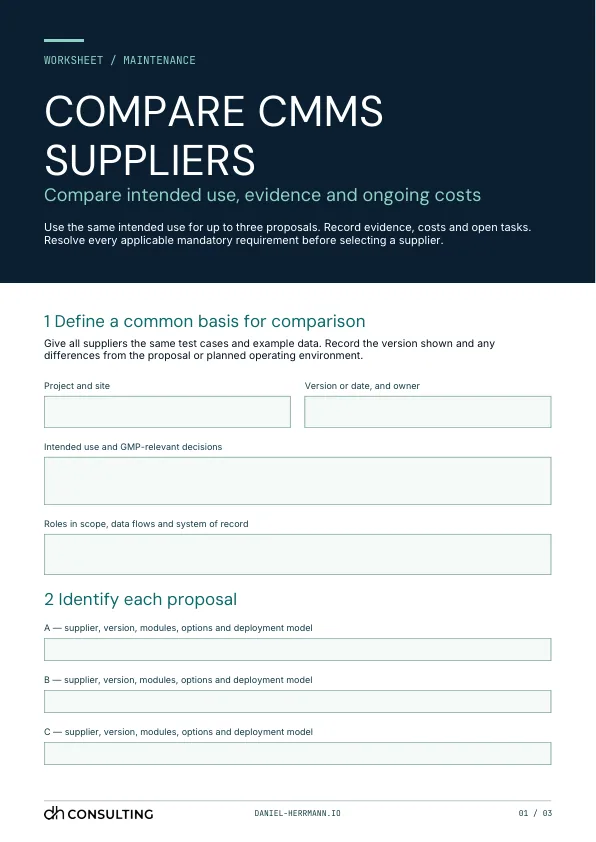
3 pages, A4, fillable PDF
CMMS supplier comparison
Compare up to three proposals against the same intended use, mandatory criteria and named evidence.
Maintenance, procurement, system owner and QA.
What’s included
- Page 1: Project scope and three provider profiles with version, module, operation and scope of services.
- Page 2: Compare mandatory criteria, evidence and outstanding questions.
- Page 3: Lifecycle costs, outstanding actions and the selection decision.
Record the system version, module and deployment model. For each criterion, enter the status observed and its supporting evidence. A reasoned shortlist with cost drivers, missing evidence and owners for follow-up.
Assess mandatory criteria separately. Keep costs, demo evidence and supplier evidence distinct.
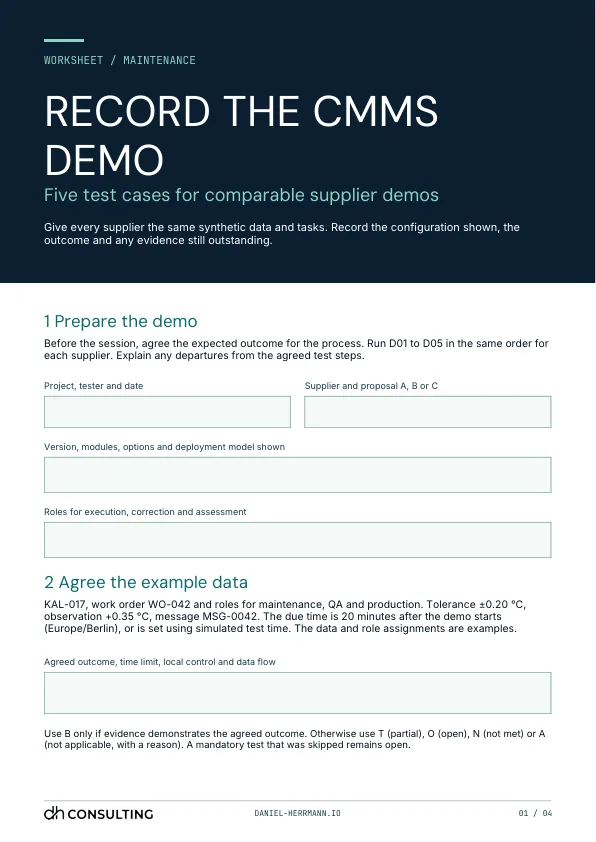
4 pages, A4, fillable PDF
CMMS demo assessment record
Prepare the same five test cases for each supplier demo and document the observed results with evidence.
Maintenance, the process team, IT and QA involved in selection.
What’s included
- Page 1: Demo version, responsibilities, example data and agreed rules for the expected result.
- Page 2: D01 and D02 cover the calibration due date and an out-of-tolerance finding.
- Page 3: D03 and D04 for rights, correction, status transfer and restart.
- Page 4: D05 covers documented release of equipment, export of its history, outstanding evidence and the decision.
Before the demonstration, specify the system version and expected behaviour. During the demonstration, record the observation, supporting evidence and any open question. A comparable demo record to support follow-up requests and subsequent test planning.
Check calibration due dates, deviations, corrections, interface failure and export using one shared example dataset.
Two PDF worksheets
Request the worksheets for your team
Enter your name, company, work email and a phone number where we can reach you. We will call you briefly about your request and then email you the worksheets. A newsletter subscription is optional.
We have received your request.
We will call you briefly to discuss your request, then email you the worksheets personally.
Tell us about your CMMS project using the enquiry form.
Ask about CMMS selectionFrequent Questions on CMMS Selection
Which maintenance software provides support for CSV?
For example, eMaint, GxPReady, and osapiens offer distinct approaches to validation support. Please inquire regarding the provided product and module, specifically concerning a validation documentation template, supported batch release, and included features. Crucially, it is essential to determine which evidence is contractually available and aligns with your requirements.
Is a CMMS that has been validated immediately available for use in our operation?
This depends on the documented suitability for your operation. Assess which version, modules, and settings are covered by the supplier documentation and how your actual usage differs. Plan appropriate checks for relevant deviations and your own processes. Maintain a documented assignment of responsibilities and the decision regarding your usage.
Must a CMMS automatically lock out upon overdue calibration?
What distinguishes a supplier demonstration from a validation test?
In the demonstration, verify whether the supplier can demonstrate the requested function and appropriate documentation. For future use, define your system status, requirements, risks, and acceptance criteria. Then evaluate which results are logically transferable and which additional assessments need to be performed.
Sources: [2]
What should we check when switching maintenance software?
Track a device identifier from source to destination, including order, report, attachment, and history. Evaluate, based on previously agreed criteria, whether the value and significance of transferred data are preserved. Concurrently determine how required historical data remains accessible and identify who assesses unresolved cases.
Sources: [2]
Sources and review date
Source: 10 November 2026. The guide refers to Human Medicinal Products GMP. Matrix, limit values and demo scenarios are editorial examples.
- European Commission: EU GMP Chapter 3, Premises and EquipmentNo. 3.34–3.35 for interpretation and maintenance, No. 3.41 for calibration, testing, and records.
- European Commission: EU GMP Annex 11, January 2011 revisionPrinciple and No. 1 on validity and risk No. 3–5 on suppliers, validation and data exchange No. 7–10, 12, 14, 16 and 17 on data, changes, access, signature, operational continuity and archiving.
- ISPE: GAMP 5 Guide, 2nd EditionIndustry Guideline, July 2022 Edition. Public Overview on Risk-Based Approach and Supplier Involvement.
- eMaint: Description of the CSV ServiceManufacturer statement regarding the service for validation and revalidation, retrieved on November 10, 2026.
- GxPReady: Description of the Transfer PackageManufacturer statement regarding documentation and support for qualification, retrieved on 10 November 2026.
- osapiens: Description of Pharmaceutical MaintenanceManufacturer statement on qualification and validation support, retrieved on 10 November 2026.
Sources checked: .


Daniel Herrmann Consulting
Discuss the next step for your CMMS selection
Tell us where you are in your selection or validation project. We will reply with the next step we recommend.
- Computer system validation →
Bring your GxP systems into validated operation, from laboratory software, MES and eQMS to ERP. We define the scope, plan risk-based tests using GAMP 5 and hand the evidence to QA for release.