

Table of contents
At a glance
How can a small manufacturer estimate a CSV budget?
Define the intended use, configuration, interfaces, migration and supplier evidence already available. Estimate external person-days by work package and multiply them by the agreed rates. Add separately priced vendor services and expenses, then budget internal process-owner and QA time. We can set a project estimate once the scope is agreed.
- The system boundary and gaps in existing evidence determine what work to estimate.
- Budget external services and internal staff time separately.
- Check whether supplier evidence covers your requirements. A package title cannot establish coverage.
- The worked example uses assumed person-days. It gives no market rates or project commitment.
Start the cost estimate with intended use
A product name alone gives little basis for a validation estimate. Which processes, data and quality decisions will the system support? The same software can serve one limited task or a multi-site operation with migration and numerous interfaces. Define the intended use and the outstanding assumptions before putting a figure on the work.
This guide focuses on computerised systems in EU GMP manufacture of human medicinal products. Annex 11 calls for a justified, risk-based validation scope. For FDA-regulated uses, identify the particular recordkeeping requirement and whether Part 11 applies. Assess other GxP areas within their own frameworks.
We developed these planning models to estimate work. They contain no survey of market prices, typical day rates or standard project costs. A usable quote defines the scope, prerequisites and division of tasks between your organisation, the software supplier and the service provider.
Two worksheets help you apply the calculation. “CSV costs: internal effort and budget” separates the resource categories. “CSV proposal: assumptions and changes” records what the estimate depends on and when it needs revisiting. Enter the quantities, rates and conditions for your project. To receive the worksheets, send the four required details and discuss the project with us briefly by phone.
How to estimate work from the factors that drive effort
User and module counts alone say little about the work. A few people may make critical decisions, while many read-only users may need limited testing. An interface with complex business rules may take longer to assess than several straightforward transfers. Use the matrix to connect technical features to the work they create.
For each item, record the information available and the questions still open. If a figure is provisional, state the assumption and when it will be checked. That shows which parts of the estimate can already support a decision.
| Effort driver | Work to allow for | Question before estimating |
|---|---|---|
| Business process scope | Define requirements, assess risk and test the process | Which decisions and variants are within scope? |
| Configuration and Roles | Test expected rules, permissions and relevant boundary cases | What customer-specific rules have actually been implemented? |
| Interfaces | Demonstrate mapping, error handling and data reconciliation | Who owns the source, the transfer and acceptance by the receiving process? |
| Migration | Clean up and map existing records, then verify the results | Which records and relationships must remain in active use or be preserved in the archive? |
| Existing evidence | Assess suitability and address remaining gaps | Do version, configuration, test scope, and results match? |
| Internal Capacity | Arrange decisions, tests and approvals | Who can commit time, and when? |
| Operational handover | Prepare procedures, training, change control and recovery | What tasks must be undertaken after release? |
When can we estimate the effort?
We establish the estimate after scoping, once the intended outcome and the boundaries of the work are clear.
In our project experience, addressing audit findings has taken between 2 and 200 consulting days, depending on the scope.
That range applies specifically to resolving audit findings. We estimate your project against its own scope.
Separate external spending from internal staff time
Distinguish four budget items. Allow for external validation work, internal process and technical staff, separately priced software supplier or implementation services and any additional materials or other resources. Identify which items belong to validation and which belong to the wider software rollout.
Your team may need to decide requirements, supply test data, carry out process tests and approve results. Reserve time for these activities even when no external invoice is due. To calculate the internal cost, multiply internal person-days by your own cost rate.
Avoid counting the same work twice. If the implementation partner documents the configuration, someone still needs to assess the evidence, but there may be no reason to recreate it. Show cash expenditure, internal capacity and future operating effort separately so management can see what each figure represents.
Check which requirements existing documents cover
Annex 11 calls for assessing supplier documentation against user requirements. Annex 15 addresses validation planning and allows justified use of suitable external data. Estimate potential savings only after checking which requirements that evidence actually covers.
Request the contents or a representative sample of the supplier package early. Check its version, prerequisites, functions, results and known deviations. For each requirement, decide whether the evidence fits, more information is needed or your team still has tests to run.
A template gives a document structure. Estimate the work needed to assess existing content, adapt it to the intended use and close actual gaps. Agree who will follow up outstanding supplier questions. Keep unavailable evidence open in the estimate.
Estimate migration and interface work separately
Plan the full data path for each interface. Include mapping into the receiving process, incomplete transfers, retries and handling of rejected data. Involve owners on both sides when preparing tests. A working endpoint confirms connectivity but does not establish that the information is used correctly.
For migration, separate cleansing, transfer and verification. Identify who resolves conflicting legacy values and how links to documents, users or open transactions will be preserved. Matching record counts alone do not establish that a historical status has kept its meaning. Annex 11 addresses both the value and meaning of migrated data.
Define the scope of active use and archiving separately. Historical records may need different evidence from cases that will continue in the new system. Allow time for trial runs, evaluation, error handling and acceptance. Where data quality or mapping rules are unknown, identify that part of the estimate as provisional.
Sources: [1]
Worked example for combining internal and external person-days
Assume an application is already configured. The project covers one defined process, one data connection and a manageable set of records to migrate.
Agree what one person-day means for everyone involved. The table separates external work from internal contributions. The alternative scenario assumes that the data mapping needs revision. It shows the impact of a single uncertainty and gives no probability that the event will occur.
The base case requires 14 external and 11 internal person-days. If the mapping needs rework, the estimate becomes 17 external and 13 internal person-days. External cost depends on the agreed rates and included services. Use your own rates for internal time. Add separately priced supplier services and other project resources.
| Work package | Assumed external person-days | Assumed internal person-days |
|---|---|---|
| Define scope and assess existing documents | 2 | 1 |
| Assess requirements and risks | 3 | 3 |
| Prepare tests and data | 2 | 1 |
| Run tests and assess results | 4 | 3 |
| Assemble the final evidence | 2 | 1 |
| Hand over to operations and obtain decisions | 1 | 2 |
| Base case total | 14 | 11 |
| Additional work if the data mapping needs revision | 3 | 2 |
| Total with mapping rework | 17 | 13 |
Person-days do not establish a completion date
Add a schedule of dependencies. Agree requirements before finalising the tests for them. Allow for the availability of test data, environments and relevant staff. Some external work can run alongside internal review. Other tasks must wait for a decision.
For an SME, a key constraint is often the availability of the people authorised to make process decisions. If one person must give several approvals, include that dependency in the plan. More external staff cannot automatically assume that authority. Arrange cover and time for questions so approvals can receive proper scrutiny.
Distinguish additional work from waiting. A missing test environment can delay the project with little extra effort. A late requirement change can create new work. Report those causes separately so decisions on schedule and budget address the right issue.
Compare proposals against the same scope of work
Compare deliverables, prerequisites and what your team must contribute. Does each proposal include requirements workshops, supplier assessment, executing tests, handling deviations and a final report? Who supplies test data and who approves results? Which migrations and interfaces are covered? Answer these questions before comparing prices.
If the data or documents are still unknown, an initial scoping assignment can define the system boundary, identify evidence gaps and produce a revised estimate. This is a commercial option. A fixed-price agreement also needs explicit assumptions and a way to handle scope changes.
Agree what happens when a deviation is found. Which activities are included, who decides what to do next and how is additional work authorised? A low-priced document package can fit if the remaining tasks have clear owners elsewhere. File counts alone make a poor basis for comparison.
Return to the base case of 14 external and 11 internal person-days. Mapping rework is already shown as a separate uncertainty scenario. Before placing the order, agree who determines whether the extra work is needed and who may commission it. Record the trigger, evidence and decision separately.
Unused budget alone is no reason to authorise another task. First establish how the proposed change affects the agreed outcome. Then decide the scope, internal contribution and schedule. This distinguishes a change in deliverables from a failed assumption or a redistribution of work. It does not imply a standard cost per interface.
| Statement in the offer | Question before placing the order | Usable result |
|---|---|---|
| “We will use existing evidence.” | Which versions, configurations and functions does the evidence cover? | Named records and a defined remaining gap. |
| "Data transfer is included." | Which datasets, relationships and acceptance criteria are included in the estimate? | An agreed starting scope, with additional mapping handled as a justified change. |
| “We will handle deviations.” | Does this include classification, technical correction, retesting and review? | An owner and agreed supplier contribution for each activity. |
| “We will provide a final report.” | What evidence will be handed over and which decisions will remain open? | A close-out package the responsible person can assess. The report title alone cannot release the system. |
Include operation and subsequent changes in the budget
Initial release is one point in the system lifecycle. Budget separately for changes, software release assessments, user administration, incidents, recovery and periodic review. Estimate concrete tasks and assign owners before applying any percentage to the implementation budget.
Assess the impact of a change before deciding which evidence it needs. A new report field, a revised calculation and a complete platform replacement can justify different responses. The change procedure needs to accommodate those differences.
Budget pressure does not justify omitting a necessary control. ICH Q9(R1) states that a lack of resources does not justify a lower level of formality in quality risk management. Options include narrowing the intended use, phasing the rollout or introducing an additional function once it has been prepared and assessed.
Checklist for estimating validation effort
Use the checklist before requesting quotes or making a budget decision. An outstanding question can remain open if it has a stated assumption and a next step. A single total can otherwise disguise how uncertain the estimate is.
For each revised estimate, record which assumption changed. This allows the decision-maker to distinguish a wider intended use from a newly discovered data problem or a gap in the evidence.
- Describe the GxP context, intended use and excluded functions.
- Define the configuration, interfaces, migration and sites in scope.
- Check existing supplier and customer evidence for suitability.
- Identify the deliverable, person doing the work, reviewer and required inputs for each work package.
- Show external services, internal person-days and separately priced items.
- Record assumptions and set a date to resolve uncertainties.
- Build staff availability, dependencies and decisions into the schedule.
- Agree operational responsibilities and rules for scope changes.
Compare prices for the same scope of work
A price means little if one supplier offers to write tests while another also runs them and investigates findings. Give every supplier the same assumptions. The example shows how to separate the work without relying on estimated market rates.
- Project scope
- Specify the site, process, system version, interfaces and data migration.
- Calculation
- Assess external deliverables, your team’s contribution and the software supplier’s work separately. Count each task once.
- Uncertainty
- Resolve uncertainties about data quality or configuration first, then update the estimate.
- Supplier selection decision
- Consider the assumptions, included corrections and handover alongside the price.
When Daniel Herrmann Consulting fits your project
You need someone to lead the technical work on a CSV project and work directly with the laboratory or process owners, IT, QA and your implementation partner. We assess what you already have, help carry out the work and transfer the knowledge to your team.
- You want to assess existing evidence and use it to define the next work packages.
- You need a technical contact for system boundaries, responsibilities and decisions that are still open.
- Your team needs to be able to use the agreed processes once the project ends.
Tell us what prompted your project, what evidence you have and where you need support. Software procurement, supplier implementation and final approval for use each have their own owner. We agree these responsibilities before work starts.
We discuss why you are getting in touch, where your system stands and which decision comes next.
What to prepare with your team before the call
If you want to prepare with your team first, request the worksheets on the linked guides. Enter your name, company, work email and telephone number. After a short call, we will email the relevant documents to you.
Worksheets for your team
Clarify CSV costs and effort assumptions
A proposal captures only part of the project's demands. Use the worksheets to separate external services, work your team must do and additional costs. Record which assumptions support the estimate and which changes would require reassessment.
Request the worksheets for your team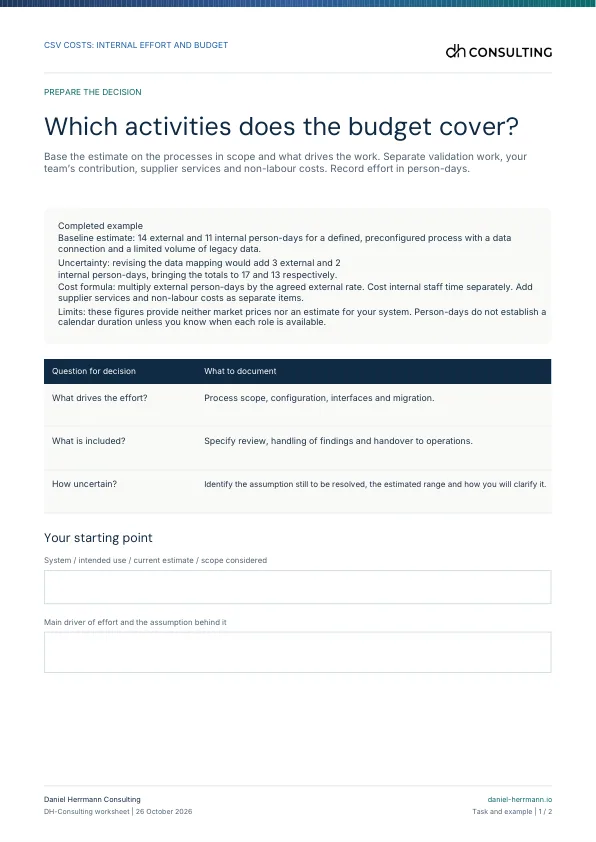
2 pages, A4, fillable PDF
CSV costs: internal effort and budget
Bring external cost estimates, internal effort and separately commissioned services together in a traceable CSV budget.
Project lead, budget owner, procurement and QA.
What’s included
- Page 1: Which activities does the budget cover? Includes a worked example, questions for the decision and space to record your starting point.
- Page 2: Estimate effort and cost using work packages, rates, extras, a baseline and an uncertainty scenario. Record the budget decision, outstanding question, owner and date. Includes sources and context.
Estimate each work package in external and internal person-days separately. Use your agreed rates and actual additional costs. A justified budget range showing internal effort, assumptions and an alternative scenario.
Establish your planning assumptions. Then use the assumptions worksheet to assess a specific change to the proposal.
2 pages, A4, fillable PDF
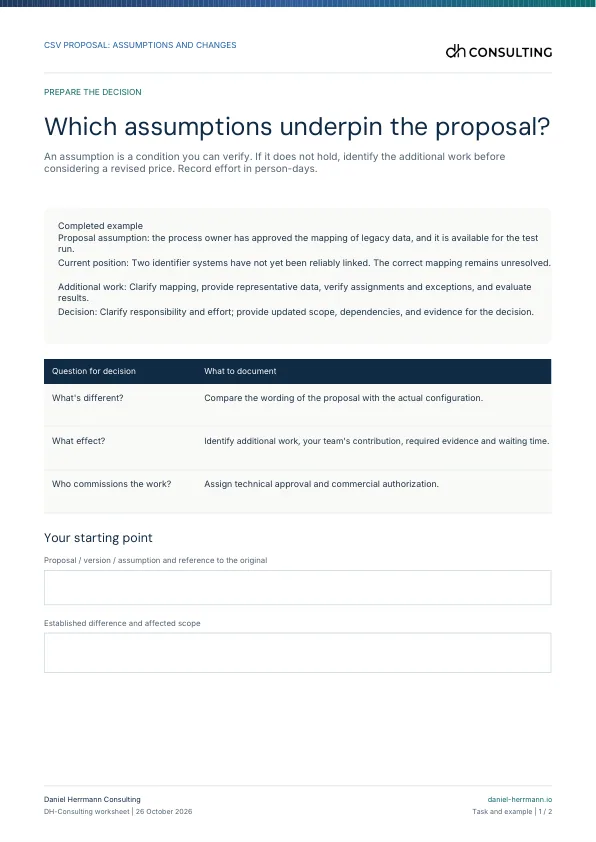
CSV proposal: assumptions and changes
Assess how a change to a proposal assumption affects scope, evidence, internal effort and timing.
Project lead, procurement, system owner and operational decision-maker.
What’s included
- Page 1: Which assumptions underpin the proposal? Includes a worked example, questions for the decision and space to record your starting point.
- Page 2: Record the assumption, change, impact and revised assignment. Document the decision, authorised person, date and consent. Includes sources and context.
Choose a decisive assumption. Describe the actual difference, the additional work and the necessary decision. A documented change question, its traceable impact and the rationale for the next assignment.
Assess a changed assumption. This worksheet provides neither a contract amendment nor a general estimate of cost increases.
Two PDF worksheets
Request the worksheets for your team
Enter your name, company, work email and a phone number where we can reach you. We will call you briefly about your request and then email you the worksheets. A newsletter subscription is optional.
We have received your request.
We will call you briefly to discuss your request, then email you the worksheets personally.
Project experience and collaboration
Build a cost estimate on assumptions you can check
A total price alone tells you little about a proposal. With your team, we break the intended work into requirements, risk assessment, testing, evaluation and handover to operations. For each package, we identify what you can reuse and who will supply the rest. A well-understood system may allow a firm scope. Unclear interfaces or legacy data may call for a limited assessment first. The estimate shows external work and your team’s contribution separately. If an assumption changes, you can see which work it adds.
Frequently asked questions about Validation effort
Is there a standard price for computer system validation?
A credible range needs a defined use and scope. Multiply external person-days by the agreed rates, then add separately priced supplier services and other costs. Estimate internal staff time separately. Agree the work packages, task split and assumptions first. Our example illustrates the calculation and gives no market price or universal range.
What information does a service provider need to prepare an initial estimate?
Provide the system and version, supported processes, GxP context, configuration, roles, interfaces and migration scope. Add available documents, known gaps and internal contacts. Identify information still missing so the estimate can distinguish supported items from provisional assumptions.
Sources: [1]
Does standard software always take little effort to validate?
A product name says little about your intended use or configuration. Interfaces, migration and business rules can create work. Assess your use and the suitability of existing evidence before estimating effort and depth of testing. A supplier statement or category alone cannot establish either.
How does a supplier validation package affect the estimate?
A suitable package can provide evidence for specific requirements when the version, prerequisites and intended use match. Estimate the review of that package and the work your organisation still needs to do. Its price does not establish coverage for your configuration, migration, interfaces or release decision.
Why budget internal staff time separately?
Business requirements, relevant test cases and decisions on results need accountable people in your organisation. Reserve their time and arrange cover. You can apply internal cost rates to that effort for planning purposes. It is a demand on staff capacity even where no supplier invoices for it.
Are the person-days in the worked example typical?
Can person-days be converted directly into project duration?
No. Their sum measures labour capacity. Project duration also depends on sequencing, staff availability, the test environment, data, decisions and approvals. Both waiting and additional work can delay delivery. Their effects on the resource budget differ.
Sources: [2]
Should CSV be priced on a fixed-price or time-and-materials basis?
Choose the pricing model for the agreed scope. Stable prerequisites can support a defined package of deliverables. Unknown data or evidence may justify an initial scoping phase. Agree contributions, acceptance criteria and change rules either way. Annex 11, Annex 15 and ICH Q9 prescribe no pricing model.
Sources: [2]
Can a tight budget determine the scope of testing?
A budget does not make an untreated material risk acceptable. ICH Q9(R1) section 5.1 states that resource constraints do not justify less formality in quality risk management. Make explicit decisions about scope or rollout and assess their consequences. Keep necessary evidence visible in the plan.
Sources: [3]
Which costs continue after initial release?
Sources and review date
Sources were checked on 6 October 2026. The regulatory focus is EU GMP for human medicinal products. We developed the effort model, tender questions and figures as planning aids. The calculation uses assumptions and does not represent a market-price survey, a completed engagement or a binding offer.
- European Commission: EU GMP Annex 11, Computerised Systems
- European Commission: EU GMP Annex 15, Qualification and Validation
- ICH Q9(R1): Quality Risk Management
- European Commission: EU GMP Chapter 1, Pharmaceutical Quality System
- FDA: Part 11, Electronic Records; Electronic Signatures – Scope and Application
- European Commission · EudraLex Volume 4 current texts
Sources checked: .


Daniel Herrmann Consulting
Estimating the effort for your project
Daniel Herrmann Consulting can review your system scope, available evidence and outstanding work packages with you. We use that information to determine what support you need and which activities your team will own.
- Computer system validation →
Bring your GxP systems into validated operation, from laboratory software, MES and eQMS to ERP. We define the scope, plan risk-based tests using GAMP 5 and hand the evidence to QA for release.