
Table of contents
At a glance
What makes a good mock audit?
Define the mock audit’s purpose, regulatory scope, processes and a justified sample. Select an auditor with suitable expertise and sufficient independence. Have the auditor trace explanations of the actual workflow to original records and use them to substantiate findings. Agree how findings will be addressed and followed up. A mock audit supports preparation within its scope. It is not certification or a guarantee of an inspection outcome.
- A pilot run requires specific questions and clear boundaries.
- The suitability of the inspector for the subject matter is to be assessed.
- Sample size and documentation depth determine the credibility of the report.
- A finding is only actionable when it is supported by rationale, impact assessment, and appropriate handling.
What should specifically be decided following the Mock Audit?
The two work aids build upon the system review described in the planning example below. In that example, the team conducts the review; however, during the pilot run, it remains unclear which changes were implemented and how they were evaluated. Prior to assignment, agree on which question the reviewer is to answer and who will further develop the review report.
In this case, the mock audit assignment defines the review period and the underlying change inventory under consideration. The report links the actually examined records with the observations and open questions. Whether the changes have been considered thus constitutes a specific review task. A limited sample does not constitute a complete evaluation of all system reviews nor does it lead to official release.
| Distinguishing in the report | Purpose | Where traceability begins |
|---|---|---|
| Audit question, scope and actual considered documentation | Limit the statement to its investigated basis | Open question or additional inspection requirement |
| Observation, requirement linkage and potential impact | Make a professional, technically sound justification for the finding. | Assign responsibility and scope for the assessment before choosing an action. |
| Agreed action and appropriate closing evidence | Completion of mere planning differs | Evaluation of the submitted evidence and documented final decision |
Therefore, please clarify in the proposal whether the scope includes only reporting and review, or also the subsequent traceability. Additional advisory support during correction may be beneficial. However, such support should not be inadvertently conflated with the role of the inspection run. The scope, suitability, and independence of the selected approach should be evaluated. Internal categories remain internal categories; they do not constitute a prediction of any official classification.
Two worksheets are available: “Mock audit: remit and sampling” helps define the question before a proposal, and “Mock audit: findings and actions” connects a finding to an owner, evidence and a closure decision. The latter does not replace the assessment or a regulator's report. Provide your name, company, work email address and phone number. We will discuss your needs briefly by phone and send the materials personally.
What type of pilot run do you need?
A self-audit serves to assess the implementation and compliance with the GMP approach, as well as identify necessary improvements. A mock audit can be designed as a targeted pilot exercise, for example, to prepare for specific inspection questions. A consultative analysis, on the other hand, can jointly with the team develop potential solutions. These approaches have distinct roles and outcomes.
In a contracted supplier audit, your company evaluates a supplier and their agreed services; Annex 11, Section 3.2 justifies the risk-based audit requirement, Chapters 7, Sections 7.5 and 7.17 address supplier qualification assessment and audit rights for outsourced activities. A regulatory inspection takes place within the organisation's own legal framework and cannot be purchased as a consultancy service.
Prior to the session, clearly define which variant is required. A reviewer who immediately provides the desired response during each conversation gains limited insight into the actual workflow proficiency. Conversely, a strictly conducted pilot run does not automatically represent the optimal approach for an early joint improvement workshop.
Define the scope based on processes and risks
Name locations, activities, and systems. Select specific questions, for example, regarding the evaluation of a LIMS change or historical data access following system decommissioning. Define interfaces to other quality processes. A focused system review can be valuable, but must not be presented as a complete site audit.
Consider known findings and changes. A recently implemented data transfer or a recurrent erroneous process may justify a different focus than a stable, well-documented procedure. Selection should be justified. Relying solely on readily available reference documentation may overlook significant issues.
Assess the technical suitability and independence of the auditor
Inquire about experience in the actually considered regulatory and process areas. For computerized systems, the auditor must understand data flows, configurations, and traceability of evidence. General audit practices do not automatically substitute for this level of depth. Conversely, product knowledge alone is not sufficient proof of an appropriate GMP assessment.
Also address potential conflicts of interest. Individuals who have designed the reviewed process themselves can provide valuable insights; however, their role as an independent auditor must be evaluated separately. Chapter 9, Section 9.2, refers to the independent and detailed execution of internal audits by designated, competent personnel within the organization. Additionally, independent audits conducted by external experts can be beneficial. An external mock audit complements the organization's own internal audit structure; it does not simply replace it with an external report. Section 9.1 requires a pre-defined audit program.
A validation plan extending beyond the document list
For a system-based pilot run, the table links inspection questions with potential validation evidence. The scope and sample size are justified for the specific task, rather than following a fixed daily number or inspection rate.
Let me explain an example test result. The phrasing "improve documentation" is significantly less helpful than specifying a particular missing reference and its potential implications.
| Component | To agree | Contribution to credibility |
|---|---|---|
| Introduction | Actual Purpose and System Boundaries | Prevents a premature conclusion |
| Sample | Procedures, time period and rationale for selection | Power viewed and not viewed areas visible |
| Discussion | Skilled personnel and representatives | Demonstrates understanding and accountability pathways |
| Evidence | Source data and associated documentation | Links the conclusion to a verifiable transaction |
| Findings | Statement, requirement and impact | Supports an objective assessment |
| Closure | Open questions and next decisions | Delivers a usable transfer |
Shifting from interview notes to actual records
Show the employee a real-time process. Trace the connection between his statement, the then-existing procedure, and the available records. For a system update, for example, relevant aspects would include justification, evaluation, verified state, and handling of results.
A lack of documentation may arise from several causes: the activity may not have been performed, the record may not be retrievable, or the selected evidence may not address the question at hand. These possibilities should be distinguished. The report should not present an unverified cause as a definitive fact.
Planning example: A completed review remains unclear
Assuming a team conducts regular system reviews, during the pilot run no one can demonstrate which changes were implemented during the considered period and how these were incorporated into the assessment. The reviewer specifically identifies this gap, the available documentation, and the remaining open question.
In the planning example, various measures are under consideration. A targeted enhancement of the selection and evaluation criteria may suffice; if further risks emerge, a review of previous assessments should be considered. Justify this decision based on the findings. A sample alone does not constitute evidence of a systemic defect.
Address findings according to their evidence and significance
Establish a clear and understandable classification methodology. It should link requirements, observed facts, and potential impacts. Internal categories defined in a mock audit are not official classifications. Where evidence is missing or questions remain unresolved, this must be clearly evident.
The operating company evaluates appropriate immediate actions, root cause analysis, and additional controls. The reviewer can support this work or later track its implementation. A closed entry alone does not prove the effectiveness of a corrective action. Any change in assessment must be substantiated with a valid rationale.
What a usable closing report contains
An appropriate assignment includes planning, execution, reporting, review, and potential traceability. Determine whether specific corrective actions are included or should be assigned separately. The availability of personnel and access to systems also influence the actual scope.
Chapter 9, Section 9.3 lists reports on self-inspections including observations, recommended corrective actions, and information on subsequent measures. For the additional, separately assigned pilot run, you shall establish clear, traceable findings and ensure their traceability. A robust report identifies both inspected and un-inspected areas, along with the scope and limitations of the sample. It enables your team to define next steps and assign responsibilities. A lengthy question list lacking clear supporting evidence may be less useful than a focused, thorough review. The key factor is whether your specific uncertainties are adequately addressed.
- Define the purpose and actual testing mode.
- Assess reviewer competence and potential conflicts of interest.
- Make the sample selection and original records traceable.
- Find, hypothesis, and open question differ.
- Plan actions and their appropriate traceability.
Worksheets for your team
Plan a mock audit and define the follow-up work
What should the mock audit examine, and how will you follow up the finding? Use the worksheets to define the assignment and sample, select an action with a documented rationale, and review the evidence for closure. The worksheets do not determine the outcome of an inspection.
Request the worksheets for your team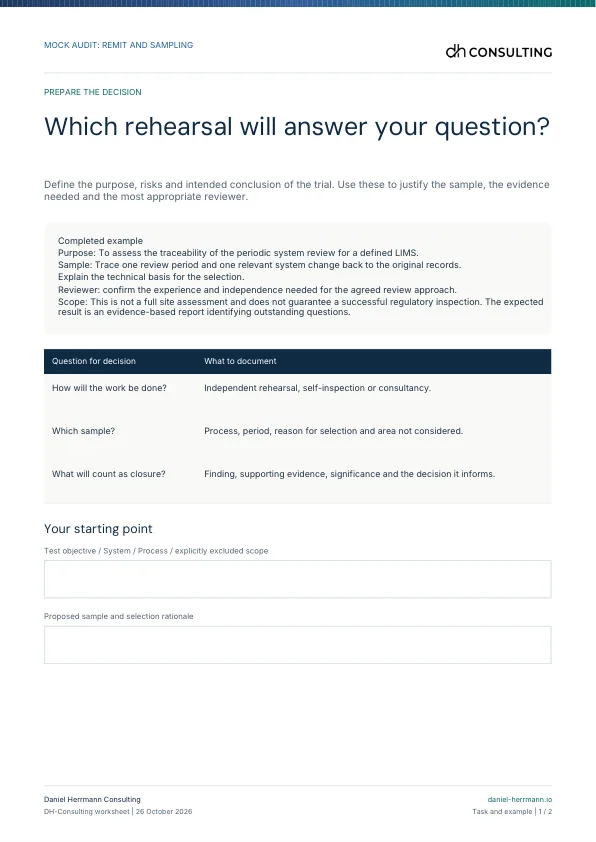
2 pages, A4, fillable PDF
Mock audit: remit and sampling
Agree the purpose, scope, reviewer role and rationale for the mock audit sample.
QA lead, commissioning party, system owner and auditor.
What’s included
- Page 1: Which rehearsal will answer your question? Includes a worked example, questions for the decision and space to record your starting point.
- Page 2: Define the mock audit approach, roles, sample, conduct and close-out. Record confirmation, date and remaining limits. Includes sources and context.
Decide whether you need an independent rehearsal or a joint advisory review. Then define the activities and evidence in scope. A defined assignment with the appropriate reviewer, a meaningful sample and a specified deliverable.
Plan the assignment and sample. Use the second worksheet to track a documented finding and its actions.
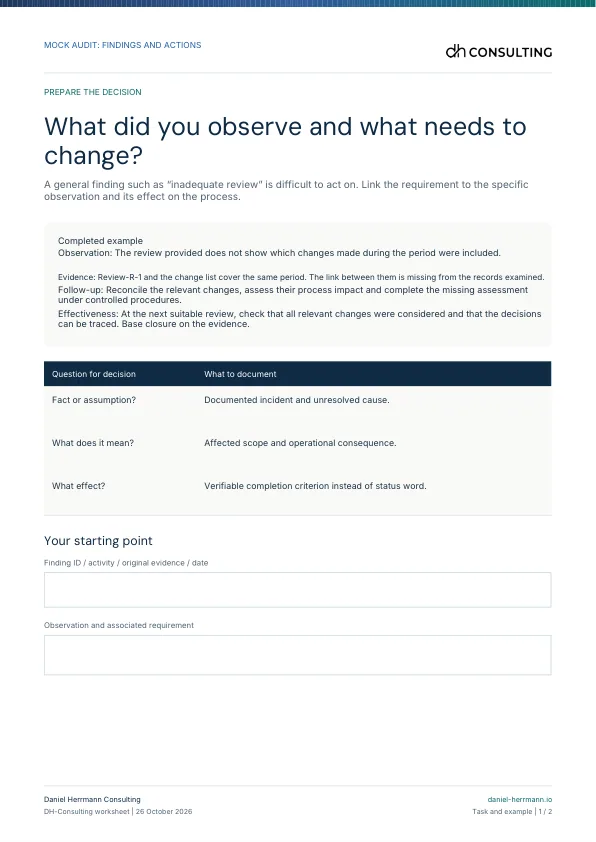
2 pages, A4, fillable PDF
Mock audit: findings and actions
Trace a mock audit finding from documented observation through action to verified effectiveness.
QA, the affected process owner, action owner and reviewer.
What’s included
- Page 1: What did you observe and what needs to change? Includes a worked example, questions for the decision and space to record your starting point.
- Page 2: Record the finding's significance, immediate response, cause, action and evidence of effectiveness. Document closure or an open item, decision-maker and date. Includes sources and context.
Describe the observation and link it to the original record. Then assess significance, immediate response, cause and effectiveness. A traceable finding, an owner, and a justified decision to close the finding or keep an item open.
Assess the finding and its impact. Internal mock audit categories do not represent an authority's classification.
Two PDF worksheets
Request the worksheets for your team
Enter your name, company, work email and a phone number where we can reach you. We will call you briefly about your request and then email you the worksheets. A newsletter subscription is optional.
We have received your request.
We will call you briefly to discuss your request, then email you the worksheets personally.
Project experience and collaboration
Plan a mock audit that produces findings your team can use
First, agree what the rehearsal should show and which processes provide a suitable test. Within that scope, we follow the team’s explanations back to the actual records and discuss the basis for any findings. An early improvement workshop can include more coaching. A rehearsal close to inspection should give staff more opportunity to answer independently. We choose the format with you.
Frequent Questions about the Mock Audit
Is a Mock Audit a Certification?
No. It is an agreed internal or external trial run with a defined scope. Its conclusions apply to the questions and supporting documents considered. It does not replace either an official decision or a separate certification process.
Must the external auditor perform a complete review of the site?
Not mandatory. A limited system- or process-specific review may be appropriate. The scope must be aligned with the objective and clearly defined in the report. A narrow scope shall not be presented as a comprehensive site assessment.
Sources: [1]
Can the same consultant who introduced the process be responsible for reviewing it?
Existing knowledge can be helpful, but potential conflicts of interest must be assessed. The role is appropriate to define for an independent self-inspection. Alternatively, a different auditor may be beneficial for the independent evaluation.
Sources: [1]
How many samples are required?
What distinguishes a pilot run from a supplier audit?
The pilot run evaluates your own processes to the agreed extent. The supplier audit assesses a supplier's performance and controls based on your requirements and relevant expectations. Objectives, information access, technical competence, and reporting are clarified for the specific assignment. A general auditor's competency profile does not yet capture this alignment.
What remains to be done after the Mock Audit?
The company evaluates findings and determines appropriate actions, which may include, as needed, immediate corrective actions, root cause analysis, and effectiveness assessment. Responsibility and a justified timeline should be clearly defined. The report alone does not close the gap.
Sources and review date
Primary source date: 17 October 2026. Chapter 9 serves as the central reference for self-inspections within the human medicinal product GMP environment. "Mock Audit" here refers to a specifically agreed-upon pilot run. Tables, audit questions, and examples are standalone methodological aids. Internal finding categories are not equated with regulatory authority decisions. Editorial addition of 26 October 2026: The newly introduced decision section and its work matrix are presented as independent methodological recommendations. The previously mentioned source date remains distinct from these developments.
- European Commission: EU GMP Chapter 9, Self InspectionSelf-inspection, independence, evidence, findings and corrective actions; no official guarantee of existence.
- European Commission: EU GMP Annex 11, Computerised Systems, January 2011 revisionHuman medicinal products – GMP; in particular, §§1–4, 7, 10–13, 16–17; specific application for each section.
- European Commission: EU GMP Chapter 7, Outsourced ActivitiesOutsourced GMP-related activities, suitability, responsibilities, agreements, and monitoring.
- ICH Q9(R1): Quality Risk Management, official text from the European CommissionRisk-driven decisions, appropriate formalities, and handling of subjectivity; own matrices are implementation proposals.
- European Commission: EU GMP Chapter 2, Personnel, effective from 16.02.2014Personal, role-specific training and assessment of practical effectiveness; official EudraLex entry with original chapter.
- European Commission: EU GMP Chapter 4, Documentation, January 2011 revisionControlled documentation and records; official EudraLex entry with original chapter.
- European Commission: EU GMP Chapter 1, Pharmaceutical Quality SystemQuality management, accountability, root cause analysis, CAPA and change control; no project budget allocation.
Sources checked: .


Daniel Herrmann Consulting
Hold three specific testing questions.
Identify the questions whose answers are currently missing to your team, as well as the affected systems and processes. From this, a limited audit assignment with appropriate documentation, personnel, and subsequent decisions can be developed.
- Audit and inspection preparation →
Go into an audit or inspection with accessible evidence and a prepared team. We begin with a walkthrough, rank open issues by risk and rehearse the inspection with your team.