

Table of contents
At a glance
Does a Marketplace review replace your GxP validation?
No. Microsoft describes technical checks of Marketplace apps primarily in terms of stability and installation in the online service. Evidence for your GxP use also needs to cover the intended process, configuration, roles, data and interfaces. You can use relevant supplier and partner evidence once you have assessed its scope and applicability to your environment.
- The relevant end-to-end process is evaluated, including base application, enhancements, and data pathways.
- Marketplace validation, technical compatibility, and professional suitability are distinct forms of evidence.
- App-ID, Version, Source, Dependencies, and actually deployed package belong to the baseline.
- Partners and users must jointly and formally define changes, test contributions, and operational procedures.
Before the next update: Clarify dependencies and scope of testing
For an upcoming update, the affected extensions and their dependencies must be clearly defined. Which combinations are currently in operation, what changes are intended, and which technical workflow could be impacted? A proposal for an update review should specifically prepare for these decisions. The general planning for Business Central validation is covered in the linked project guide; here, the focus is on providing evidence for the modified combination.
A planning example: The app of an industry partner is updated. The technical provision runs successfully. In your process, however, another extension uses a material status set by this app. The order should therefore not end with the successful installation. It is necessary to clarify whether status meaning, rights or transfer changes and what proof covers the intended material use. Microsoft compatibility is an input document with limited significance; it does not confirm GMP suitability of your use.
Before engagement, change information, starting and target states, as well as known dependencies, should be available. Additionally, confirm whether a test environment, appropriate data, and necessary point of contact personnel are available. If any element is still missing, identify the contribution to the inventory review or impact assessment. The matrix is a proposed tool for this alignment. It describes the required work state prior to engaging a subsequent review of the modified process.
| Required outcome | To be provided accordingly | Before acceptance, clarify |
|---|---|---|
| Traceable App Stock | Installed versions, dependencies, relevant configurations, and environment | Does the directory match the actually used combination? |
| Justified scope for the change | Change information, affected usage, and appropriate existing records | Which assumptions are unresolved, and which assessments are required? |
| Evaluation of the affected process flow | Expected behavior, controlled test setup, data, and responsible reviewers | Are results, deviations, and decisions interrelated? |
The document "Business Central: Capture Extensions and Dependencies" helps you organize your current status and identify missing information prior to the partner meeting. "Business Central: Determine Update and Scope" guides you from a specific change to a justified next step. Both are intended as support tools for internal alignment; they do not constitute product release approval. Name, company, business email, and telephone number form the basis of the inquiry. Following a brief phone call, we will personally deliver the supporting documents.
Start the process and identify the operating mode
First, inquire which task the enhancement assumes within the regulated process. Does it alter a material decision, calculate a relevant quantity, or transfer required records? The number of screens provides little indication. A minor adjustment to a critical booking can be more significant than a comprehensive purely accounting module.
The technical guidance in this article applies to Business Central Online and the referenced Microsoft Learn pages. Separate operating and update procedures may apply to on-premises deployments. The regulatory focus is on GMP processes for human medicinal products. Do not unverifiedly extend this classification to other regulatory areas or to any installed application.
Document the relevant process boundary and the components included within it. Derive the scope of validation evidence from the impact of these components. Neither the marketplace distribution channel nor the customer-owned extension designation automatically assigns a GAMP category.
Understand what Microsoft actually evaluates
Microsoft describes the primary purpose of technical Marketplace validation as the stability of the online service and the installability or executability of the apps. This includes, among other things, package metadata, dependencies, compilation, and checks using AppSourceCop. These technical evaluations do not address the full question about the process regarding your material release or documentation process.
The manufacturer's instruction for the Extension Test specifies CRONUS de-modulated data as the basis for the associated app validation. Microsoft also emphasizes that the publisher remains responsible for functional and logical evaluations. Therefore, a successful technical assessment constitutes only a limited form of evidence, whose specific implications you should document in your supplier evaluation.
A function offered within the industry module does not need to be completely redeveloped or require a full reperformance of each supplier assessment. Instead, evaluate which requirements are adequately covered by existing, relevant evidence and identify any gaps remaining for your specific version, configuration, and process combination.
Build a reliable inventory of extensions
Capture for each relevant app the app name, publisher, app ID, version, environment used, intended use, and responsible partner. Include dependencies and configurations that impact your workflow. The "Manage Apps" page in the Administration Center provides visibility into installed apps and available updates. A screenshot alone does not constitute alignment with your requirements.
Microsoft distinguishes global apps, environment-specific per-tenant extensions and DEV extensions. For PTEs, an important feature is documented: The same ID and version can have different content in different environments. Therefore, for the transferability of a test result, you should clearly assign the actual released package, for example via a controlled storage and checksum.
Also consider library apps without a dedicated interface. If an update introduces new or modified dependencies, the scope of the assessment may expand. Document the associated combination, rather than evaluating only the named industry solution.
Assign Microsoft, partners, and end users unambiguously
The following matrix represents a proposed framework for task definition. It does not describe a general contractual obligation of a specific supplier. Please indicate your preferred assignment for the following responsibilities: who provides documentation, defines technical specifications, investigates deviations, and makes decisions. EU GMP Annex 11 requires clear accountability for third-party involvement; the specific agreement must align with your actual services and data pathways.
Particularly when multiple partners are involved, the overall process requires a designated responsible party. Otherwise, each component may individually be deemed functionally capable, while the handover between them remains unclarified. Therefore, designate a point of contact responsible for coordinating any issue across product boundaries.
| Subject | Microsoft contribution | Partner contribution | User responsibility |
|---|---|---|---|
| online platform | Platform documentation and technical verification steps | Explain dependencies of the delivered solution | Define appropriate environment and required evidence |
| Extension Function | Documenting technical framework conditions | Specifications, version notes, and appropriate test results provided | Assess coverage of own requirements |
| Own configuration | Available platform mechanisms are described | Implement configuration and document in a traceable manner | Define and approve the expected process rules |
| Interface | Document technical interface capabilities | Mapping, error handling and integration demonstration | Assess the consistent technical outcome |
| Update and Failure | Service information and technical notifications | Maintain compatibility and coordinate troubleshooting | Assess the impact and decide on further usage |
Request relevant documentation from the partner
Request documentation for the actually deployed version including: described functions, limitations, configuration options, required privileges, supported dependencies, and known restrictions. Additionally, release notes and traceable results from supplier evaluation are helpful for relevant changes. A general product brochure is insufficient to justify the assessment of a specific failure risk.
Assess transferability: Were comparable processes, data, and prerequisites evaluated? Are results and deviations identifiable? A validation report from a different configuration may be useful, but must be appropriately contextualized. Identify missing information as specific open points with defined responsibility.
Define the lifecycle of the solution: Who ensures compatibility, notifies of changes, and provides support during failures? What occurs during a partner change or module retirement? Crucially, long-term access to required records must be guaranteed, not just short-term installability.
Example: assess a sector module for material selection
Assume a generic industry module enhances your process by introducing a review status and impacting material consumption. This represents a standalone example, not a guaranteed function of a specific application. As a business requirement, you establish that material shall not be used in affected processes in the absence of a required decision.
Now, document all relevant pathways: manual entry, mobile data capture, background processing, and, if applicable, integration interface. Describe where the rule is actually evaluated. A lock on a single input form does not constitute evidence that another booking pathway considers the same decision.
Perform both authorized and unauthorized actions using the intended roles. Additionally, assess the impact on previously recorded activities following a correction or status change. Acceptance criteria must be defined prior to execution; technical success in booking may, in fact, represent a procedural error.
| Risk | Targeted test batch | Expected process outcome |
|---|---|---|
| The rule applies only to a surface. | Attempt the same unauthorized action via another approved data pathway | The required control also applies there |
| Permissions are too broadly granted | Normal inventory account attempts a deferred decision | Unauthorized actions are prevented and appropriately addressed. |
| Units are incorrectly transferred. | Representative quantities with differing units transmitted via the data path lead to discrepancies. | Identity, value, and significance remain accurate |
| Replication produces a dual effect | After interruption, resume the same procedure. | One clearly reconciled business transaction with no undetected duplicate |
| Source history loses its coherence | Ongoing open process to be further edited after Extension-Update | Required references and valid decisions remain traceable |
Sources: [10]
Design interfaces and test environment appropriately
Microsoft documents that outgoing HttpClient calls must be authorized per extension, including for library apps. A call may fail before reaching the external service. Therefore, when a failure occurs, both the connection and authentication must be evaluated, as well as the technical processing at the destination. A successful HTTP status alone is only part of the validation evidence.
A copy environment does not reproduce every productive configuration unchanged. The documentation, for example, lists suspended background tasks and reset integration settings. Therefore, prior to execution, verify the required data pathways and establish appropriate test endpoints. Do not activate real external downstream actions solely to mask a test error.
For a technical integration test, representative roles and expected outcomes are more important than visual similarity between two surfaces. Microsoft identifies, among other potential causes, user accounts, permissions, and HTTP settings as possible differences between sandbox and production environments. Document such differences and their impact on the validity of your test results.
Evaluate extension updates and data modifications jointly
A new app package may require additional dependencies or updates to existing apps. The documented technical compatibility assessment for PTEs does not replace a professional evaluation of your workflow. Clarify which change to the extension, its base application, or a dependent library justifies the planned run.
Review existing data and open activities within affected data structures. A successful new process run following installation does not confirm whether prior records retain their relevance or whether an open task has been properly carried forward. Select appropriate, representative data sets and compare expected values before and after the change.
Agree on who receives and processes technical incompatibility alerts. Microsoft notes that incompatible extensions may be removed under certain update conditions. Remaining on an outdated version is therefore not a reliable operational approach. Work with the partner to establish a robust response strategy for disruptions and necessary contingency procedures.
Release the tested combination with traceable justification
Record the Business Central version, app packages, configuration and data flows that were actually assessed. Link the requirements, supplier evidence used, internal results and deviations. Document the decision on continued use and any restrictions.
During transfer to production, verify that exactly this combination is being used and that necessary environmental differences are considered. A different package with the same display number or an additional library may alter the previous assessment. This requires a justified reevaluation of the impact, not an automatic full restart.
Subsequently, assign responsibilities for incident reporting, changes, and regular evaluations. If an expansion affects relevant records, also consider the required change documentation and retention requirements. These controls align with the specific process; the installation of an app does not create a blanket obligation to record every field.
Clarify involvement and resource requirements prior to commencement
For planning, the department, quality assurance, system administrator, and relevant partners should convene. The department defines the intended outcome; technical point of contact outlines the implementation and data pathways. Any party that solely delegates to the other without addressing process questions risks a successful installation test with unaddressed process issues.
Determine effort primarily from unknown dependencies, customer-specific logic, interfaces, data quality, and lack of validation evidence. An overview app list can assist but does not constitute a workload estimation. First, identify a representative, complete workflow and outstanding decisions. From this, derive work packages and required resource involvement.
- Document the operating mode, platform version, and relevant processes.
- Capture the origin, identity, version, and actual package of all required applications.
- Assign libraries, dependencies, and customer-specific settings.
- Verify supplier certifications for specific scope and transferability.
- Define intended values, roles, and failure scenarios prior to testing.
- Prepare test environment and secure counter-systems appropriately.
- Consider existing data and pending activities during updates.
- Document deviations, usage decisions, and operational responsibility.
Sources: [10]
Worksheets for your team
Include Business Central extensions in the test scope
A successful app installation does not establish that the updated workflow is fit for use. Record extensions, versions and dependencies first. Then assess the specific update and the tests needed for your intended use.
Request the worksheets for your team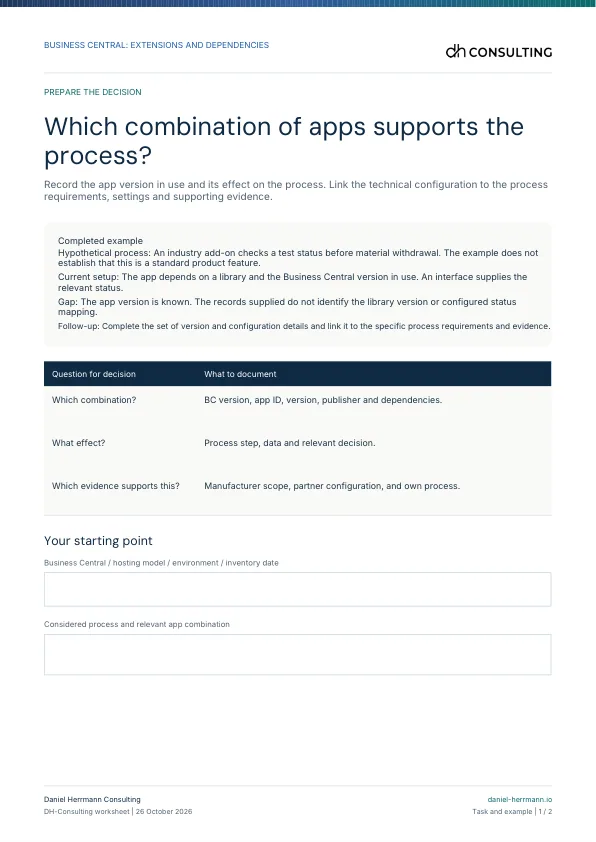
2 pages, A4, fillable PDF
Business Central: extensions and dependencies
Record the combination of Business Central apps, versions and dependencies that supports the GxP process.
Business Central owner, implementation partner, process team and QA.
What’s included
- Page 1: Which combination of apps supports the process? Includes a worked example, questions for the decision and space to record your starting point.
- Page 2: Record each extension, dependency, operational impact, available evidence and inventory gap, plus the owner, deadline and confirmed version. Includes sources and context.
Record the process first. Map its apps, base system, configuration and data paths. A version-specific inventory explaining relevance and identifying missing information or evidence.
Record the current app inventory and its impact. Use the update worksheet to assess the specific changed combination.
2 pages, A4, fillable PDF
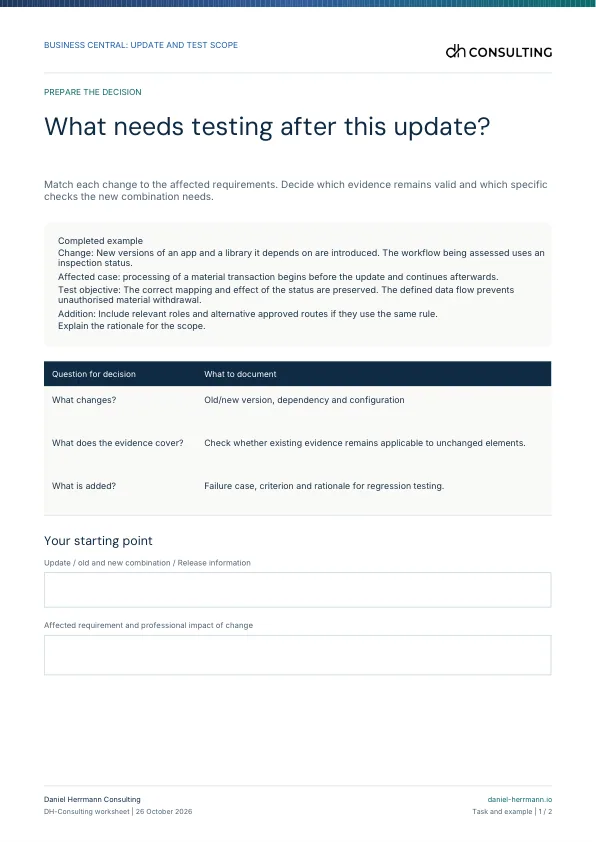
Business Central: update and test scope
Identify which checks a Business Central or extension update requires for the specific combination in use.
Business Central owner, process team, partner and QA.
What’s included
- Page 1: What needs testing after this update? Includes a worked example, questions for the decision and space to record your starting point.
- Page 2: Identify what remains valid, what to retest, the conditions and the result. Record the update decision, decision-maker, date and operating condition. Includes sources and context.
Compare the old and new combinations. Trace the change to its operational impact and select suitable tests. A justified update decision recording test scope, coverage and assessment of open items.
Assess the change and determine the test scope. This worksheet neither duplicates the app inventory nor imposes full testing in every case.
Two PDF worksheets
Request the worksheets for your team
Enter your name, company, work email and a phone number where we can reach you. We will call you briefly about your request and then email you the worksheets. A newsletter subscription is optional.
We have received your request.
We will call you briefly to discuss your request, then email you the worksheets personally.
Project experience and collaboration
Complete the evidence trail between Business Central and its extensions
With users, we follow a Business Central transaction and identify where extensions or industry modules intervene. We map app versions, dependencies and available partner evidence to those steps. Where an additional function is already largely covered, we address the outstanding questions. If several apps jointly affect a quality decision, we plan an end-to-end test. With the partner, we clarify who reports changes and which tests are available after an update.
Frequently asked questions about Business Central extensions
Does a marketplace entry already demonstrate GxP suitability?
No. Microsoft describes technical validation with a focus on stability and technical behavior in online service environments. This represents a limited contribution. The suitability for your regulated use also depends on additional factors such as requirements, configuration, data, and operational conditions. Therefore, verify which evidence actually exists and which questions regarding your process remain unanswered.
What expansions should be included in the validation scope?
All components and dependencies that may influence your relevant process or the data required by it must first be assessed. This includes, where applicable, library apps without a dedicated user interface. This does not imply the same level of validation effort for each application. Justify which requirements are affected and which existing or additional evidence is appropriate to support them.
Should the App-ID and version number be provided for identification?
Not in any case. Microsoft documents that PTEs with the same ID and version can have different content in different environments. Therefore, you can clearly assign the environment and the package actually used. A controlled package storage with traceable origin and checksum is a possible own approach to make tested and productive status comparable.
Sources: [3]
Who bears responsibility: Microsoft, partners, or end users?
Microsoft describes technical platform and Marketplace evaluations. The publisher must maintain and functionally or logically verify its extensions. The regulated user assesses the intended use and transferability of the evidence. Clearly define scope, responsibilities, and collaboration in writing. Particularly when multiple partners are involved, the entire process requires a single point of contact for cross-cutting incidents.
What documentation should we request from the industry partner?
Version-related functional description, prerequisites, dependencies, relevant settings, rights, known limits and suitable test results are useful. In case of changes, concrete release notes are added. The usability for your requirements is decisive. A general certificate or a standard compatibility statement does not replace any comprehensible explanation as to which combination and which process were actually investigated.
Do we need to repeat all supplier tests?
Not at all. First, evaluate the quality, scope and portability of the available evidence. Suitable results can already cover certain requirements. Own tests will then focus on remaining risks, configuration, process combination and relevant error paths. Unclear or unavailable supplier proofs may not be treated as implicitly passed.
Sources: [10]
Why is a successful sandbox test not always transferable?
The test environment may have different packages, permissions, data, and integration settings. Microsoft also describes specific characteristics of sandbox environments and changes associated with copies. Therefore, compare the relevant conditions for your inspection scenario with production. Documented differences may be acceptable, provided their impact is assessed and additional supporting evidence is available.
What should we specifically test at an interface?
Verify that the identity, value, and significance of required data are correctly received and processed. For risk-appropriate scenarios, account for invalid inputs, interruptions, repetitions, and corrections. Consider user rights and technical authorizations of involved extensions. The mere success of a call or an empty error list does not fully address the technical question.
How do we verify an extension update?
Assess the change including dependencies and select appropriate regression tests accordingly. In addition to new activities, consider existing data and ongoing processes. Assign the results to the actual test package executed. Technical compatibility checks support the process but do not relieve you of the professional judgment regarding the usability of your configuration.
What must a small and medium-sized enterprise (SME) prepare, and what causes effort and duration?
The following are required: a documented process, the relevant app combination, available partner documentation, and personnel capable of assessing intended values and results. Contributions from the department, quality assurance, IT, and affected partners must be planned in advance. Significant effort arises particularly due to unknown modifications, data pathways, and gaps in traceability. A fixed duration or a cost based solely on the number of installed apps would not be sustainable.
Sources: [10]
Sources and review date
Source: 6 October 2026. The manufacturer's instructions concern Business Central Online and the app types described in each case. Concrete platform and app versions, licensing and partner services are to be compared for their own use. Matrix, test cases and industry module are their own examples; no specific partner app is evaluated. Regulatory focus: GMP processes for human medicines. Editorial supplement of 26 October 2026: The new decision section and its work matrix are own methodological proposals. The previously mentioned source level remains separate from this.
- Microsoft Learn: Technical validation for Business Central Marketplace Apps
- Microsoft Learn: Testing your extension
- Microsoft Learn: Extension types and scope
- Microsoft Learn: Managing Apps
- Microsoft Learn: Update Lifecycle for Customizations of Business Central Online
- Microsoft Learn: Maintain Marketplace apps and Per-Tenant extensions in Business Central online
- Microsoft Learn: Production and sandbox environments
- Microsoft Learn: Call external services with the HttpClient data type
- Microsoft Learn: Troubleshooting web service errors
- European Commission: EU GMP Annex 11, Computerised Systems
- European Commission: EudraLex Volume 4, current GMP guidelines
Sources checked: .


Daniel Herrmann Consulting
Clarify your business-central extension test contribution
We support you in integrating supplier certificates, your own requirements, and cross-cutting data pathways into a traceable evaluation. The starting point is your actually deployed combination.
- Computer system validation →
Bring your GxP systems into validated operation, from laboratory software, MES and eQMS to ERP. We define the scope, plan risk-based tests using GAMP 5 and hand the evidence to QA for release.