

Table of contents
At a glance
What does ALCOA+ mean for an actual GxP record?
ALCOA stands for attributable, legible, contemporaneous, original and accurate. The plus adds complete, consistent, enduring and available. Follow one record through creation, correction, review and retrieval. Check the link to the right sample, the reasons for any change and whether an authorised reviewer can reconstruct the full record later.
- A result and the context needed to interpret it form the evidence together.
- Check completeness against the records you expect to find.
- Keep the original information and reason traceable when correcting a record.
- Control later retrieval as well as the initial recording.
Apply the principles within the right regulatory scope
PIC/S and the MHRA describe data integrity across the data lifecycle. ALCOA+ helps teams understand the principles. It does not certify a product. Identify requirements for the actual process and regulatory area.
The examples concern GMP for human medicinal products. Research, clinical trials, medical devices and pharmacovigilance have different frameworks. Using the same laboratory software does not make every GMP worksheet transferable to all these activities.
For UK GLP within the OECD Mutual Acceptance of Data (MAD) framework, the MHRA has pointed to the precedence of the OECD data integrity document since 2021. The notice is specific to that area. It does not displace the MHRA guidance across all GxP activities. The worked examples below remain within human medicinal product GMP.
Turn ALCOA+ into questions you can answer from records
Select one defined record and trace it from capture to decision. The table suggests questions and evidence. Different processes may need different technical controls.
| Property | Question | Possible evidence |
|---|---|---|
| Attributable | Who or what generated the value? | Identity and link to the instrument and sample. |
| Legible | Can the reader understand the content, unit and context? | Readable output with the necessary definitions. |
| Contemporaneous | Was the event recorded when it actually took place? | A record tied to the event, without reconstruction from memory. |
| Original | Which record is the authoritative first capture? | The source record or a verified complete copy. |
| Accurate | Are the value, assignment and calculation correct? | Comparison with an independently established expected result. |
| Complete | Are all the necessary parts present? | Reconciliation against the identifiers expected. |
| Consistent | Do the versions and sequence of events agree? | Traceable sequence across handovers. |
| Enduring | Does the required record remain protected? | Suitable storage and preservation controls. |
| Available | Can the responsible person use the evidence later? | Tested retrieval of the record with its context. |
Define the complete record before reviewing it
List the information needed for the decision, such as sample, method, raw values, parameters, calculation, result, relevant changes and assessment. A technical log entry does not necessarily belong to every result. Equally, a PDF on file does not make up for a missing parameter that affects a decision.
Map the handovers between instrument, file, application and report. A value can lose its unit or link to a sample at these points without triggering a technical error.
Distinguish the original record, result report and retained dataset
A laboratory test can generate several representations of the same activity. The instrument records a measurement, an application calculates a value and a report summarises it. They may establish different facts. Identify the authoritative record and the context needed to assess it.
Our example requires sample P-17, three input values, their unit, the factor applied and a traceable calculation. A report showing only “100.00 mg/L” answers a narrower question than the full dataset. A PDF can itself be the authoritative record or a suitable copy if it preserves the necessary information and functionality.
| Component | Question it answers here | What else to establish |
|---|---|---|
| Instrument capture | Which readings were generated for which sample? | The settings, identifiers and related information needed to interpret them. |
| Calculation | Which inputs and parameters produced the result? | Version, selection of inputs and traceable corrections. |
| Result report | Which value was presented for the decision? | Whether the report preserves every detail needed for this use. |
| Retained dataset | Can a reviewer later reconstruct what happened? | Tested access and preservation of the necessary relationships. |
Laboratory example with an independent expected calculation
Sample P-17 has a specified dilution factor of 50. The three valid readings are 1.98, 2.00 and 2.02 mg/L. The defined calculation uses all three. Their mean is 2.00 mg/L. Multiplying by 50 gives 100.00 mg/L. The assessment range in this example is 98.00 to 102.00 mg/L.
If the third reading is omitted without justification, the first two average 1.99 mg/L and give 99.50 mg/L. That result also falls within the assumed range. Meeting a result limit cannot demonstrate that the dataset is complete or the calculation appropriate.
| Case | Expected calculation or check | Assessment in this example |
|---|---|---|
| All three measurements present | (1.98 + 2.00 + 2.02) / 3 × 50 = 100.00 mg/L | The calculation matches the defined expectation. |
| Third reading omitted without justification | (1.98 + 2.00) / 2 × 50 = 99.50 mg/L | Plausible result based on incomplete data. |
| Factor entered as 5 in error | 2.00 × 5 = 10.00 mg/L | Detect and address the parameter error. |
| Sample ID P-71 instead of P-17 | The calculated value may remain unchanged. | The incorrect sample assignment must still be detected. |
Correct errors while retaining their history
An incorrect sample ID needs correction. Data integrity does not require leaving an error uncorrected. The authorised intervention, original information and reason for change must remain traceable.
After correcting the example, check more than the name in the report. Identify the original record affected and whether any other relationships changed. A “last modified” field alone may not establish those links.
Assess technology alongside the way people work
Individual access, limited change rights and suitable logging support reliable records. Check their effect in the actual workflow. With a shared account, a timestamp may be available even though the person who made the change cannot be identified.
Staff also need a way to record observations when they occur and report errors openly. Where no controlled means of recording is available at the workstation, additional training alone will not solve the problem. Examine the task as performed as well as the software configuration.
Test later access to the record and its meaning
A successful backup does not settle whether later users can understand the evidence. Verify that they can reopen the required record, interpret it and assess it with its history. Determine the retention period from the record type and applicable requirements.
For P-17, a result without the dilution factor and input readings cannot support the defined reconstruction. Test retrieval of precisely that information. You need not include every technical file from the original environment if it serves no purpose in the reconstruction.
Turn a data integrity finding into a verifiable improvement
Describe what you observed. “ALCOA+ not met” does not explain the problem. “The archived dataset for sample P-17 is missing the dilution factor used” identifies a gap someone can verify. The team can now identify the decisions affected and the information still available.
Separate immediate handling of the affected record from lasting process improvement. First protect available information from further loss and assess the effect on the decision. The responsible staff determine further action under the applicable quality procedure.
For the example, specify which data the archive must retain and retrieve a second suitable record to test the change. A revised procedure alone cannot show that the new process works. Document observable evidence of implementation and effectiveness. Set actions and timing for the actual gap.
| Item to record | Example entry |
|---|---|
| Observation and scope | The required factor is missing from the selected archived dataset. |
| Effect on the decision | The defined calculation cannot be fully reconstructed from this package. |
| Decision and responsibility | The assigned owner assesses the affected transactions and decides on further action. |
| Action | Preserve the required data elements during the actual handover. |
| Evidence of effectiveness | A later retrieval produces the values, factor and required sample relationship together. |
Where QA, IT and the laboratory can start
The process team identifies the decision and necessary context. IT identifies storage locations, permissions and data transfers. QA assesses the applicable requirement and documented gap. Start with one representative process.
Distributed records, unclear ownership and manual intermediate lists often drive effort. Identify concrete actions. A tick against each principle says little unless someone can demonstrate where the control actually works.
- Define the decision and data flow to examine.
- Identify expected records, identifiers, units and parameters.
- Test at least one normal handover and one failure.
- Include correction, review and later retrieval.
- Document each gap, its effect, the owner and the appropriate action.
Worksheets for your team
ALCOA+: Review the data flow and controls with us
Two fillable PDFs developed by our team guide you from the original record and data handovers to specific integrity findings and actions. They are designed for the GMP workflows described and need adapting to your actual use. You record observations and decisions you can substantiate in place of an overall compliance score.
Request the worksheets for your team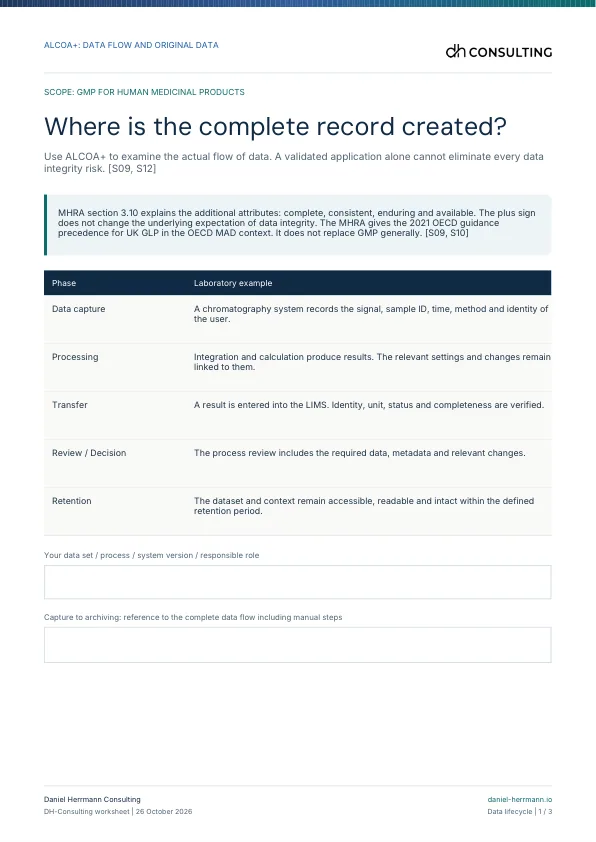
3 pages, A4, fillable PDF
ALCOA+: data flow and the original record
Capture a GMP data flow and its original record including metadata, transformations and hybrid transitions.
Laboratory manager, process owner, QA, data owner and system owner.
What’s included
- Page 1: ALCOA+ in context, the boundary between GMP and GLP, and a laboratory example across the data lifecycle.
- Page 2: Define the original record, including data, metadata, changes, dynamic functions, copies and retention.
- Page 3: Document a hybrid transfer, its control, error handling, owner and action. Includes sources.
Trace a representative record from creation through retention. Link to the actual evidence. An original-record plan identifying data transfers, controls and open actions.
Starts with the complete data context and tracks manual and electronic transitions over the life cycle.
4 pages, A4, fillable PDF
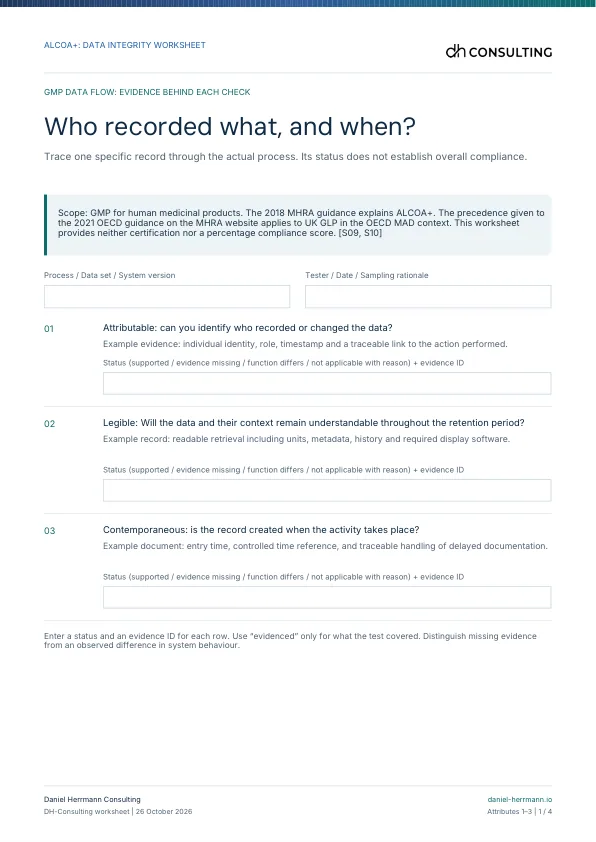
ALCOA+: data integrity worksheet
Assess the nine ALCOA+ attributes against actual evidence of controls in a GMP data flow.
QA, laboratory manager, process owner, data owner and system owner.
What’s included
- Page 1: GMP and GLP context, scope, and questions on whether data are attributable, legible and contemporaneous.
- Page 2: Questions on original, accurate and complete data, with an example of missing source data.
- Page 3: Questions on consistent, enduring and available data. Identify a risk-based review trigger instead of a fixed frequency.
- Page 4: Record the finding, affected data, containment, investigation, follow-up and effectiveness check. Includes sources.
Select a representative data flow. Evaluate each question based on real evidence and track open points. A completed control matrix with findings, containment actions and a traceable follow-up decision.
Each principle has a control question and a type of evidence. The worksheet sets neither a percentage score nor a universal review frequency.
Two PDF worksheets
Request the worksheets for your team
Enter your name, company, work email and a phone number where we can reach you. We will call you briefly about your request and then email you the worksheets. A newsletter subscription is optional.
We have received your request.
We will call you briefly to discuss your request, then email you the worksheets personally.
Project experience and collaboration
Check how ALCOA+ applies at each stage of the data flow
A plausible result may still lack supporting evidence. With the people responsible, we trace a value from its source through transformation, review and storage to its intended use. We look for missing links, later corrections and exports that omit important metadata. Clearer responsibility may resolve a local procedural fault. A technical gap also requires a change to data processing and testing of that change. Each finding is linked to the affected record.
Frequently asked questions about ALCOA+
Is ALCOA+ a law in its own right?
No. ALCOA+ is a mnemonic for data integrity principles described in regulatory guidance, including FDA and PIC/S guidance. Applicable regulations and GMP rules establish the requirements. The 2025 consultation drafts would use the terminology explicitly. Draft Annex 11 section 2.4 names ALCOA+. Draft Chapter 4 section 4.63 names ALCOA++ with the additional attribute “traceable”. Neither draft was in force on 26 October 2026.
Is a correctly calculated final number enough?
Must every technical log be retained?
May incorrect data be corrected?
Is a PDF automatically an original record?
File format alone cannot establish this. A PDF can be the original record or a reduced representation of other data. Identify the information and functionality needed for the intended evidence.
Sources: [2]
Does validated software automatically make the data reliable?
Suitable software provides a basis. User practice, access rights, configuration and handovers also affect integrity. An uncontrolled manual intermediate step can undermine an otherwise well-controlled system.
Sources: [2]
How do we check completeness?
Does every data entry require a second person?
ALCOA+ does not prescribe double checking of every entry. Assess significance, potential failure and existing controls. For critical manually entered data, Annex 11 calls for an additional accuracy check, which can also be performed by validated electronic means.
Sources: [6]
How can we start without a large data integrity programme?
Is ALCOA+ the same as audit trail review?
Are ALCOA+ templates available for a joint review?
Our two fillable worksheets cover data flow and the original record, and data integrity checks. Use them to record handovers, required context, observations and actions in the GMP setting described here. They are our own working documents. They do not constitute an official form or an automatic assessment of compliance. We send them personally after a short call.
Sources and review date
The original sources were checked on 6 October 2026. The statements about original records, the calculation, the worksheets and the MHRA note concerning UK GLP were checked separately on 26 October 2026. The text identifies document scope and status. Adapt the examples and worksheets to your process.
- PIC/S, PI 041-1, Data Management and Integrity1 July 2021, sections 3–7, 8.9–8.11, 9.6, 9.8–9.10, 10 and 12
- MHRA, GxP Data Integrity Guidance and DefinitionsRevision 1, March 2018. Sections 2–5 and 6.1–6.11 cover data review and archiving terminology.
- European Commission, EudraLex Volume 4 document indexAccessed 6 October 2026. The human medicines GMP section lists Chapter 4 and Annex 11. Veterinary medicines are treated separately.
- European Commission, EU GMP Chapter 4: DocumentationJanuary 2011. Principle, Records and sections 4.1 and 4.8–4.12.
- FDA, Data Integrity and Compliance With Drug CGMP: Questions and AnswersFinal guidance, December 2018. Section III, Q1–3, Q7–9 and Q10–11.
- European Commission, EU GMP Annex 11: Computerised SystemsJanuary 2011 revision. Principle and sections 1–4, 7, 9–13 and 17.
- European Commission, Annex 11 consultation draft, 2025Consultation draft. The review on 18 October 2026 covered data integrity in section 2.4 and alarm management in section 8. Assess other proposals within their stated scope. The draft was not in force.
- European Commission, Chapter 4 consultation draft, 2025Consultation draft, not in force. Section 4.63 describes ALCOA++ and traceability. The original text was checked on 18 October 2026.
- MHRA, Guidance on GxP data integrity: status page and UK GLP noticeStatus checked on 26 October 2026. The UK GLP notice dated 27 September 2021 is specific to that regulatory area.
Sources checked: .


Daniel Herrmann Consulting
Discuss a decision that depends on the integrity of your data
We help connect the applicable requirement, actual data flow and evidence your team needs. We start with your existing records and the question they leave open.
- Computer system validation →
Bring your GxP systems into validated operation, from laboratory software, MES and eQMS to ERP. We define the scope, plan risk-based tests using GAMP 5 and hand the evidence to QA for release.