

Table of contents
At a glance
What belongs within the scope of SAP GxP validation?
In SAP ERP and S/4HANA, quality management (QM), materials management (MM), production planning and process manufacturing (PP/PP-PI), warehousing (EWM/WM), shipping (SD) and plant maintenance (PM) can all support GxP activities. Module names alone do not determine validation scope. Identify the activities, data and decisions that affect product quality, patient safety or data integrity. Use these workflows and dependencies to derive requirements and risk-based evidence. Scope ByDesign and Business One separately because their functions use different names.
- Start with professional judgment and potential errors, not with a generic module list.
- Track relevant data across master data, interfaces, reporting, and storage throughout the lifecycle.
- Distinguish process functions, required technical support, and justified excluded usage.
- Associate each essential testing requirement with a specification, a responsible party, and an appropriate validation evidence.
From module offering to a clearly defined inspection task
A verifiable SAP request specifies the relevant business process, system status, and expected outcome. Additionally, document the information provided by your team and identify who determines open scope questions. This transforms technical delineation into a clear work assignment that both the supplier and internal team can fully understand.
In addition to the batch release procedure described below, we consider a second example involving a data pathway: a quantity transfer between SAP and an attached packaging system. The originating quantity must arrive at the destination with the correct unit. It remains unclear, however, how a rejected message is handled and whether a retry could trigger a second booking. These are questions pertaining to the described process, not assertions about a specific SAP standard function. A simple comparison of the two quantities neither addresses the issue of retransmission nor the technical application of the destination ledger.
| Note the discussion | Appropriate task result | What else might still be missing |
|---|---|---|
| Subject matter: Start, end, and anticipated decision | Limited procedure with key data and target criteria | Process owner or designated requirement |
| Affected Systems, Configuration and Data Transfers | Justified system boundary with responsibilities and existing evidence | Version, interface description or appropriate test environment |
| Relevant normal process flow, errors, and recurrence | Appropriate test scenarios and subsequently evaluated result documentation | Controlled test data, access to the partner system or reviewer capacity |
Not every of these questions needs to be addressed at the first point of contact. What is essential is that any missing prerequisite remains visibly apparent in the offer. If the scope is to be clarified initially, the exact state of that decision constitutes the outcome. When subsequent testing is assigned, execution, evaluation of results, and handling of deviations must be included. An automatically expanded scope for each additional module would be no more justified than a blanket exclusion of a linked system.
With "SAP: Define processes and GxP decision boundaries," you prepare the technical basis for decision-making. The second document, "SAP: Define interfaces and inspection assignment," supports coordination of data transfers, required documentation, and outstanding prerequisites. The final decision remains subject to your actual implementation. Please request the documents with your name, company, business email, and telephone number; following a brief phone call, you will receive them personally.
Sources: [1]
How GxP validation differs from SAP’s built-in data checks
In SAP documentation, validation may also refer to input validation, counting control, or professional plausibility rules. This article addresses the suitability of a computerized system for its intended regulated use. Correctly configured field validation can contribute to this objective, but remains insufficient as a complete validation evidence for a business process.
The regulatory examples apply to human medicinal product GMP. Annex 11 serves as the GMP guideline for computerised systems; the European Commission continues to maintain the revision from January 2011. Medical devices, veterinary medicinal products, and other activities require their own specific requirements. FDA Part 11 is additionally evaluated in accordance with applicable record-keeping obligations and electronic usage.
Record the specific reason prior to the technical discussion: Introduction, modified process, migration, or evaluation of an existing system. The same SAP inventory may require different levels of documentation depending on the change. An inventory describes what is currently available; the scope decision explains why and what portion is being assessed.
Decisions and consequences begin
Select a process with a clear beginning and end, for example, the acceptance of a raw material up to its authorized use. Who decides, based on which information, that further processing is permitted? What consequences would arise from incorrect, missing, or delayed information? Describe also the scenario in which an authorized employee must deviate from the standard procedure.
These questions constitute a standalone reference document for risk-based boundary definition. The EMA recommends for complex systems a detailed evaluation of critical functions. Consequently, a process description may extend beyond the organisational responsibility of any single module. A specification may originate in an application, while the evaluation takes place in the laboratory, and material movement is subsequently triggered in SAP.
Use concise, testable statements: An undefined material status must not permit the defined production withdrawal. The released result must be attributable to the correct material. Such statements help QA and IT jointly discuss technical requirements and implementation. They are significantly more specific than the requirement that SAP must be GxP-compliant overall.
Use the module as an orientation tool and justify exclusions.
Module names assist in locating functions and responsible parties. However, they do not provide a reliable boundary between relevant and irrelevant. Even a seemingly purely financial restriction may interact with a logistical release. Determine whether this interaction influences a quality-related decision or merely pertains to a separate business process.
The following matrix serves as an internal discussion aid and is not an official regulatory classification. It outlines potential review questions, not a blanket categorization of entire modules. Your decision should specify the actual workflow utilized and the underlying assumptions. Any unclarified assumption should be treated as an open item in the planning phase rather than silently excluded.
A justified exclusion could state: The considered travel expense reconciliation generates and modifies no GMP-relevant records and is not part of the described quality decision process. A shared user administration remains, however, a separate technical dependency. The existence of a shared platform does not imply that every travel expense function must be subject to equivalent technical scrutiny.
| Area of responsibility | Typical components in SAP ERP/S/4HANA – internal assignment | Potential GxP exposure | Question to define the scope |
|---|---|---|---|
| Purchasing and the material master | MM and utilized master data functions | Identity, specifications and intended material usage | Which data influence acceptance or use? |
| Storage and Shipping | EWM or WM, shipping in SD | Status, Assignment and Actual Material Movement | What pathways must a block consider? |
| Manufacturing | PP or PP-PI and associated configuration | Specifications, materials used, and execution records | Which information control or support the manufacturing process? |
| Quality Control | Quality Management and Related Laboratory Processes | Results, Assessment and Quality Decision | What errors could lead to an incorrect conclusion? |
| Finance and Billing | FI/CO and relevant interfaces to other components | If applicable, shared data or linked locks | Is there a relevant dependency or merely spatial proximity within the ERP? |
| Technical Operation | Operational and IT operations, as well as integrated components utilized | Access, data transfer, and recovery | What support is required for the defined process? |
| Maintenance and calibration | PM with the employed QM functions | Device status, maintenance, and intended use | Which information affects the authorized use? |
Make the data flow and its significance visible
For the selected decision, retain at least one data record from origin to storage. Identify the primary system, used identifiers, units, versions, and status. Distinguish between a displayed value and the underlying recording, as well as any derived or aggregated representation.
A product-specific example illustrates why this is necessary: In ByDesign, identified stock numbers may be unique only within a product depending on configuration. A pure batch number without a product reference would then not constitute a sufficient key. This finding applies to the evaluated ByDesign documentation and is not extended to all SAP products.
Also assess seemingly harmless transitions: An export removes a status, a report aggregates data sets, or an interface converts units. Within your own scope, determine whether the decision-relevant information retains its significance. The EMA explicitly addresses the significance and logical relationship of data in database-driven systems. Simply having the correct total sum does not answer this question.
Dependences up to professional efficacy are pursued
Draw a simple system limit with inputs and outputs: SAP application, laboratory, warehouse, document source, identity service and relevant evaluations. Identify where data is generated, checked, taken over or modified. An external service does not remain outside the scope of consideration, just because another contract or team is in charge of it.
The technical interface must align with the specific product stage. For example, SAP describes a workflow for external result capture via the Inspection-Lot-API in the S/4HANA Cloud Public Edition 2608. This example does not include result capture for inspection points. This limitation highlights why a general-purpose interface cannot cover all functional variations.
Double messages, incorrect assignment, delayed feedback and restart after interruption are suitable as your own test questions. Determine which system detects an objection and who processes it. Nevertheless, technically successful data transport can be wrong in technical terms. The proof therefore ends with the correct effect in the target process, not already with the successful transmission protocol.
Assign vendor, partner, and end-user documentation.
Separate three questions: What is documented regarding the standard function? How was your specific solution implemented or enhanced? And does it function for your intended workflow? Relevant documentation can be provided as supplementary. You are not required to replicate all manufacturer tests nor to consider unverified partner documentation as sufficient.
State the current status, the substantiated fact, and remaining limitations of an inherited piece of evidence. A supplier certificate may demonstrate a specific defect handling approach; the assignment of your own material identifiers may remain a user verification. The actual delivered content determines the outcome, not a general assumption about what the supplier routinely tests.
Name the responsible parties for requirements, configuration, data interfaces, and technical evaluation. The process owner justifies the decision, provides IT with the data flow, and communicates the technical implementation to the execution partner. QA assesses the evidence of traceability within the agreed quality framework. For closure, these perspectives must align; a single signed cover sheet does not replace open substantive questions.
Sources: [1]
Deriving from the scope a reasonable test depth
GxP Relevance and test depth are two distinct decisions. First, determine which usage scenario is involved. Then, assess the potential impact of a failure, how it would be detected, and what controls are in place. From this evaluation, key focus areas for successful processes, edge cases, and unauthorized actions emerge.
A one-size-fits-all GAMP category for the entire SAP landscape does not adequately address these questions. Core functionalities, configuration settings, custom extensions, and interfaces may require distinct validation evidence. Clearly describe these differences without inferring a rigid classification based on product name or deriving a fixed number of test scripts.
Leverage supporting infrastructure appropriately. Annex 11 distinguishes between the validation of the application and the qualification of the IT infrastructure. Common services such as access and data backup are not rendered irrelevant, but do not need to be described as separate, dedicated ERP processes. Assess performance for critical workflows and make existing, relevant documentation available for use.
Example: Release information from laboratory to warehouse
The following example does not describe a guaranteed SAP standard function. A laboratory evaluates a batch of raw materials. An ERP process takes over the decision, and a storage process should only provide suitable material for a defined manufacturing order.
For this process, correct result assignment falls within the scope, as does the transfer and the actual impact on sample withdrawal. An independent cost center reconciliation is technically infeasible for this example. Nevertheless, their shared infrastructure and potential data interconnections are documented. The boundaries are thus defined by justified functions, not by organizational teams.
The second support function translates requirements into validation evidence. Within the project, this results in specific test data and acceptance criteria. For example, if the intended application can continue to operate despite outdated release information, this constitutes an initial finding. Decide, based on the intended process, which technical or organizational control is required; do not retrospectively alter the expected outcome, as this would invalidate the test result.
| Requirement | Relevant dependency | Custom in-house testing procedure |
|---|---|---|
| Decision belongs to the correct batch | Product and batch identifiers | Intentionally swap similar identifiers and verify assignments |
| Only the assessed result status will be used | Status and version of the feedback | Old status transferred after a newer decision |
| Lock acts at defined sampling point | ERP and warehousing process | Take with affected material and appropriate test roll attempt |
| Transmission error remains detectable | Interface and Responsibility | Break the connection and verify a controlled restart. |
| Decision remains comprehensible later | Recording and retention | Rationale, data record, and documentation relationships to be retrieved again |
Scope for existing installations and modifications to be continued
For existing landscapes, begin with actual usage and available documentation. The EMA specifies for legacy systems requirements and gap analysis as the foundation for suitability assessment. Missing documentation does not automatically imply that all components are unusable, nor does long-term usage suffice as a substitute for proper evidence.
After a change, confirm whether any assumptions from the previous scope remain valid. A new interface, an updated report, or an additional role may be relevant, even if a new SAP module is not introduced. Also assess the potential for new uses of existing data: a previously purely operational report may one day become part of a quality decision.
Data migration and retention require separate evaluation when data formats, structures, or access rights change. This applies equally to system decommissioning. Assess which historical relationships must be preserved and which controlled access options are provided. The specific scope depends on the change and relevant documentation; a change in batch release does not automatically necessitate a full restart of validation.
Finalise the scope with the appropriate stakeholders in an operational state.
For a small team, walking through a representative process together is often the best entry point. Bring together process owners, QA, IT, and the relevant laboratory, production, or storage personnel. Use a real-world process flow as a conversation foundation, and then apply controlled, appropriate data for the subsequent testing.
The first draft should include a clear boundary, key risks, existing evidence, and open decisions. Workload planning should be based on this foundation. Numerous variants, customizations, poor master data, or unclear responsibilities increase the need for clarification. A robust estimation identifies these drivers and their assumptions; it does not guarantee a fixed duration solely based on the number of modules.
- Intended use and regulatory basis are specified.
- Process start, end, decisions, and potential consequences of errors are described.
- Relevant data, leading systems, and professional identifiers are captured.
- Interfaces, external services, and supporting infrastructure are assigned.
- Included functions and exclusions have a clear rationale.
- Supplier and partner certifications are evaluated based on version and scope.
- Open questions have responsible parties and a planned decision.
- Requirements, key inspection focus areas, and acceptance criteria are aligned.
- The agreed scope will be re-evaluated upon modifications and for new uses.
Sources: [1]
Agree the validation scope for your SAP processes
Which business processes and handovers belong in the assignment? We work with process owners, IT, QA and the implementation team. You show us how the system is used, and together we resolve the next open question about scope.
Start with our computer system validation guide →
We discuss why you are getting in touch, where your system stands and which decision comes next.
Worksheets for your team
Define the SAP GxP processes and test brief
A module name alone does not define a validation assignment. The worksheets link your process decision to the systems involved and the interface questions to test. Record operational assumptions separately from functions supported by evidence.
Request the worksheets for your team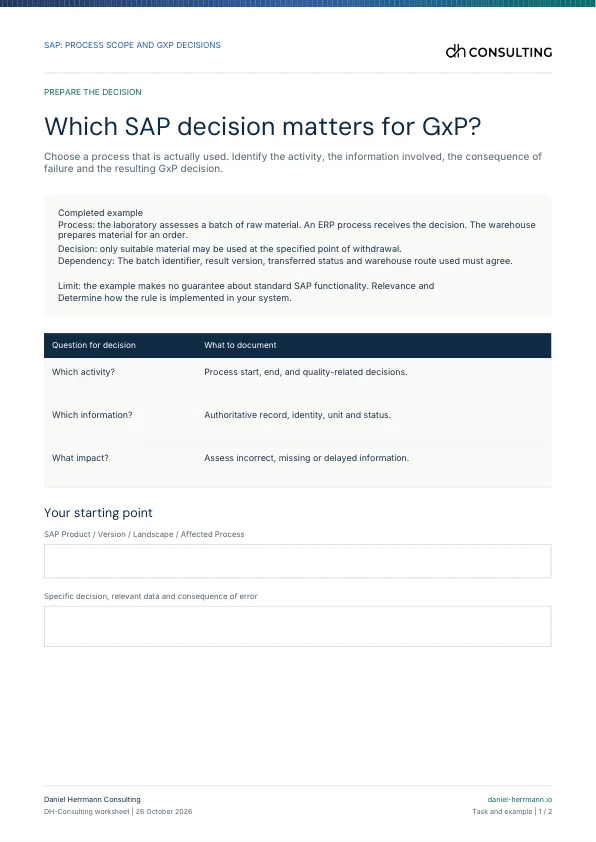
2 pages, A4, fillable PDF
SAP: process scope and GxP decisions
Explain the GxP relevance of an SAP process in actual use and the quality decisions it supports.
Process owner, SAP owner, process team and QA.
What’s included
- Page 1: Which SAP decision matters for GxP? Includes a worked example, questions for the decision and space to record your starting point.
- Page 2: Define SAP process scope, dependencies, exclusions and evidence needed. Record who confirmed the scope, when, and any outstanding prerequisite. Includes sources and context.
Start with a transaction and the decision it supports. Use module names to locate functions and responsibilities. A justified process scope with relevant data, dependencies, exclusions and the tests to commission.
Decide which use is relevant. The second worksheet traces a specific data transfer and the responses to errors.
2 pages, A4, fillable PDF
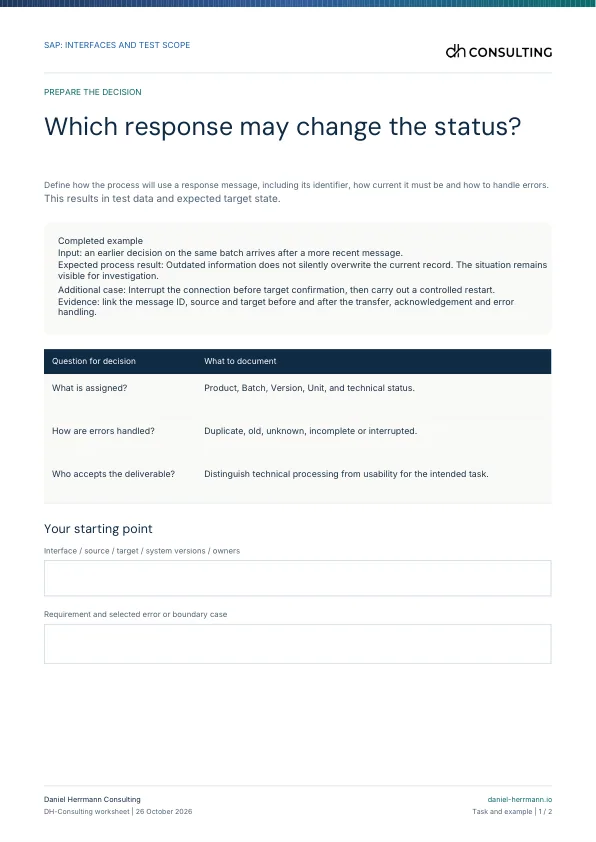
SAP: interfaces and test scope
Define the business requirement, failure cases and result records for an SAP data transfer.
Interface owner, SAP operations, laboratory or warehouse team and QA.
What’s included
- Page 1: Which response may change the status? Includes a worked example, questions for the decision and space to record your starting point.
- Page 2: Define interface test data, steps and criterion. Record the actual result, deviation, decision, responsible roles, date and remaining limit. Includes sources and context.
Follow one record from its source to its operational use. Plan mapping and restart before running the test. An interface test brief with observable criteria, an owner and a decision on findings.
Assess one transfer and its significance. This does not classify entire SAP modules as GxP-relevant.
Two PDF worksheets
Request the worksheets for your team
Enter your name, company, work email and a phone number where we can reach you. We will call you briefly about your request and then email you the worksheets. A newsletter subscription is optional.
We have received your request.
We will call you briefly to discuss your request, then email you the worksheets personally.
Project experience and collaboration
Define the SAP validation scope along the material and data flows
With SAP owners, we follow a relevant process, such as material receipt through to permitted batch use. We identify components, custom extensions, interfaces and manual decisions. For a known module change, the assessment may be limited to affected functions. An implementation or migration first needs a shared view of authoritative data and ownership. We document justified exclusions so the team can explain why each area needs evidence and how its handovers to other areas are tested.
Frequently asked questions about SAP validation scope
Must the entire SAP landscape be validated?
The scope is justified based on the intended regulatory use. Relevant processes and their technical interdependencies must be considered; not every independent function requires the same level of technical validation. In particular, document the interfaces and exclusions. A simple list of used modules is no more sufficient than a general statement that the entire ERP system is included.
Are financial modules automatically outside the scope of GxP?
No. A standalone accounting function may lie outside the described GMP process. If other relevant workflows use, restrict, or make decisions based on its data, such interconnections must be evaluated. Justify each specific usage and its dependencies. The term "Financial Module" alone is neither sufficient to exclude a function nor a valid basis for assessing all financial functions at the same depth.
Sources: [1]
Are SAP-QM functions always automatically GxP-related?
Quality relevance makes them natural candidate for testing, but does not replace consideration of actual usage. A quality management (QM) process for non-regulated materials may be appropriately structured differently from a critical raw material inspection for human medicinal products. Describe the actually used functions, data, and consequences. Product-specific mechanisms and established exceptions are then evaluated within the appropriate system context.
What distinguishes GxP validation from a SAP data entry validation?
An input validation checks, for example, a format, an allowable value, or a booking rule. GxP validation evaluates whether the implemented computerized system is suitable for its intended use. This includes considerations such as requirements, relevant risks, validation evidence, and regulated operation. A single plausibility check may represent a necessary control, but it does not automatically cover the entire business process.
Sources: [1]
Do Excel analyses and associated laboratory systems fall within the scope?
When calculating, modifying, transferring, or providing data for a quality decision, you must assess your role in the process. This may involve establishing specific requirements and interface documentation. Particular attention should be given to identity, significance, and the data version used. The mere fact that SAP remains the central ERP system does not render a file or external system irrelevant.
Which evidence may we accept from the supplier or implementation partner?
Appropriate evidence, whose version, subject, and results align with your requirements. Document which question is addressed and which limitations remain. The actual delivery scope may vary. Custom configurations, additional requirements, or process transitions may necessitate supplementary testing; a blanket reperformance of all supplier tests is neither justified nor acceptable without proper evaluation.
Sources: [1]
Does a GAMP category suffice as justification for the scope of validation?
No. Even a categorization justified within a project does not encompass all relevant business processes, data flows, and failure cascades. To determine the scope, you need to consider the intended usage and perform a risk-based evaluation of functions and dependencies. Avoid rigid categorization solely based on product name. Evidence should address specific requirements and demonstrate suitability.
How do we start with a long-operating SAP system that has documentation gaps?
First, establish the current usage, key configurations, and existing documentation. Define the required requirements and compare them against the verifiable current state. The EMA refers to this approach as requirements and gap analysis. This leads to prioritized tasks; long-term usage alone is not sufficient justification for replacement, and the absence of documentation does not justify an unverified, full-scale rebuild of all evidence.
Sources: [5]
Who determines the scope and exclusions?
The decision requires technical and professional input. Process owners shall describe the intended workflow, IT shall outline dependencies, and QA shall define the applicable quality framework. Manufacturers or partners shall provide technical information and supporting documentation. The project team shall clearly define who will approve the aligned decision. A technical inventory alone or a sole financial project boundary is not sufficient as a basis for such a decision.
Sources: [1]
When must we re-evaluate the scope decision?
When changes may affect usage, data, controls, or dependencies. Examples include a new interface, additional permissions, modified reports, migration, or new usage of existing data. Periodic evaluation may also yield new insights. Document what is impacted and what evidence is required; a software update does not automatically imply that all previous validations must be fully repeated.
Sources and review date
Regulatory reference: Human Medicines GMP; other fields of application are to be defined separately. The matrix and test aids are own methodological proposals. Manufacturer examples apply only to the explicitly mentioned products and document stands, retrieved on 6 October 2026. Editorial supplement of 26 October 2026: The new decision section and its work matrix are own methodological proposals. The previously mentioned source level remains separate from this.
- EU GMP Annex 11: Computerised Systems
- European Commission: EudraLex Volume 4
- FDA: Part 11 — Scope and Application
- EU GMP Chapter 4: Documentation
- EMA: GMP/GDP Questions and Answers — Annex 11
- SAP: Example: Recording Inspection Results in an External System
- SAP Business ByDesign Library 2608
Sources checked: .


Daniel Herrmann Consulting
Define the scope of your SAP process validations specifically
Daniel Herrmann Consulting supports you in integrating business processes, system dependencies, and existing documentation into a justified scope of work.
- SAP S/4HANA validation →
Support an SAP go-live with evidence your team can defend at audit while keeping validation on schedule. We take a risk-based approach from the template to the interface for greenfield or brownfield projects and existing ECC systems.