

Table of contents
At a glance
What should a validation plan test for a proposed AI use?
Start with the decision or record the output will affect. For drafting, test whether proposed text agrees with approved sources. If staff copy it into a GxP record, demonstrate traceability, qualified review and controlled transfer. If it informs a quality decision, the accountable person needs enough evidence to evaluate the result and a working means of rejecting it. Each intended use calls for different acceptance criteria.
- Read the draft and verify its sources
- Checking how information enters a GxP record
- Deciding who can approve use
- An AI validation brief needs a specific intended use.
- An overall average can mask significant error types.
- Separate the data used for development from those used for independent evaluation.
- Models, configurations, knowledge sources, and controls may change after implementation.
What happens to the AI output?
Describe what happens to the output of a document analysis. Is it displayed as a search aid, entered into a record or used for a quality decision? Even a nominal draft can matter if staff use its contents without checking them.
Identify the inputs, permitted data types, expected outputs and tasks outside scope. Describe what happens if the output is wrong, incomplete or unavailable. Use those consequences to plan the assessment. The same technology can pose different risks when used for different purposes.
The worksheet “AI project: test scope and boundaries of use” helps the process team and QA define the task. Use “AI project: data access and test decisions” to check whether the data and references needed for the decision are accessible. The worksheets support project planning. They do not establish that the application is suitable. Send the four required details and we will briefly discuss your use case by phone, then send you the worksheets personally.
Step 1. AI suggests wording for a work instruction
A document author is updating a work instruction for document control. The assistant receives revision 4 of the approved process specification and the existing working draft. It may propose wording and cite passages. It has no authority to write to the approved version.
The test set deliberately includes superseded revision 3. That version requires a second signature which revision 4 does not require for this step. The author checks the suggestion, document ID and section against revision 4. A citation to revision 3 or an unsupported signature requirement means rejecting the suggestion. The author records the version checked and the correction made.
Step 2. A statement is transferred to a GxP record
The document owner wants to enter the reason for the change in the change record. The owner checks each statement against the original and records the document ID, revision 4, the exact passage, the review outcome and who carried out the review. In this test case, an AI-generated citation alone is insufficient evidence.
Step 3. Who decides whether to approve the document?
The person authorised under the quality system receives the corrected version and change record. They can withhold approval and record why. The test passes if the invalid requirement is detected, the workflow remains blocked until correction and a reviewer can reconstruct the decision from the record.
If the assistant gains the ability to write directly to the approved document, it has exceeded the original limits of use. Before allowing that use, the team must assess the additional impact and define the evidence it needs.
Which model and which regulatory text apply?
The 2025 Annex 22 consultation draft addresses static, deterministic AI and ML models in a defined set of critical GMP applications. It excludes dynamic and probabilistic models as well as generative AI from that proposed critical scope. The draft gives no general approval to use LLMs for critical GMP decisions.
Check whether a text was still in draft on the assessment date or was part of the published GMP guidance for human medicines. A draft does not replace applicable requirements or assessment of your specific project. Other rules may also apply. Assess their scope separately. GxP relevance and a legal AI classification are different questions.
The EMA workshop report published on 2 October 2026 records discussion of expanding the scope of Annex 22 to dynamic, adaptive, probabilistic and generative models, subject to the requirements of the annex and a documented, robust, risk-based control strategy. Its “Next Steps” section says that the contributions will inform the ongoing revision. The report is neither a final annex nor general approval for a particular use.
What are regulators asking about AI in pharma?
European Union, as of 17 November 2026. The EMA report published on 2 October describes discussion of extending the scope to more model types under a documented, robust, risk-based control strategy. For your project, record the model type, the actual application and the outstanding evidence separately.
United States. In its warning letter to Purolea Cosmetics Lab dated 2 April 2026, FDA cited this drug manufacturer’s use of AI to prepare specifications and procedures without adequate expert review. In your pilot, ask the reviewer to substantiate selected requirements against the original and demonstrate that they can reject an unsuitable instruction.
On 29 June 2026, the UK MHRA Inspectorate reported problems with AI-assisted responses to inspection findings. Examples included references to sources that did not exist and answers that missed the actual finding. Take a sample finding and check whether your response gives evidence of what happened at the site and how the finding is being addressed.
The ISPE GAMP Guide: Artificial Intelligence, published in July 2025, offers industry guidance for such projects. Determine the legal position for your intended use from the jurisdiction, the specific process and applicable requirements.
What question should the test answer?
The test brief should state the question and what result would answer it. We developed the matrix below as a planning aid. It is not a mandatory Annex 22 template and does not approve a particular use.
Agree that the assessment may conclude that the application is unsuitable for its intended purpose. A brief that allows only a favourable conclusion cannot support an open assessment.
| Subject | Question to ask | Expected result |
|---|---|---|
| Purpose | What task may the application perform? | Clear limits on permitted and excluded uses |
| Data | Can you establish the source and suitability of the test data? | A justified link between the test data and the reference used |
| Error | Which incorrect output would matter? | Relevant failure modes and consequences |
| Criteria | When is the performance sufficient for this purpose? | Acceptance criteria defined and justified before testing |
| Control | How is an inappropriate result identified and addressed? | Realistic, verifiable workflow with defined responsibilities |
| Operation | What change can affect suitability? | Process for assessment and response |
Choose test data and performance measures for the intended task
An assessment needs a traceable reference. Decide who determines the correct classification or answer and how ambiguous cases will be handled. The test data should represent the intended use, including relevant variations and boundaries. A few straightforward demonstration cases may be insufficient.
Record which cases were used in development and which in testing. Cases used repeatedly to improve the model offer limited evidence of independent performance. Overall accuracy can also hide rare but important errors. Select metrics and limits that fit the task and the consequences of mistakes.
For static, deterministic models in its proposed critical scope, the Annex 22 draft gives more detail. The table links sections of the 2025 draft to work packages we might include in a proposal. Check the model type before using it. The draft’s scope cannot be applied wholesale to LLMs.
Where organisational independence cannot be maintained, section 6.5 describes a specific paired-work approach to personnel separation. This does not permit reusing development cases and calling them independent tests. Match scope, roles and controls to the actual model type.
| Work package | Deliverable to agree | Section of the 2025 draft |
|---|---|---|
| Performance benchmark | Known performance of the process being replaced, with acceptance criteria at least at that level | Section 4.3. Its Annex 11 reference is to the parallel draft. |
| Scope and subgroups | A justified test-set size that supports appropriate statistical confidence, including within each relevant subgroup | 5.1–5.2 |
| Reference quality | Verification of reference labels and a defined approach to ambiguous cases | 5.3 |
| Independence | Technical and organisational separation of test data, access and personnel | 6.1–6.5 |
| Explainability | The contributing features needed for interpretation, with a reasoned assessment by the relevant specialist | 8 |
| Confidence | Recorded confidence where applicable, with a defined route for inconclusive results | 9 |
Does human review detect consequential errors?
“A member of staff checks it” does not describe a sufficient control. Establish what expertise, original information, time and decision authority the reviewer has. The reviewer must be able to detect a relevant error and reject the unsuitable output. Try the control with representative cases.
Human review does not remove the limits on intended use. In particular, a human confirmation click does not make a critical generative AI application suitable if the draft Annex 22 excludes it from scope. If the intended use cannot be supported, consider a narrower task or another technical approach.
Worked example for finding passages in approved instructions
Suppose a team is assessing a tool to help staff find approved instructions. Before use, the team defines which documents the tool may search, how it identifies the relevant version, and how to handle missing passages or incorrect matches. Staff should still base the decision on the authoritative original information.
Include cases with obsolete revisions, similar terms and questions for which no source exists. If staff cannot reliably recognise unsuitable output, revise or restrict the approach. Suitability depends on the proposed use.
Which supplier, model version and components affect the result?
For an external application, establish what the supplier can tell you about the model, changes, data processing and limitations. Prompt instructions, connected document collections and technical filters can all affect output. A product name alone rarely identifies the configuration assessed.
Agree how to handle changes and unexpected deviations. Does the application still support the original task after a change? Which signals trigger an investigation? An initial assessment covers the versions and configurations assessed at that time.
What does the operating team need at handover?
At project close, relate the permitted tasks and system version to the test data, results and remaining limitations. Assess each open issue and identify how it will be handled. The operating team must know when to restrict or suspend use and who decides what happens next.
An external partner should help your team make that decision. Check whether each proposal covers data preparation, establishing reference answers, testing controls and ongoing operation. A guarantee of “AI validation evidence” tells you little if the task itself has not been defined.
For the search assistant, a proposal should specify more than “test the RAG system”. A useful first deliverable defines the permitted document set, reference answers and testable system configuration. Those details allow the supplier to scope test execution and evaluation. Use the following comparison when agreeing the deliverables.
If the reviewer cannot access permitted inputs or actual outputs, or identify the version under test, resolve that first. Identify the information needed to support the specific conclusion before requesting the supplier’s internal data. If access is insufficient, narrow or redesign the work. The final report must explicitly identify any conclusion the available evidence does not support.
- Define the intended purpose and excluded tasks.
- Classify the model type and determine the applicable regulatory scope.
- Justify the test data and the consequential failure modes selected.
- Test whether human oversight works in practice.
- Assign responsibility for changes and limits of use during operation.
| Claim in the proposal | Deliverable to agree | Limit on the conclusion |
|---|---|---|
| “Connect the documents” | List of authorised document versions, exclusions and how obsolete revisions are handled. | Access to a file alone does not make it a suitable reference. |
| "Verify answer quality" | A justified set of cases, including questions with no source and similar terminology. Record the reference, observed output and assessment for each case. | A good overall result cannot close a significant unresolved error. |
| “Hand over for use” | Permitted task, version assessed, limitations and decision owner. | Handover gives no blanket approval for new tasks or later model versions. |
Worksheets for your team
Define the scope of the AI validation project
To assess an AI project, you need a defined test brief and data you can access. These worksheets clarify both before commissioning the work. You still need to assess suitability and decide whether the proposed use is acceptable.
Request the worksheets for your team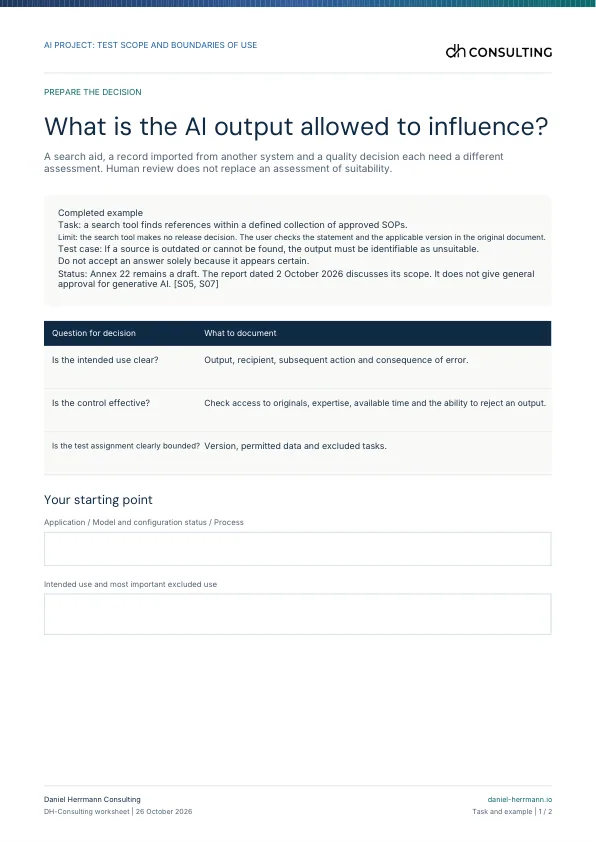
2 pages, A4, fillable PDF
AI project: test scope and boundaries of use
Define an AI test brief using the task, output, intended use and human control.
Process owner, QA, system owner and AI project lead.
What’s included
- Page 1: What is the AI output allowed to influence? Includes a worked example, questions for the decision and space to record your starting point.
- Page 2: Define your AI test brief, intended use, consequences of error, control, criterion and tests. Record the decision and its owner, outstanding prerequisite, date and record location. Includes sources and context.
Describe how the output affects the process. Define the limits of use and controls you can test. A test brief identifying permitted use, exclusions, criteria and decisions to make.
Define the task and its control. Use the data worksheet to decide whether you have suitable data and evidence for testing.
2 pages, A4, fillable PDF
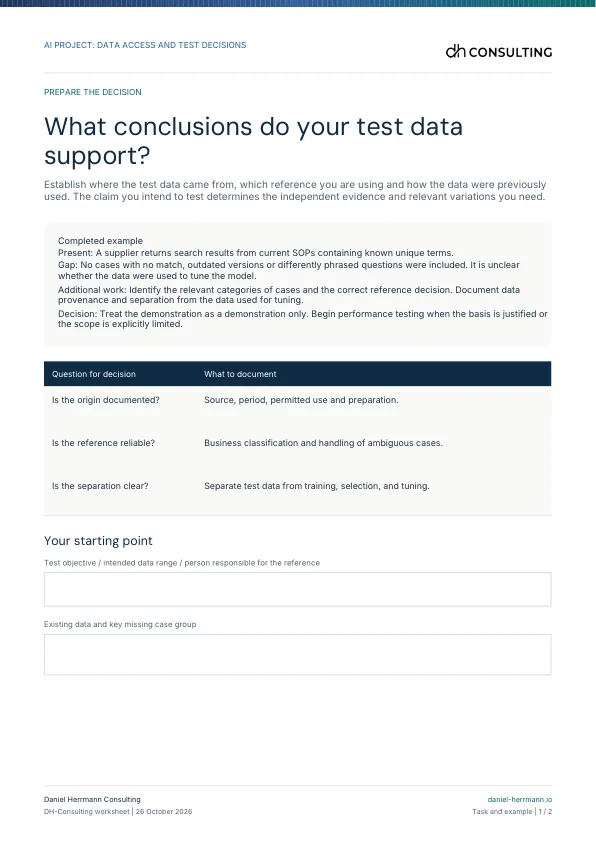
AI project: data access and test decisions
Assess whether the available data and reference can support the conclusion you want to draw from an AI test run.
Data owner, subject matter expert, data scientist, QA and AI project lead.
What’s included
- Page 1: What conclusions do your test data support? Includes a worked example, questions for the decision and space to record your starting point.
- Page 2: Assess data access, the reference, independence, case groups and uncertainty. Record your decision about testing. Includes sources and context.
Describe the source, reference and independence of the data. Limit your conclusions if relevant groups or evidence are missing. A reasoned decision on whether testing can start, which data are missing and what subsequent conclusions can cover.
Decide whether the test basis is suitable and where its limits lie. This worksheet does not grant general approval for the AI system.
Two PDF worksheets
Request the worksheets for your team
Enter your name, company, work email and a phone number where we can reach you. We will call you briefly about your request and then email you the worksheets. A newsletter subscription is optional.
We have received your request.
We will call you briefly to discuss your request, then email you the worksheets personally.
Project experience and collaboration
Assess a specific AI task before defining the tests
With your team, we describe the task and the consequences of a wrong decision. That gives us a basis for discussing reference cases, acceptance criteria and controls that can address the risk. A tool that helps staff find information raises different questions from one that makes a quality-relevant decision. Agree the limits of use and the basis for assessment before committing to a test programme or drawing a conclusion about suitability.
Frequently asked questions about AI validation in pharma
Can any AI system be validated for a critical GMP task?
The task, technology and regulatory scope must fit. The Annex 22 consultation draft limits the proposed critical scope and excludes certain model types. A successful demonstration cannot by itself establish suitability for a critical GMP task.
Sources: [3]
Is Annex 22 already a binding general standard for AI?
Is 95% accuracy enough?
An overall threshold makes little sense without the task and the consequences of errors. Within its proposed scope, section 4.3 of draft Annex 22 uses the known performance of the process being replaced as the minimum benchmark. Examine relevant failure modes and subgroups as well. The linked articles explain how an overall average can conceal important errors.
Does a human review make every AI output usable?
Should changes to prompts and knowledge sources be assessed?
Yes, where they could affect the intended use or relevant outputs. Determine the scope of change assessment from impact and risk. The initial assessment can become outdated even when the model name stays the same.
Sources: [1]
What does a consultant need for a specific AI project?
Describe the task, data types, intended output, consequences in the process and available supplier information. Add known failure scenarios, planned controls and the responsible roles. This lets the consultant assess the basic feasibility first and then define the test brief.
Sources and review date
The EudraLex index, consultation draft and EMA report were checked on 17 November 2026. The industry overview examines dated original sources from the EU, the US and the UK, alongside an ISPE industry guide. We developed the document-control test case.
- European Commission: EU GMP Annex 11, Computerised Systems, January 2011 revisionGMP for human medicinal products, particularly sections 1–4, 7, 10–13 and 16–17, applied as cited in the relevant sections.
- ICH Q9(R1): Quality Risk Management, official text from the European CommissionRisk-based decisions, appropriate formality and management of subjectivity. We developed the matrices as implementation examples.
- European Commission: Annex 22 Artificial Intelligence – consultation draft 2025Consultation draft. It does not establish a requirement in force or give general approval for generative AI within its critical scope.
- European Commission: 2025 Consultation on Chapter 4, Annex 11 and new Annex 22Identifies the drafts and their consultation status. It does not establish entry into force.
- European Commission · EudraLex Volume 4 index of current publicationsThe human medicinal products section was checked on 17 November 2026. Separate veterinary medicines rules changed on 16 July 2026.
- European Commission: EU GMP Chapter 7, Outsourced ActivitiesOutsourced GMP-related activities, suitability, responsibilities, agreements, and monitoring.
- European Commission · EU GMP Chapter 2, Personnel, effective from 16 February 2014Personnel, role-specific training and assessment of practical effectiveness. The official EudraLex entry links to the original chapter.
- EMA: Workshop report on the development of Annex 22EMA/156789/2026, published on 2 October 2026. On 26 October 2026, the introduction on p. 3 and “Next Steps” on p. 14 were checked against the original report. The review covered those passages.
- FDA · Warning letter to Purolea Cosmetics Lab, 2 April 2026Specific US inspection case involving AI-generated specifications and procedures.
- MHRA Inspectorate · Use of AI for GxP inspection responses, 29 June 2026The UK inspectorate describes observed problems and its expectations for responses to findings.
- ISPE · GAMP Guide: Artificial Intelligence, July 2025Publisher’s public description of its industry guide.
Sources checked: .


Daniel Herrmann Consulting
Defining the task, output and subsequent decision
Bring a specific use case and known failure scenarios. Together we can identify which boundaries to assess first and which information is still needed to define a test brief.
- AI system validation →
Bring your AI system into GxP use with traceable evidence and keep it under control in operation. Once the system and intended GxP use are defined, we validate according to risk, addressing data, supplier, tests, release and change control.