

Table of contents
At a glance
How do you plan LIMS validation with an external partner?
Define the sample types, methods, result processing, reports and interfaces needed for intended use. Assess what supplier documentation demonstrates for your configured LIMS. Select tests for remaining questions around calculations, status changes, corrections and data transfers. Assign responsibility for master data approval, migration and operation. For LabWare and other LIMS, the configured laboratory process determines evidence needs.
- The evaluation begins with the laboratory request and ends with the used, traceable result.
- Methods and specifications are professional inputs for validation planning.
- Device connectivity, calculation, and reporting require a common data reference.
- A supplier assessment should address a specific laboratory issue and provide supporting evidence.
Trace a test order from sample receipt to reporting
Select an actually intended workflow: for example, the inspection of incoming material against a defined specification. Follow the sample setup, method assignment, data capture or transfer, data calculation, evaluation, and reporting. Identify activities outside the LIMS as well. A device evaluation may originate in a separate application and can only involve the transfer of a derived result.
For each transition, it should be clearly defined which record is generated, which system is used to maintain it, and who is authorized to use it. This enables identification of gaps between laboratory, IT, and implementer functions. The instruction must explicitly specify additional sample types and analytical methods involved. A carefully reviewed pilot process does not prove that any other configuration has been adequately covered.
The document "LIMS: Laboratory process and test request" supports alignment on sample pathway, performance limits, and involvement. "LIMS: Transfers and edge cases review" deepens the question of whether the same technical data is received at all relevant sites. Use both tools to support your established process; this does not imply a predefined test sequence for each LIMS. Include name, company, business email, and telephone number in the form to prepare for a brief coordination meeting; thereafter, we will personally send you the work aids.
Evaluate methods, specifications, and master data jointly
A properly functioning application can lead to an inappropriate decision if its set limits are incorrectly configured. Therefore, assess not only software functionalities but also relevant methodologies, units, rounding rules, specifications, and release procedures. Clarify the significance of a limit value prior to test execution. Displayed and actually decision-relevant values may raise different concerns.
Confirm with the contractor whether he performs only a technical processing check or also supports the structured evaluation of the facility. The technical correctness of an analytical method cannot be substituted by a general LIMS functionality assessment. Similarly, laboratory software validation must be distinguished from any required method validation.
What a conclusive test must demonstrate
An appropriate test links requirements, input data, expected behavior, and actual results. The table below serves as a standalone planning aid. The selection and depth of testing depend on the specific risks identified; not every row requires the same level of effort in every project.
Chapter 6 section 6.16 calls for recorded results and critical examination of calculations. Section 6.17 specifies items including test results and calculations, the people performing the work, a verifier where applicable, and a clear status decision signed and dated by the responsible person. Translate these requirements into named roles, records and test cases for your LIMS configuration.
A test report should indicate which stage was verified. Screenshots without data context, environment details, and result evaluation only partially address these questions. Therefore, request, in any example of evidence, a justification explaining why the test is appropriate.
| Stage | Preceding note on clarifying question | Possible evidence |
|---|---|---|
| Sample registration | How is a sample clearly assigned? | Continuous reference between job and sample |
| Result import | How are unit and sample acquisition obtained? | Comparison of defined source and target values |
| Calculation | Which formula and rounding rule applies? | Justified reference results including edge cases |
| Assessment | When is a result considered out of range? | Evaluation of agreed decision rules |
| Change | How can a correction be traceable? | Appropriate documentation of changes and context |
| Approval | Who reviews and determines the acceptable result? | Authorized assessment, required signature, and unambiguous data reference |
| Report | Which version and status are issued? | Comparison of release data with approved data |
Verify equipment and ERP interface transfers as professional communications.
For each relevant interface, you require mapping, transmission trigger, feedback, and exception handling. Specifically clarify whether a repeatedly transmitted dataset should be created anew, assigned, or rejected. The intended response must be derived from your process and compared against the actual implemented behavior.
The "successfully transferred" technical notification alone is not sufficient as evidence. For selected cases, verify sample traceability, values, units, and required context. In cases of errors, it must be clearly identifiable who has authority to act and when further processing must be halted. A manual alternative pathway conducted outside the system also requires a structured evaluation.
Sources: [1]
How can LabWare experience be assessed?
If you require support for LabWare, distinguish general CSV expertise from knowledge of your specific system. Three screening questions can help: How are existing LIMS basic configuration adjustments interpreted and validated? How are LabStation data imports evaluated with sample and result linkage? Which components of a pharmaceutical template actually align with your requirements? The supplier should provide specific inputs and validation evidence, rather than relying on a product name as a suitability justification.
The questions relate to publicly described LabWare functional and training areas; not every area is implemented in every environment. The existing LabWare technical document elaborates on product-specific testing questions. This guide addresses the project scope and task delegation.
Separate implementation, troubleshooting, and independent result evaluation in task planning. A supplier can contribute multiple elements, provided responsibilities and necessary controls are defined. Crucially, a technical solution must not be simultaneously unverified and treated as professionally accepted output. Manufacturer documentation is assessed for suitability in the actual application context.
Example: A result is retrospectively corrected
Assuming a laboratory identifies a defective unit after the first data entry, the involved parties must predefine who is authorized to correct the data, which original information must be retained, and how previously generated outputs should be handled. The review process must trace the path from the data change through result evaluation to the required documentation. The responsible reviewer must be able to identify the amended data state and demonstrably perform the required second review. Critical manual entries, as specified in Annex 11, Section 6, require an additional accuracy verification by a second individual or through validated electronic means.
An out-of-specification result and a erroneous data entry constitute distinct investigation triggers. Chapter 6, Sections 6.7 and 6.9 addresses procedures for out-of-specification (OOS) and out-of-trend (OOT) results, including their investigation. Clarify how such a case is initiated, linked to the original record, and professionally assessed.
Different approaches may be appropriate: an appropriate configuration, a controlled correction workflow, or a modification to the interface workflow. The suitability of any particular approach depends on functionality, risk, and operational structure. This example represents a planning scenario and does not constitute a commitment to specific LabWare functionalities.
For order acceptance, the correction case can be explained in more detail from the example: Order A-17 belongs to sample P-04; the first recorded result level E1 is corrected before release to E2 checked. The laboratory provides the correct value as a suitable reference. The service provider should show whether application, report and related further processing handle this agreed status correctly.
"Successful interface testing" would be too vague for this acceptance criterion. Agree on responsibility for preparing the reference dataset, performing the technical evaluation, and assessing the meaning in the process of the results. If the wrong version appears in the report, this constitutes a finding related to the reviewed process; correct transmission of the appropriate version does not resolve this. The scope of defect correction and retesting is explicitly included within the performance boundary. This ensures the offer is comparable to the required laboratory results, rather than merely to the number of pre-defined test cases.
| Transition | Agreed expected result for the example | Required result reference |
|---|---|---|
| Data entry → Correction | E1 remains traceable with the correction linked to E2. | Task, Sample, Original Status, Change and Responsible Person. |
| Correction → technical review | The reviewer evaluates the current state of E2 with the required context. | Actual verified result version and documented assessment. |
| Release → Report | The report uses the result version approved for that purpose. | Comparison of result version, status, and issued report. |
| Re-transmission of E1 | The outdated version does not replace E2 without notice. | Preliminary defined reaction, actual observed behavior, and management of the finding. |
Plan migration and productive operation early
During a migration, it is not necessary to automatically transfer all legacy data into the new LIMS. Reasonably determine which data must be retained in the target system and which can remain accessible in an appropriate legacy or archive repository. The essential information and relationships required for the specific retention purpose must be preserved. A simple count of records does not guarantee the completeness or accuracy of the data.
For the operation, you agree with those responsible for method changes, user rights, relevant protocol reviews and faults. Also, check how new methods or changed reports are evaluated. A transfer is only practical when laboratory and IT can process such a change request on the basis of the existing information.
Compare scope of services and participation in the offer
A measurable offering includes the considered processes, existing source documentation, required enhancements, and specific delivery outcomes. Separate explanations should be provided for associated costs related to master data management, interface integration, report correction, and repetition. This encompasses internal point of contact responsibilities and timely availability of representative data.
A good closure links documents to actual laboratory operations. Walk through a regular case and a relevant out-of-specification case together. Open items require evaluated handling and clear accountability. An external service provider can assist with processing; a general assurance of error-free operation does not substitute for these decisions.
- Identify representative laboratory procedures and variations.
- Standards and specifications for testing methods to be maintained and ensured.
- Record devices, ERP, and reports in the same data path.
- Separate access and archiving for legacy data sets.
- Changes in the later laboratory operation to be assigned to responsible personnel.
Define the LIMS assignment with the laboratory, IT and QA
For your LIMS project, we discuss the laboratory workflow, system version, available evidence and interfaces. Daniel Herrmann Consulting helps you define a work package and agree what each team will deliver.
Start with our computer system validation guide →
We discuss why you are getting in touch, where your system stands and which decision comes next.
Worksheets for your team
Define the LIMS project brief and evidence needs
LIMS validation should follow the laboratory workflow and its data transfers. Use the first worksheet to define a test brief. Use the second to prepare relevant import, correction and exception cases.
Request the worksheets for your team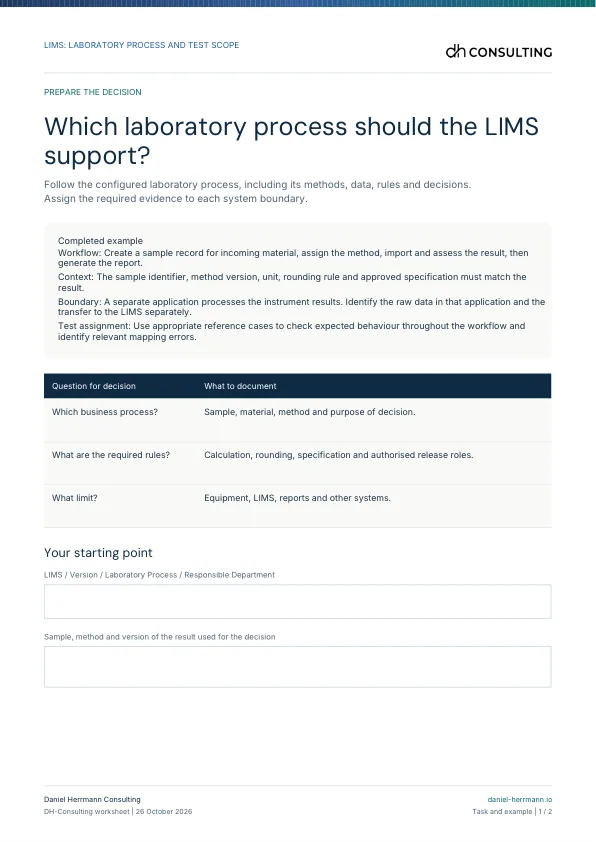
2 pages, A4, fillable PDF
LIMS: laboratory process and test scope
Define the LIMS test brief from sample receipt to reporting, including the relevant methods and master data.
Laboratory manager, LIMS owner, subject matter expert and QA.
What’s included
- Page 1: Which laboratory process should the LIMS support? Includes a worked example, questions for the decision and space to record your starting point.
- Page 2: Define the LIMS workflow, operational rules, critical deviation and test brief. Record scope limits, further technical checks, decision and date. Includes sources and context.
Choose a laboratory workflow you intend to use. Distinguish software functions, configured process rules and work performed outside the LIMS. A process profile identifying relevant requirements, test boundaries and responsible operational roles.
Define the laboratory process and assignment. Use the second worksheet to examine specific data transfers and failure cases.
2 pages, A4, fillable PDF
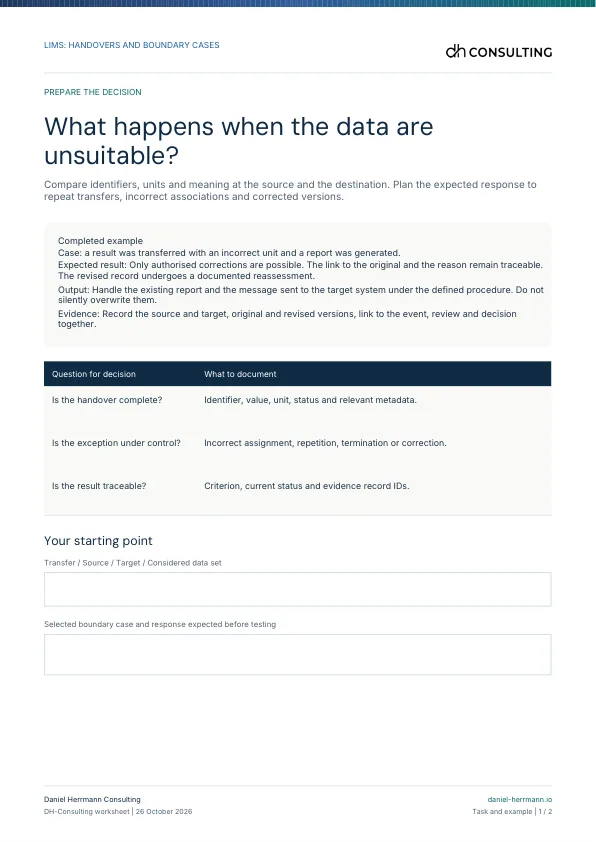
LIMS: handovers and boundary cases
Plan a boundary case for a LIMS transfer or correction, with an expected response and evidence.
LIMS owner, laboratory team, interface owner and QA.
What’s included
- Page 1: What happens when the data are unsuitable? Includes a worked example, questions for the decision and space to record your starting point.
- Page 2: Record the LIMS boundary case, test conditions, procedure, criterion, actual result, finding, decision, use restriction, owner and date. Includes sources and context.
Select one transfer. Define the expected outcome and error response before testing. Record the actual result afterwards. A fillable test case with data reference, criterion, observation and evaluated deviation.
Test a specific handover, including exception handling. Retain the separate LIMS process profile.
Two PDF worksheets
Request the worksheets for your team
Enter your name, company, work email and a phone number where we can reach you. We will call you briefly about your request and then email you the worksheets. A newsletter subscription is optional.
We have received your request.
We will call you briefly to discuss your request, then email you the worksheets personally.
Project experience and collaboration
Follow one sample through the laboratory and LIMS
With the laboratory, QA and IT, we trace a sample from its master data through calculation and correction to the final report. This shows what the LIMS configuration already covers and which questions remain open. We use it to define tests and assign responsibility. Whether methods, instrument interfaces or migration need the most attention depends on your laboratory workflow and existing system.
Frequent Questions on LIMS Validation
Is the LIMS provided by the supplier fully validated for our laboratory use?
Supplier documentation can serve as a key foundation. However, it must align with your actual system status and usage. Custom configurations, methods, roles, and interfaces are not automatically fully validated. The request should explicitly include an evaluation of existing documentation and justified supplementation.
Sources: [1]
Is LIMS validation the same as validation of our analytical method?
No. The suitability of the software for the intended workflow and the technical validity of an analytical method are distinct responsibilities. There are interfaces, for example, in calculations and result evaluation. Both responsibility areas and their required inputs should be integrated into the project.
Can existing tests from another laboratory be transferred?
Only to the extent that the suitability for the customer's specific requirements, configurations, and risks is demonstrable. Deviations in methods, roles, or associated systems may require additional validation evidence. Simple name similarity of the software is not an adequate criterion.
Sources: [1]
What should a LabWare service provider know before providing a quotation?
Useful are version and operating mode, employed modules, modifications, sample types, methods, reports, and interfaces. Supplement existing documentation, planned migration, and outstanding issues. This enables a specific task to be clearly defined, rather than estimating a general document package.
Must all historical data be transferred into the new LIMS?
Not mandatory. What is essential are a justified data strategy and continued access to retained information, along with the necessary context. An alternate access or archive must genuinely fulfill this purpose. The decision should be made prior to migration and decommissioning.
Sources: [1]
What should I look for in a handover to operations?
Labor and IT can identify who performed a method change, a flawed result, or a system interface failure. They can access relevant system and process documentation and are aware of outstanding tasks. Simply transferring the directory listing is often insufficient for this purpose.
Sources and review date
Primary source date: 17 October 2026. The regulatory reference framework pertains specifically to computerized systems in human medicinal product manufacturing. The audit matrix and correction example serve as standalone planning aids. The supplemental FDA data integrity guidelines are referenced from a U.S. perspective; the referenced laboratory requirements are aligned with EU GMP Chapter 6. No unverified functions of a LabWare version are asserted. Product status, configuration, and technical laboratory requirements are to be evaluated on a case-by-case basis.
- European Commission: EU GMP Annex 11, Computerised Systems, January 2011 revisionHuman medicinal products – GMP; in particular, §§1–4, 7, 10–13, 16–17; specific application for each section.
- FDA: Data Integrity and Compliance With Drug CGMP – Questions and Answers, December 2018Data integrity in pharmaceuticals under CGMP; no reinterpretation of new tests into historical records.
- ICH Q9(R1): Quality Risk Management, official text from the European CommissionRisk-driven decisions, appropriate formalities, and handling of subjectivity; own matrices are implementation proposals.
- European Commission: EU GMP Chapter 6 – Quality ControlFinal Version, effective from 1 October 2014; laboratory calculations, result documentation, and out-of-specification/out-of-trend investigations.
- European Commission: EU GMP Chapter 7, Outsourced ActivitiesOutsourced GMP-related activities, suitability, responsibilities, agreements, and monitoring.
- LabWare: Function-specific training for LIMS Basic, LabStation, and Pharma TemplatePublic offering demonstrates functional and competency areas, no setup required in every customer environment.
- European Commission: EU GMP Chapter 2, Personnel, effective from 16.02.2014Personal, role-specific training and assessment of practical effectiveness; official EudraLex entry with original chapter.
Sources checked: .


Daniel Herrmann Consulting
Describe their main result pathway
Provide a typical laboratory task, a relevant method, and an overview of the involved systems. Using this example, it can be clarified which data transfers are already adequately described and where your validation mandate should first establish clarity.
- Computer system validation →
Bring your GxP systems into validated operation, from laboratory software, MES and eQMS to ERP. We define the scope, plan risk-based tests using GAMP 5 and hand the evidence to QA for release.