Pillar WissenJun 9, 2026 · 11:009 min readBy Daniel Herrmann
CSA vs CSV: What the FDA Final Guidance Means for Your Validation Strategy
CSA vs CSV: direct FDA scope, process risk, suitable assurance activities and objective evidence for your validation strategy.
Computer Software Assurance (CSA) is the final FDA guidance for risk-based software assurance in medical-device production and quality management systems. The revised guidance issued in February 2026 supersedes the September 2025 version and aligns it with the amended 21 CFR Part 820 Quality Management System Regulation (QMSR). Its methods can inform risk-based CSV in other Pharma GxP contexts, but that does not extend the direct FDA scope.
In February 2026, FDA revised its final guidance “Computer Software Assurance for Production and Quality Management System Software.” This version supersedes the final guidance issued on 24 September 2025 and reflects the amendments to 21 CFR Part 820 under the Quality Management System Regulation (QMSR). The core issue remains: test volume is not a synonym for software assurance. IT leads, QA owners and Business Process Owners must therefore establish scope first. This article explains what CSA changes, when the FDA guidance applies directly and how its risk-based methods can be transferred without overstating applicability.
What CSA really is — the FDA definition
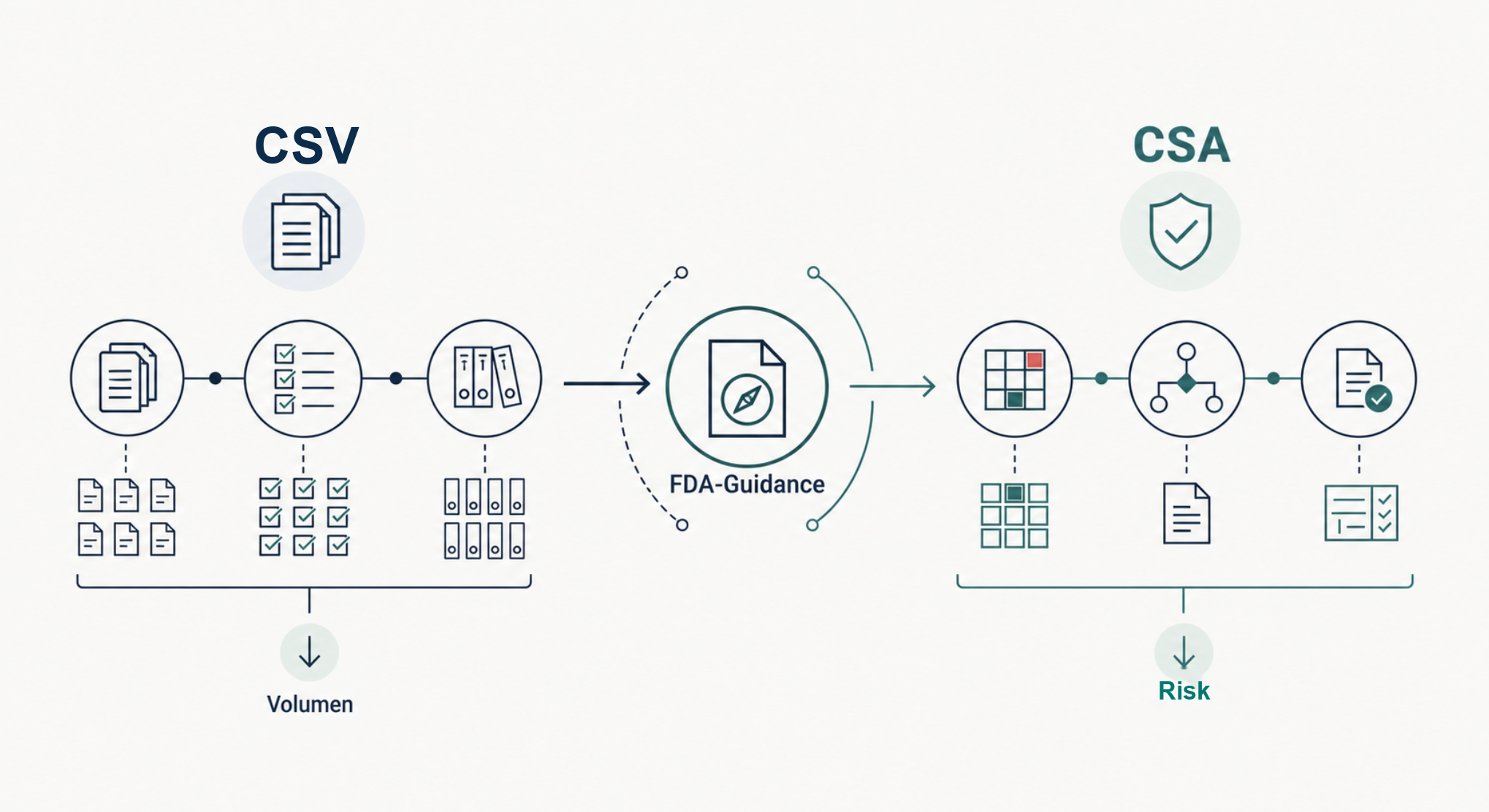
Computer Software Assurance is the FDA's methodological answer to a discrepancy that has been growing for years. On one side stood established CSV practice: documentation-heavy, test-intensive, with a tendency toward formalism. On the other side stood the reality of modern software development: agile, iterative, cloud-based, with ever shorter release cycles. CSA closes this gap.
The scope is clear: CSA applies to computers and automated data processing systems used in medical-device production or the manufacturer's quality management system. Depending on intended use, this may include production, laboratory, training, document or quality applications. Software as a Medical Device follows separate regulatory requirements. A LIMS, MES or ERP module is not in scope merely because of its product category; manufacturer context and intended use decide.
At its core, CSA shifts the logic of Validation: away from "test everything that is technically testable" toward "assess on a risk-based basis what protects patient safety and product quality". This shift is not a softening of the requirements. It is a refinement of what Validation should achieve: safety for patient and product — not completeness of test scripts.
Important for context: CSA exists in parallel to 21 CFR Part 11 and 21 CFR Part 820. The regulatory obligations — audit trails, electronic signatures, data integrity, quality system requirements — remain unchanged. CSA does not change what you have to demonstrate. CSA changes how you demonstrate it.
CSV vs CSA in direct comparison
The following table shows the central shifts between classic CSV practice and FDA CSA methodology:
Aspect
documentation-heavy CSV practice
CSA (FDA Final Guidance, revised 2026)
Basic approach
Compliance-first
Assurance-first (patient + product)
Test philosophy
Full testing, scripted
Risk-based, focused
Documentation depth
Extensive, procedural
Lean, benefit-oriented
Mindset
Prove everything
Risk-based justification
Validation effort
High, often proportional to function count
Proportional to risk
Patient safety focus
Implicit
Explicit, primary
Audit trail
Test-volume oriented
Justification-oriented
Modernisation fit
Hard to combine with Agile/DevOps
Natively supported
The comparison table makes it clear: CSA is not less than CSV — CSA is structured differently. Whoever reads column two against column three and thinks "less effort = less safety" has missed the point. CSA reduces redundancy, not substance. Audit robustness remains — it just emerges from documented assessment rather than documented test volume.
"CSA is not less CSV. CSA is smarter CSV."
The four core principles of the FDA methodology
For implementation, we condense the guidance into four working principles. This is a dh Consulting practice model, not the FDA's verbatim structure. It provides a workable framework for software assurance within the direct CSA scope.
First principle: define Intended Use. Before validation begins, it must be clear what the software is used for. A LIMS function that generates sample identifications has a different Intended Use than a LIMS function that prints sample labels. The FDA explicitly requires this differentiation — and not only in the test script, but already in validation planning.
Second principle: assess risk. Which functions could compromise patient safety or product quality if they malfunction? This question governs the entire validation effort. High-risk functions are tested in depth. Low-risk functions are — with documented justification — reduced or covered through supplier declarations. The risk assessment is not an appendix; it is the steering instrument.
Third principle: plan assurance activities. On a risk basis, select the activities that provide the necessary assurance: scripted or unscripted testing, supplier evidence, monitoring and other suitable methods. The choice must fit intended use and process risk; scripted testing is not universally required.
Fourth principle: keep records appropriately. Documentation scales with the effort of the assurance activities. A thoroughly tested high-risk function receives full test records. A low-risk function covered by supplier assessment receives a brief justification document. The idea: every page of documentation serves a purpose. Whatever has no purpose is not produced.
These four principles work together. Whoever neglects the first cannot assess the second cleanly. Whoever chooses the third incorrectly produces either too little or too much in the fourth. CSA is methodical — and that is exactly where the efficiency gain comes from.
When CSA applies — and when CSV still does
The question "CSA or CSV" is not binary. Both methodologies coexist in 2026 — with a clear scope:
CSA applies directly to: computers and automated data processing systems used in medical-device production or a medical-device manufacturer's quality management system. Whether a LIMS, MES, ERP, document, training or quality application is in scope depends on its intended use.
Other CSV frameworks remain relevant for: pharmaceutical GMP, GCP, GLP or GDP systems outside that direct scope and for other regulatory contexts. Risk-based assurance can be implemented through GAMP 5, ICH Q9 and the applicable rules without presenting FDA CSA as a direct requirement.
Software as a Medical Device (SaMD) follows its own regulatory logic. 21 CFR Part 820, IEC 62304 and the relevant FDA guidances on AI/ML SaMD form the framework here. CSA principles are methodologically related but not directly applicable.
In practical terms, classify manufacturer context, intended use and regulatory basis first. Only systems in the direct scope should be described as FDA CSA applications. Suitable methods may be adopted for other GxP systems, but must remain justified within their own regulatory framework.
What changes in practice in your validation strategy
Whoever applies the CSA methodology consistently sees measurable changes in three areas.
Test volume can be reduced selectively. Where process risk, intended use and usable supplier evidence support it, blanket scripted tests can be replaced with more suitable assurance activities. The result is not automatically less work, but better-justified use of effort.
Documentation structure changes. CSV documentation is classically template-driven — every function is described according to the same scheme. CSA documentation is justification-driven — every function is documented according to its risk profile. Templates remain helpful, but they become tools, not mandatory structures.
The rationale becomes central evidence. Your dossier must show why a function was assessed as high or not high process risk and why the selected assurance activities are appropriate. Audit preparation therefore covers both test evidence and the traceable decision path.
For your validation strategy, clarify applicability, realign risk assessments and test strategies, build reviewer competence and update affected procedures. Timeline and effort depend on the portfolio, governance, system risk and available evidence.
The path to implementation — where to start
CSA introduction is not a big-bang project. It is a structured transition in four steps:
Classify your system inventory. Which of your GxP systems fall within the CSA scope? Which do not? A simple classification table is enough as a starting point.
Select a CSA pilot system. Start with a clearly bounded system in the direct CSA scope whose process risk and evidence base support a defensible pilot assessment.
Apply the methodology in the pilot. Risk assessment, assurance activities, appropriate records — run the four principles through the pilot. Document what works and what needs to be adjusted.
Scale the framework. Based on the pilot, adapt your SOP set, your templates and your reviewer training. Then roll out the methodology across the entire system portfolio.
Set the timeline based on the number and criticality of systems, affected procedures, reviewer competence and governance maturity. The pilot provides the defensible basis for rollout.
Frequently asked questions
Does CSA fully replace the CSV framework?
No. CSA describes a software-assurance approach within its direct scope; the obligation to demonstrate fitness for intended use remains. Outside medical-device production and the related quality management system, the applicable CSV and GxP requirements continue to govern. 21 CFR Part 11 and quality management system obligations remain unchanged.
Does CSA also apply outside the USA, e.g. to EU pharma?
CSA is an FDA guidance with a defined US regulatory scope. Risk-based methods can align with European GxP approaches, but this does not create a direct CSA obligation for EU Pharma. The applicable legal and guidance basis must be established per system.
How do CSA and GAMP 5 2nd Edition relate to one another?
They can be complementary, but they are not interchangeable. GAMP 5 is broader and supports risk-based validation across GxP contexts. FDA CSA directly applies to software used in medical-device production and quality management systems. Methodological overlap helps implementation, but conformity to both references must still be justified separately.
Daniel Herrmann Consulting — boutique consultancy for GxP compliance and Computer System Validation in pharma, biotech and MedTech. 17+ years of hands-on expertise. 60+ validated systems. 100% audit pass rate. 0 critical findings.
VAT identification number pursuant to § 27a German VAT Act (UStG): DE328451232
Consumer dispute resolution (VSBG)
In accordance with § 36 VSBG: we are neither willing nor obliged to participate in dispute resolution proceedings before a consumer arbitration board.
Liability for content
We are responsible for our own content on these pages under the general laws. Under Articles 4 to 8 of Regulation (EU) 2022/2065 (Digital Services Act, DSA), as a service provider we are not obliged to monitor transmitted or stored third-party information or to investigate circumstances that indicate unlawful activity.
Note: The §§ 7–10 of the previous Telemedia Act (TMG) on the liability for digital services have not been transferred to the German Digital Services Act (DDG). Liability for digital services is now primarily regulated by Regulation (EU) 2022/2065 (DSA), in particular Articles 4–8 — referenced above. The §§ 7–10 DDG cover other subjects (limited responsibility under DSA Articles 4–8 + Wi-Fi access, blocking claims under copyright law, lists of audiovisual-media-service and video-sharing-platform providers, and information-request rights of the competent authorities under state law).
Copyright
The content and works on these pages created by the site operator are subject to German copyright law. Reproduction, processing, distribution and any kind of exploitation outside the limits of copyright require the written consent of the respective author.
Privacy Policy
1. At a glance
The following information gives a simple overview of what happens to your personal data when you visit this website. Personal data is any data that can be used to identify you personally.
2. Controller
The controller responsible for data processing on this website pursuant to Art. 4 (7) GDPR is:
Daniel Herrmann Consulting Daniel Herrmann (sole proprietor) Enzweilerweg 3a · 66709 Weiskirchen · Germany Phone: +49 170 7878065 Email: info@daniel-herrmann.io
A data protection officer has not been appointed; the controller is your point of contact for all data protection matters.
3. Server logs
When you visit this website, the hosting provider automatically collects technical information in server log files: IP address (anonymised after 7 days), date and time of access, page accessed, referrer, user agent. Legal basis: Art. 6 (1) (f) GDPR — legitimate interest in technically reliable operation. Retention: 7 days, then automatic deletion. No merger with other data sources.
4. Contact
If you contact us via form, email or phone, we store the information you provide (name, email, company, message content) to process the enquiry and for follow-up questions. Legal basis: Art. 6 (1) (b) GDPR (pre-contractual measures) and Art. 6 (1) (f) GDPR (legitimate interest in answering enquiries). Retention: deletion as soon as the enquiry has been finally processed, at the latest after 12 months, unless statutory retention obligations apply. Data is not shared with third parties.
5. Lead magnets (PDF downloads)
To request our practical guides (e.g. Strategy Guide, Compliance-Gap Analysis, Execution Playbook) we ask for your email address and, optionally, your name and company. The data is stored solely to provide the requested material and for documentation of consent. Legal basis: Art. 6 (1) (a) GDPR (consent). Retention: until your withdrawal, at most 24 months. The newsletter subscription is offered as a separate, opt-in checkbox on the lead-magnet form (no coupling — you can request the material without subscribing). No marketing emails are sent without separate consent.
5a. Newsletter (Double-Opt-In)
If you sign up for our newsletter, we use the double-opt-in procedure: after entering your email and name you receive a confirmation email with a verification link. Only after you click the link do we activate the subscription and document your consent. Data: email, name, consent timestamp, confirmation IP. Purpose: sending our monthly newsletter with practice insights, plus documentation of the consent process (Art. 7 (1) GDPR). Legal basis: Art. 6 (1) (a) GDPR (consent), § 7 (2) Nr. 3 UWG. Retention: for as long as your subscription is active; consent logs retained for 3 years after the end of the subscription as evidence in the event of complaints. Withdrawal: every newsletter contains a one-click unsubscribe link in the footer. Alternatively a short email to info@daniel-herrmann.io is sufficient. Processor: the newsletter is sent via our hosting provider's SMTP infrastructure; we currently do not use a third-party email-marketing tool. As soon as we transition to a dedicated newsletter-tool (e.g. Brevo), we will update this section and conclude an additional data-processing agreement.
5c. Link-click tracking in our emails
To understand which content in our lead-magnet emails and newsletter issues is actually useful, we route outbound links through an internal redirect endpoint (`/t/`). Each link in each send gets an aggregate click counter — but we do NOT store an identifier of the individual recipient, NO IP address and NO user agent. The data we keep is comparable to anonymous server logs (e.g.: ‘link X in send Y was clicked 42 times in total’). It does not allow us to infer who clicked. Therefore no separate consent or cookie banner is required (recital 26 GDPR — anonymous data, no personal-data processing per Art. 4 (1) GDPR). Legal basis for the redirect itself: Art. 6 (1) (f) GDPR (legitimate interest in measuring content effectiveness for our own communications). Legal pages (Impressum, Datenschutz) and the unsubscribe link are NEVER routed through the redirect, so the click behaviour on legally relevant links is never measured.
5b. Retention overview & justifications
A consolidated view of all retention periods with the rationale behind each one — the principle: minimal storage, clear purpose, documented basis.
Data categoryRetentionJustification
Server logs7 daysSufficient for technical fault analysis & security forensics — Art. 6 (1) (f) GDPR. IP anonymisation kicks in immediately on log close.
Contact enquiries12 monthsB2B sales cycle in pharma typically runs 6–9 months. 12 months covers follow-ups without unnecessary stockpiling. Statutory retention (e.g. § 257 HGB) only applies once a contract is concluded.
Lead magnetsup to 24 monthsUntil withdrawal of consent; 24-month cap covers documentation of consent (Art. 7 GDPR) and re-engagement cycle. Withdrawal at any time, deletion within 7 days of request.
Newsletter subscriptionactive subscription + 3 yrs consent logEmail + name only as long as the subscription is active. Consent log (timestamp + IP) retained 3 years to cover statutory limitation period (§ 195 BGB) for complaints under § 7 UWG.
Cookies (incl. analytics)30 min – 14 monthsPer-tool detailed in 6.9. GA4 capped at 14 months (the GA4 minimum, shorter possible only via property reset); all other tools below or equal to industry standard.
Cookiebot consent12 monthsMaximum window the EDPB considers reasonable for repeat-consent requests. After 12 months a fresh banner appears.
6. Cookies, analytics & tracking
This website uses analytics and tracking tools that go beyond pure reach measurement and create usage profiles. Personal data may be processed (in particular IP address, device and browser information, behaviour data) and transferred to third countries (including the USA). Legal basis is your consent pursuant to § 25 (1) TTDSG and Art. 6 (1) (a) GDPR. The consent is granted on first visit via our cookie banner and can be withdrawn at any time with effect for the future — see section 6.10 below. Withdrawal is as simple as granting consent (Art. 7 (3) GDPR); the lawfulness of processing carried out on the basis of consent prior to withdrawal remains unaffected.
6.0 Consent management (Cookiebot)
Provider: Cybot A/S, Havnegade 39, 1058 Copenhagen, Denmark (a Usercentrics company) — EU-based. Purpose: Cookiebot is the consent management platform (CMP) we use to document your consent in line with § 25 TTDSG and Art. 7 GDPR and to block analytics / tracking tools until you opt in. Data: Cookiebot stores a ‘CookieConsent’ cookie containing your consent state (categories, timestamp, anonymous identifier) and a server-side consent log. Retention: up to 12 months from the moment consent is given; renewed on each new visit after expiry. Legal basis: the processing of consent itself rests on Art. 6 (1) (c) GDPR (legal obligation to document consent). Third-country transfer: primary processing in the EU; sub-processors may include service providers outside the EEA under EU Standard Contractual Clauses. Data processing agreement: concluded with Cybot A/S. More info:Cookiebot Privacy Policy.
6.1 Google Analytics 4
Provider: Google Ireland Limited, Gordon House, Barrow Street, Dublin 4, Ireland (parent company: Google LLC, USA). Purpose: Tracking tool that goes beyond pure reach measurement. Google uses the collected data for the operation of GA4 and partly for its own purposes (no commissioned processing in the narrow sense for these purposes). Data: pseudonymous identifiers (client ID), IP address (shortened on EU server, see below), page views, dwell time, scroll depth, click events, device and browser information, approximate location (country / region from IP). Retention: up to 14 months for event-level data, then automatic deletion. IP shortening: The IP address is shortened on an EU server before being forwarded to the USA (‘_anonymizeIp’ equivalent in GA4 is active by default). Third-country transfer: data is processed on servers in the USA. Safeguards: EU Standard Contractual Clauses and the EU-US Data Privacy Framework (Adequacy Decision of 10 July 2023). Note that the supervisory authorities point out that the legal certainty gained may only be temporary; previous adequacy regimes (Safe Harbor, Privacy Shield) were invalidated by the CJEU. Data processing agreement: concluded with Google Ireland Ltd. More info:Google Privacy Policy, Browser opt-out.
6.2 Microsoft Clarity
Provider: Microsoft Ireland Operations Ltd., One Microsoft Place, South County Business Park, Leopardstown, Dublin 18, Ireland (parent: Microsoft Corporation, USA). Purpose: Session recordings and heatmaps to improve usability. Note: session recordings are a particularly intensive form of processing — they can capture sensitive content even though input fields are masked by default. We have configured the strictest masking level (‘Strict’) for all form fields. Data: mouse movements, clicks, scroll behaviour, page views, device and browser information, shortened IP address, country. Retention: up to 12 months from the last recorded session. Third-country transfer: Microsoft is a US group; data may be processed on servers in the USA. Safeguards: EU Standard Contractual Clauses and the EU-US Data Privacy Framework. The reservations noted above for GA4 apply analogously. Data processing agreement: Microsoft Online Services DPA concluded. More info:Microsoft Privacy Statement.
6.3 Leadfeeder (Dealfront)
Provider: Dealfront Germany GmbH (Leadfeeder), Markgrafenstraße 36, 10117 Berlin, Germany — EU-based provider. Purpose: B2B identification of visiting companies based on commercially licensed IP-address databases (e.g. RIPE, ARIN, public corporate IP ranges). We use this to inform our sales outreach. The aim is identification of the company, not of an individual user. Important note from a data protection perspective: IP addresses can constitute personal data, particularly when combined with other data. We therefore treat Leadfeeder processing as relevant under GDPR. Data: IP address, page views, timestamp, dwell time, referrer. Data sources: Dealfront enriches IP data with publicly available company information and licensed B2B databases. Retention: up to 12 months on visit level; aggregated reports may be retained longer. Third-country transfer: Dealfront operates primarily on EU infrastructure; sub-processors may include US service providers under EU Standard Contractual Clauses. Data processing agreement: concluded with Dealfront Germany GmbH. More info:Dealfront Privacy Policy.
6.4 Google Ads
Provider: Google Ireland Limited, Gordon House, Barrow Street, Dublin 4, Ireland (parent: Google LLC, USA). Purpose: We use Google Ads conversion tracking and (where activated) remarketing to measure the success of advertising campaigns and to address visitors with relevant ads. Data: pseudonymous click ID (gclid), conversion event, conversion timestamp, device and browser information. Cookies used include `_gcl_au` (conversion linker) and `test_cookie` (doubleclick.net technical test cookie). Retention: `_gcl_au` up to 90 days, conversion logs in the Google Ads account according to Google retention settings. Third-country transfer: data is processed on Google servers including the USA. Safeguards: EU Standard Contractual Clauses and the EU-US Data Privacy Framework. Data processing agreement: concluded with Google Ireland Ltd. More info:Google Privacy Policy, Ad personalisation settings.
6.5 LinkedIn Insight Tag
Provider: LinkedIn Ireland Unlimited Company, Wilton Plaza, Wilton Place, Dublin 2, Ireland (parent: LinkedIn Corporation, USA). Purpose: The LinkedIn Insight Tag enables campaign measurement, audience analytics and (where activated) retargeting for LinkedIn ad campaigns. Data: IP address (truncated), timestamp, page URL, device characteristics, LinkedIn member ID where the visitor has been logged in to LinkedIn. Cookies used include `bcookie`, `lidc`, `bscookie`. Retention: up to 6 months for direct identifiers; aggregated campaign reports may be retained longer. Third-country transfer: data is processed on LinkedIn servers including the USA. Safeguards: EU Standard Contractual Clauses and the EU-US Data Privacy Framework. Data processing agreement: concluded with LinkedIn Ireland Unlimited Company. More info:LinkedIn Privacy Policy, LinkedIn opt-out.
6.5a Meta Pixel (Facebook Pixel)
Provider: Meta Platforms Ireland Ltd., Merrion Road, Dublin 4, D04 X2K5, Ireland (parent: Meta Platforms, Inc., 1601 Willow Road, Menlo Park, CA 94025, USA). Purpose: The Meta Pixel (also ‘Facebook Pixel’) enables reach measurement, conversion tracking and (where activated) retargeting for advertising campaigns on Facebook and Instagram. It lets us measure the effectiveness of our ads and show relevant advertising to visitors. Data: pseudonymous identifiers, IP address, device and browser information, referrer URL, triggered events (e.g. page view). Cookies used include `_fbp` (first-party cookie used to recognise the browser) and `_fbc` (click identifier derived from the `fbclid` URL parameter). If the visitor was logged in to Facebook / Instagram at the time of the visit, Meta can attribute the visit to the respective account. Joint controllership: for the collection and transmission of the data to Meta there is joint controllership within the meaning of Art. 26 GDPR between us and Meta; we have concluded Meta’s controller addendum for this. Meta is solely responsible for any subsequent processing of the data for its own purposes. Retention: `_fbp` up to 90 days; on the event level according to the retention settings in the Meta Events Manager. Third-country transfer: data is processed on Meta servers including the USA. Safeguards: EU Standard Contractual Clauses and the EU-US Data Privacy Framework (Adequacy Decision of 10 July 2023). The reservations noted above for GA4 apply analogously. Legal basis: your consent pursuant to § 25 (1) TTDSG and Art. 6 (1) (a) GDPR. The pixel is only loaded after you have given consent via our Cookiebot banner. More info:Meta Privacy Policy, Meta ad settings.
6.6 Google Tag Manager
Provider: Google Ireland Limited (see 6.1). Purpose: Google Tag Manager (GTM) is a tag-management system that loads other tracking tags (e.g. Google Analytics, Google Ads, LinkedIn Insight Tag) on this website. GTM itself does not set any cookies and does not collect personal data per se; it only orchestrates the tags loaded after consent. Data: technical request data (IP address, timestamp, user agent) is briefly seen by Google’s GTM-loader server. No persistent identifier is set by GTM itself. Third-country transfer: the GTM loader is hosted on Google infrastructure including the USA. Safeguards as in 6.1. Note: we have configured GTM so that no measurement tag fires before you have given consent via our Cookiebot banner. More info:Google Privacy Policy.
6.7 Cloudflare (CDN & bot management)
Provider: Cloudflare, Inc., 101 Townsend Street, San Francisco, CA 94107, USA, with EU representative Cloudflare Germany GmbH, Rosental 7, c/o Mindspace, 80331 Munich. Purpose: Cloudflare is used by our hosting provider as a Content Delivery Network (CDN) and security layer. The ‘__cf_bm’ cookie is set by Cloudflare’s bot-management to distinguish humans from automated traffic and to mitigate DDoS attacks and content scraping in real time. Why we consider this technically necessary: Without bot-mitigation our website would be vulnerable to credential-stuffing, scraping and DDoS attacks that compromise availability, integrity and the security of the personal data we process (e.g. lead-magnet form submissions, newsletter signups). Bot-mitigation is therefore a technical security measure within the meaning of Art. 32 GDPR (security of processing). Cloudflare itself classifies ‘__cf_bm’ as ‘strictly necessary’ (Cloudflare cookie documentation). Replacing Cloudflare bot-management would weaken the security of personal data on this site. Data: IP address, request headers, technical fingerprint of the request. No persistent identifier across sites. Retention: ‘__cf_bm’ cookie expires after at most 30 minutes of inactivity. Aggregated security logs at Cloudflare are retained briefly under Cloudflare’s standard retention. Legal basis: § 25 (2) Nr. 2 TTDSG (technically required to operate the requested service) and Art. 6 (1) (f) GDPR (overriding legitimate interest in a secure, available website). Third-country transfer: Cloudflare is a US group; data may be processed on servers in the USA. Safeguards: EU Standard Contractual Clauses and the EU-US Data Privacy Framework (Adequacy Decision of 10 July 2023). Please note that the legal certainty of the framework may be limited; the General Court of the EU has annulment proceedings pending (case T-553/23). Data processing agreement: concluded as part of the hosting contract. More info:Cloudflare Privacy Policy.
6.8 Google Search Console
Provider: Google Ireland Limited (see 6.1). Purpose: Google Search Console (GSC) lets us monitor how the site performs in Google’s search results — indexing status, search queries that lead to the site, click-through rates, technical crawl errors. Cookies / tracking on visitors: GSC itself sets no cookies on visitors of this website and runs no client-side script. The site ownership is verified by a static HTML meta tag and / or a DNS TXT record. Data: aggregated search analytics from Google’s side (search queries, impressions, clicks); these are not directly linked to individual visitors. The data is made available to us only in aggregated form. Legal basis: Art. 6 (1) (f) GDPR — legitimate interest in monitoring the site’s search visibility. Third-country transfer: the aggregated reporting is generated on Google infrastructure including the USA. Safeguards as in 6.1. More info:Google Privacy Policy.
6.9 Cookie storage durations
Session cookies are deleted when the browser is closed. Permanent cookies have the following maximum lifetimes: Google Analytics 4 — up to 14 months (data retention shortened to 14 months in GA4 settings); Microsoft Clarity — up to 12 months; Google Ads (`_gcl_au`) — up to 90 days; Meta Pixel (`_fbp`) — up to 90 days; LinkedIn (`bcookie`) — up to 6 months; Cloudflare (`__cf_bm`) — at most 30 minutes of inactivity; Leadfeeder — typically session-based, not stored on the device; CookieConsent (Cookiebot) — up to 12 months from the moment consent is given.
6.10 Withdrawal of consent
You can withdraw your consent at any time with effect for the future — withdrawal is as easy as granting consent:
1. Open cookie settings: click the ‘Cookie settings’ link in the footer to re-open the banner and adjust your choice (this controls all of GA4, Clarity, Google Ads, LinkedIn, Meta Pixel and Leadfeeder). 2. By email: send a short message to info@daniel-herrmann.io — we will block the relevant tools for you. 3. Per tool: for Google Analytics the official browser opt-out is available; for Google Ads under Ad personalisation settings; for LinkedIn under LinkedIn opt-out; for the Meta Pixel under Meta ad settings. Microsoft Clarity and Leadfeeder are controlled exclusively via our cookie banner.
The lawfulness of processing carried out on the basis of consent prior to withdrawal remains unaffected (Art. 7 (3) GDPR).
7. Web fonts
This website loads Google Fonts. Connection data (in particular the IP address) is transmitted to Google. Provider: Google Ireland Limited (see section 6.1). Legal basis: Art. 6 (1) (f) GDPR — legitimate interest in a consistent typographic presentation. As an alternative, fonts are also held in a local fallback so that font loading can fail safely without breaking the layout.
8. Technical and organisational measures (TOM)
To protect your data we implement appropriate technical and organisational measures pursuant to Art. 32 GDPR — among them: TLS encryption (HTTPS) for the entire site, encrypted database connections, server hosting in the EU (Kinsta / GCP Frankfurt), restricted admin access via individual accounts with strong passwords and 2FA, regular automatic backups, role-based access controls, a documented record of processing activities pursuant to Art. 30 GDPR, and data minimisation at the application level. We continuously review and update these measures.
9. Your rights
Under the GDPR you have the following rights:
Right of access (Art. 15 GDPR) — information about which of your personal data we process.
Right to rectification (Art. 16 GDPR) — correction of inaccurate data.
Right to erasure (Art. 17 GDPR) — deletion of your data where the legal conditions are met.
Right to restriction of processing (Art. 18 GDPR).
Right to data portability (Art. 20 GDPR) — receipt of your data in a structured, common, machine-readable format.
Right to object (Art. 21 GDPR) — to processing based on legitimate interest, including for direct marketing. See highlighted box below.
Right to withdraw consent (Art. 7 (3) GDPR) — at any time with effect for the future, see section 6.10.
Right to lodge a complaint (Art. 77 GDPR) — with a supervisory authority, in particular in the EU member state of your residence, your workplace or the location of the alleged infringement. Competent supervisory authority for our office location: Independent Data Protection Centre Saarland (Unabhängiges Datenschutzzentrum Saarland), Fritz-Dobisch-Straße 12, 66111 Saarbrücken.
Requests regarding these rights are to be directed to: info@daniel-herrmann.io. We will respond within the statutory period (usually one month).
10. Currency of this Privacy Policy
Last updated: 29 June 2026. We reserve the right to adapt this policy so that it always meets current legal requirements. The current version is always retrievable from this website.
Free material by email
Your material is on the way.
Enter your name and email, we send the material directly to your inbox, with a short personal note from Daniel.
Thanks, check your inbox.
We just sent the material to your email. If it doesn't arrive within a few minutes, please check your spam folder.
Once a month · CSV practice
CSV insights from real Pharma projects.
What you get next: the GAMP 5 2nd Edition impact, what the FDA CSA Final Guidance means for your validation strategy, and the 8-week CSV sprint we deliver in 60+ projects. Unsubscribe anytime in one click.
Almost done.
Confirm your email via the link we just sent to your inbox. After confirmation we'll send the latest newsletter issue right away.
We use your data exclusively for the newsletter. No sharing with third parties. Privacy policy.